The Brain (OCR GCSE Biology A (Gateway Science Suite)): Revision Notes
📚Revision Notes
5.1.4 The Brain
Note
The brain is made up of many connected neurons and controls complex behaviour. It is a part of the central nervous system, along with the spinal cord. Different regions control different functions.
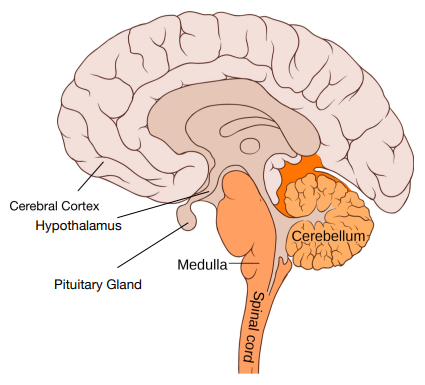
Components of the brain:
- Cerebral cortex : controls consciousness, intelligence, memory and language; it is the outer part of the brain
- Cerebellum : controls fine movement of muscles; rounded structure towards the bottom/back of brain
- Medulla : controls unconscious actions such as breathing and heart rate,; found in the brain stem in front of the cerebellum
Investigating brain function and treating brain damage and disease is difficult because:
- It is complex and delicate
- It is easily damaged
- Drugs given to treat diseases cannot always reach the brain because of the membranes that surround it
- It is not fully understood which part of the brain does what
Neuroscientists (those that study the nervous system) can map out the regions of the brain using a number of methods:
-
Studying patients with brain damage Observing the changes in an individual following damage on a certain area of the brain can provide information on the role this area has.
-
Electrically stimulating different parts of the brain This can be done by pushing an electrode into the brain. The stimulation may result in a mental or physical change in the individual, providing information on the role this area of the brain has.
-
Using MRI scanning techniques A magnetic resonance imaging scanner can be used to create an image of the brain. This can be used to show which part of the brain is affected by a tumour, or which part is active during a specific task.