History of the Atom (OCR GCSE Chemistry A, Combined (Gateway Science Suite)): Revision Notes
📚Revision Notes
1.1.6 History of the Atom
Early Ideas about Atoms
Note
The concept of atoms has evolved significantly over time as scientists gathered new experimental evidence and refined their atomic models.
John Dalton (1803)
Note
John Dalton was the first to publish a scientific theory about atoms in 1803. He proposed that all matter is composed of tiny particles called atoms. According to Dalton, these atoms were indivisible and indestructible spheres.
J.J. Thomson and the Electron (1897)
- Nearly 100 years after Dalton, J.J. Thomson conducted experiments that led to the discovery of the electron. This finding prompted him to propose the plum pudding model of the atom.
- Plum Pudding Model: In this model, the atom is depicted as a ball of positive charge with negatively charged electrons scattered throughout, much like currants embedded in a Christmas pudding.

Ernest Rutherford and the Nuclear Model (1909)
- In 1909, Ernest Rutherford designed an experiment to test the plum pudding model. He fired positively charged alpha particles at a thin sheet of gold foil.
Note
Key Findings:
- Most of the alpha particles passed straight through the foil, indicating that atoms are mostly empty space.
- However, a small number of alpha particles were deflected in various directions, suggesting that there is a small, dense, positively charged region at the centre of the atom.
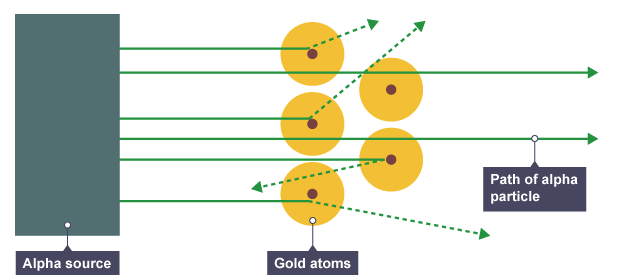
Alpha particle scattering experiment
Note
Nuclear Model: Based on this evidence, Rutherford proposed a new atomic model, known as the nuclear model.
- In this model, the mass of the atom is concentrated in a central region called the nucleus.
- The nucleus is positively charged and contains most of the atom's mass.