Properties of Metals & Alloys (OCR GCSE Chemistry A (Gateway Science Suite)): Revision Notes
📚Revision Notes
2.2.8 Properties of Metals & Alloys
Note
Metals have certain properties that make them useful for everyday items like frying pans, electrical cables, and car parts. In general, metals:
- Have High Melting Points: They don't melt easily, which is why they're good for cooking and other high-temperature uses.
- Conduct Heat and Electricity: Metals are good at transferring heat and electricity, making them ideal for pots, pans, and electrical wiring.
- Have High Density: Metals are usually heavy for their size.
- Are Malleable: Metals can be bent or hammered into shapes without breaking. This makes them useful for making things like car parts and metal sheets.
- Brittle vs. Malleable: A brittle substance breaks easily when bent, while a malleable one bends without breaking.
Exceptions to the General Properties:
Mercury: Unlike most metals, mercury is a liquid at room temperature. It has a low boiling point, which is why it doesn't solidify like other metals.
Graphite: Although graphite is a form of carbon (a non-metal), it can conduct electricity because it has free-moving electrons, similar to metals.
What are Alloys?
Note
Alloys are mixtures of two or more elements, where at least one element is a metal.
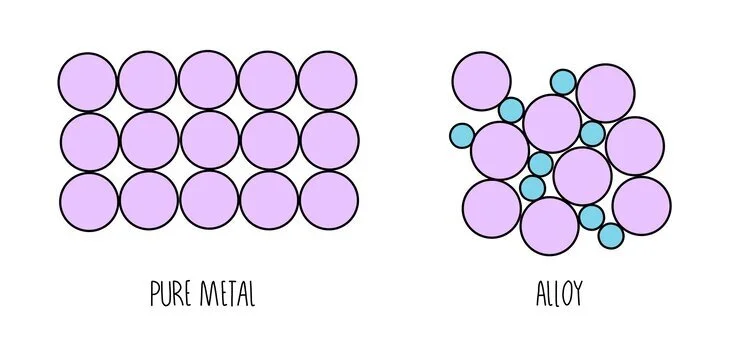
- Pure Metals: In a pure metal, the atoms are arranged in neat rows, forming a regular lattice. These layers can slide over each other easily, making the metal softer.
- Why Are Alloys Stronger?: When another element is mixed with a metal to create an alloy, the atoms are different sizes. This disrupts the regular arrangement, making it harder for the layers to slide over each other. As a result, alloys are much stronger and harder than pure metals.
Example
Example: Steel is an alloy made from iron and carbon. The carbon atoms disrupt the iron atoms' regular arrangement, making steel much stronger than pure iron.