Required Practical: Preparation of a Soluble Salt (OCR GCSE Chemistry A (Gateway Science Suite)): Revision Notes
📚Revision Notes
4.2.5 Required Practical: Preparation of a Soluble Salt
Note
This practical involves creating a soluble salt, which dissolves in water, by reacting an acid with an insoluble metal base.
When salts are formed in chemical reactions, they can either be soluble or insoluble in water:
- Insoluble salts will precipitate out of the solution, meaning they form solid crystals that settle at the bottom of the reaction vessel.
- Soluble salts dissolve in water, remaining in the solution. In this experiment, the goal is to produce a soluble salt by reacting hydrochloric acid (HCl) with copper(II) oxide (CuO), an insoluble metal base. The product of this reaction, copper(II) chloride (CuCl₂), is a soluble salt.
Note
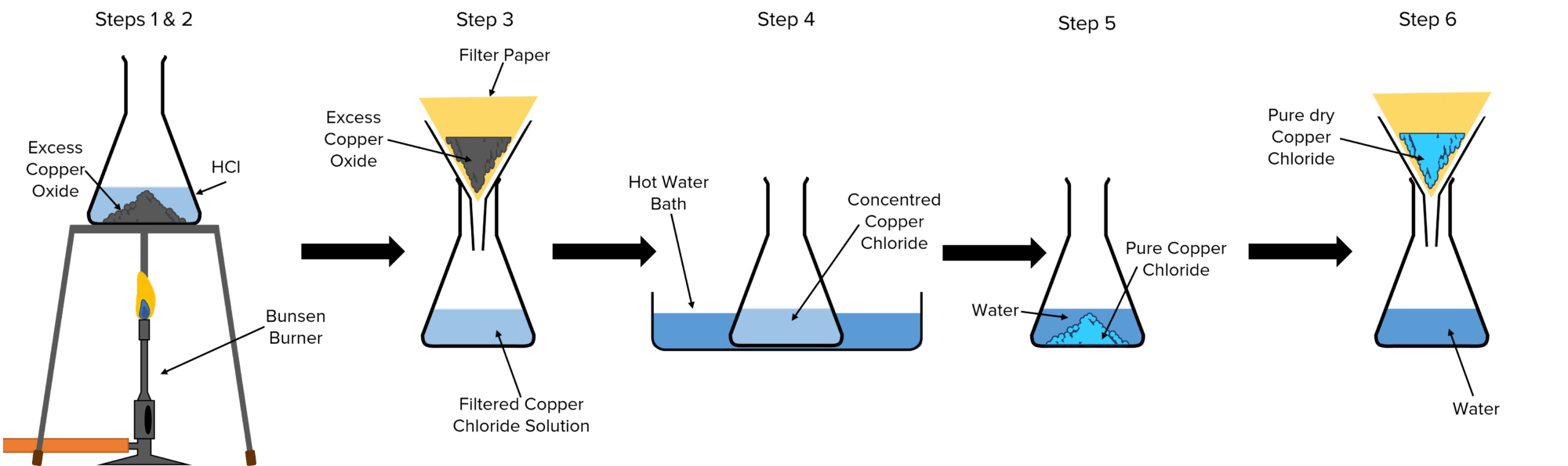
Method for Preparing a Soluble Salt
- Heating the Acid:
- Pour a measured amount of hydrochloric acid (HCl) into a flask.
- Gently heat the acid using a Bunsen burner. This increases the reaction rate by providing the energy needed for the reaction to proceed.
- Adding the Metal Base:
- Gradually add copper(II) oxide (CuO) to the heated acid. Stir the mixture continuously.
- Continue adding CuO until no more reacts. This point is reached when the solution remains clear, and excess CuO remains undissolved at the bottom. This indicates that all the acid has reacted and the CuO is in excess.
- Filtering the Solution:
- Philtre the solution to remove the unreacted excess CuO. This step ensures that only the dissolved copper(II) chloride remains in the solution.
- Evaporating the Water:
- Transfer the filtered solution to a water bath and gently heat it. The heat causes the water to evaporate, increasing the concentration of copper(II) chloride in the solution.
- Crystallisation:
- Remove the solution from the heat and allow it to cool slowly. As it cools, copper(II) chloride crystals will begin to form. This process is known as crystallisation.
- Collecting the Crystals:
- Once a sufficient amount of crystals has formed, philtre the solution again to separate the crystals from any remaining liquid.
- Finally, dry the copper(II) chloride crystals to obtain the pure solid salt.
Note
Summary of the Reaction The overall reaction between hydrochloric acid and copper(II) oxide can be written as:
This reaction illustrates how an acid ( reacts with a metal oxide to produce a soluble salt and water.
Note
Key Concepts and Observations
- Excess Reactant: Using an excess of copper(II) oxide ensures that all of the hydrochloric acid is neutralised, and no acid remains in the final solution.
- Crystallisation: The formation of pure crystals from a solution as it cools is a common technique for purifying substances in chemistry.
- Filtration: This technique is used multiple times in the process to separate solids from liquids, ensuring a pure product.