Using Electrolysis to Extract Metals (OCR GCSE Chemistry A (Gateway Science Suite)): Revision Notes
📚Revision Notes
4.3.3 Using Electrolysis to Extract Metals
Note
Electrolysis is a powerful technique used to extract metals from their ores, especially for metals that are too reactive to be extracted by traditional reduction methods, such as using carbon. One of the most common applications of this process is the extraction of aluminium from its ore, bauxite.
Example
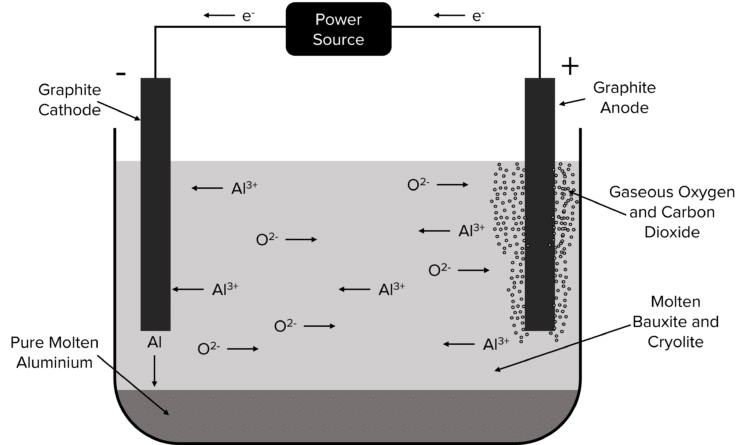
Example: Extraction of Aluminium from Bauxite Bauxite is the primary ore of aluminium and has the chemical formula Al₂O₃ (aluminium oxide). To extract aluminium from bauxite, the ore must first be molten so that it can undergo electrolysis. However, aluminium oxide has an extremely high melting point, making direct melting impractical. To solve this, the bauxite is mixed with cryolite, a compound that lowers the melting point of the mixture, making the process more energy-efficient.
Note
The Electrolysis Process Once the bauxite-cryolite mixture is molten, it is subjected to electrolysis using graphite electrodes:
- At the Cathode (Negative Electrode):
- Aluminium ions (Al³⁺) are attracted to the negative cathode.
- At the cathode, the Al³⁺ ions gain electrons (reduction) to form molten aluminium metal:
- This molten aluminium is denser than the surrounding mixture and therefore sinks to the bottom of the electrolytic cell, where it can be collected.
- At the Anode (Positive Electrode):
- Oxide ions (O²⁻) are attracted to the positive anode.
- At the anode, the O²⁻ ions lose electrons (oxidation) to form oxygen gas:
- In addition to forming oxygen gas, the oxide ions can react with the carbon in the graphite anode, producing carbon dioxide gas ($CO2).
Summary of the Process
- Electrolysis of Bauxite: The bauxite ore, mixed with cryolite, is melted and then electrolysed to produce aluminium metal and oxygen gas.
- Reduction at the Cathode: Aluminium ions gain electrons and are reduced to molten aluminium.
- Oxidation at the Anode: Oxide ions lose electrons and are oxidised to oxygen gas, or react with carbon to form carbon dioxide.