Encryption (OCR GCSE Computer Science): Revision Notes
📚Revision Notes
Encryption
Note
Encryption is the process of converting data into a coded form so that it cannot be understood if intercepted.
It ensures that sensitive information, such as passwords or financial details, is protected from unauthorised access. The data can only be decrypted and understood by someone who has the correct key.

Note
Decryption: The process of converting encrypted data back to its original form using a key.
The Principle of Encryption to Secure Data
Encryption secures data as it travels across networks by scrambling it into an unreadable format. Even if the data is intercepted during transmission, it remains secure because the person intercepting it cannot understand it without the correct key. This is essential in protecting personal information and maintaining privacy over the internet, especially in activities like online banking, email communication, and file transfers.
Types of Encryption
Caesar Cipher
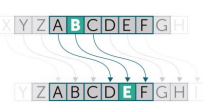
- A simple encryption technique where each letter in the message is shifted by a certain number of places in the alphabet.
- For example, shifting "A" by 3 would make it "D". It is easy to break but introduces the concept of encryption.
Symmetric Encryption
- The same key is used for both encrypting and decrypting the data.
- Both parties must have access to the secret key, making key management crucial.
- It's faster but less secure if the key is intercepted.
Public Key Encryption (Asymmetric Encryption)
- Uses two keys: a public key to encrypt the data and a private key to decrypt it.
- The public key is shared openly, but the private key is kept secret by the receiver.
- More secure since only the private key holder can decrypt the data.
Encryption for Wi-Fi Security
- WEP (Wired Equivalent Privacy) and WPA (Wi-Fi Protected Access) are common encryption methods used to secure Wi-Fi networks.
- WEP is older and less secure, while WPA and newer versions like WPA2 offer stronger encryption and better protection against unauthorised access to the network.
Note
Key Points to Remember
- Encryption protects data by turning it into an unreadable format that only authorised parties can decrypt.
- Symmetric encryption uses the same key for both encryption and decryption, while asymmetric encryption uses a pair of public and private keys.
- Modern Wi-Fi networks use encryption methods like WPA to secure wireless communications and prevent unauthorised access.