Global Variations in Economic Development - DTM (OCR GCSE Geography A (Geographical Themes)): Revision Notes
📚Revision Notes
5.1.2 Global Variations in Economic Development - DTM
Development and the DTM
- Level of Development: Indicates economic, social, cultural, or technological advancement.
- Demographic Transition Model (DTM): Shows population changes over time through five stages, linked to development levels.
Key Points:
- Changing Birth and Death Rates:
- Affects population growth.
- Higher birth rates than death rates lead to population growth (natural increase).
- Birth and death rates vary by country, impacting growth speed, especially in LICs.
- Economic Development:
- Linked to changing birth and death rates.
- Population growth changes within a country as it develops.
5 Stages of the DTM:
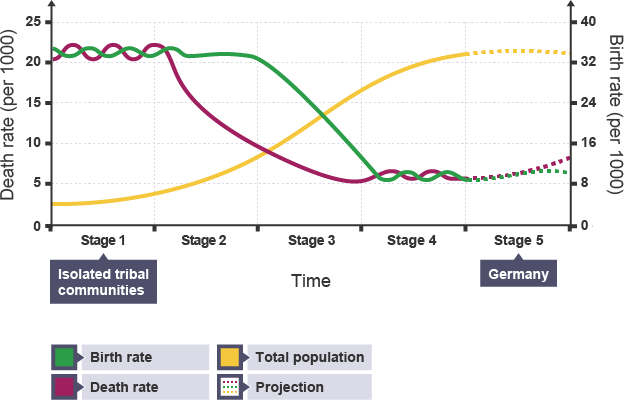
Stage 1: High Fluctuating
- Birth Rate: High
- Death Rate: High
- Population: Low and fluctuating
- Characteristics**:**
- Little healthcare, low life expectancy, no birth control.
- Population fluctuations due to disease, famine, war.
Stage 2: Early Expanding LIC
- Birth Rate: High
- Death Rate**:** Rapidly decreasing
- Population: Rapidly increasing
- Characteristics:
- Improved living standards, hygiene, healthcare reduce death rates.
- Increased life expectancy.
- High natural increase due to birth-death rate gap.
Stage 3: Late Expanding NEE
- Birth Rate: Rapidly decreasing
- Death Rate: Slowly decreasing
- Population: Slowly increasing
- Characteristics:
- Continued fall in death rates.
- Rapid fall in birth rates due to birth control.
- Smaller families become beneficial and more common.
Stage 4: Fluctuating HIC
- Birth Rate: Low
- Death Rate: Low
- Population: High
- Characteristics:
- Low birth and death rates with stable population.
- Birth rates fluctuate with economic conditions.
Stage 5: Population's Decreasing HIC
- Birth Rate: Slowly decreasing
- Death Rate: Slowly increasing
- Population**:** Slowly falling
- Characteristics:
- Increased death rates due to ageing population.
- Declining birth rates as careers and economic uncertainty impact family size decisions.