Economic Futures in the UK (OCR GCSE Geography A (Geographical Themes)): Revision Notes
📚Revision Notes
5.1.6 Economic Futures in the UK
Economic Development in the UK: A Post-Industrial Economy
Why has the UK's Economy Changed?
- De-industrialisation:
- Decline of manufacturing (secondary) industry.
- Growth in tertiary and quaternary employment.
- Contributing Factors:
- Machines and Technology:
- Replaced many jobs in modern industries 📝 (e.g., car production).
- NEEs 📝(e.g., China, Malaysia, Indonesia):
- Cheaper labour costs.
- Produce cheaper goods.
- Lack of Investment:
- High labour costs and outdated machinery.
- Made UK products too expensive.
- Industry Decline:
- Traditional UK industries (coal mining, engineering, manufacturing) have declined.
- UK is now a world centre for financial services, media, research, and creative industries.
Key Causes of Economic Change in the UK:
- De-industrialisation:
- Decline of the UK's industrial base.
- Fewer jobs available in manufacturing.
- Shift to tertiary and quaternary sectors.
- Globalisation:
- Manufacturing moved overseas where labour is cheaper.
- TNC headquarters remain in the UK, production in NEEs 📝 (e.g., India).
- Government Policies:
- Investment in new infrastructure and technology.
- Membership in trading groups facilitates global trade.
What is a Post-Industrial Economy?
- Definition:
- Economy where manufacturing is replaced by service and tertiary jobs.
- Growth in quaternary industry in the 21st century.
- Quaternary Sector:
- Also known as the 'knowledge economy'.
- Involves information development, technology, biotechnology, and creative industries.
- Workforce Shift:
- 15% of the UK workforce now in the quaternary sector.
- Only 10% in manufacturing (compared to 55% in 1900).
- High-Tech Corridor:
- M4 corridor from London to Bristol.
- Home to high-tech industries over the past 30 years.
- Companies like Microsoft based there.
Economic Development in the UK: SCIENCE & BUSINESS PARKS
Why has the UK seen a rise in business parks and science parks?
- Industries:
- Quaternary and tertiary industries are increasingly found in science or business parks.
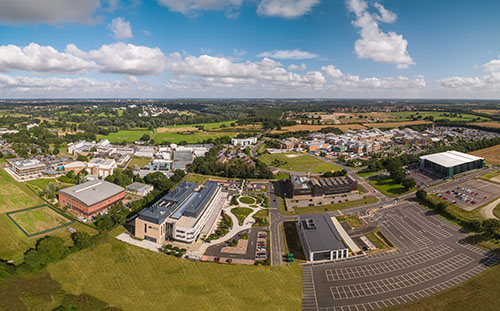
- Quaternary and tertiary industries are increasingly found in science or business parks.

Science Parks:
- Definition**:**
- A group of scientific and technical knowledge-based businesses located on a single site.
- Focus:
- Emphasis on technology, hence linked to the quaternary sector.
- Location:
- Often on town edges, near transport links and prestigious universities.
- Facilities:
- Include laboratories and offices.
- Low-rise buildings with ample parking and green spaces.
Business Parks:
- Definition:
- An area of land with a cluster of businesses on a single site.
- Focus:
- Commerce and services, hence linked to the tertiary sector.
- Location:
- Typically on town edges near transport access.
- Facilities:
- Low-rise offices with good parking and green spaces.
- Cost:
- Cheaper land is prioritised over proximity to universities.
Growth of Parks:
- Demand:
- Increasing demand for high-tech products.
- Universities:
- High number of strong universities for science parks to form links with.
- Proximity to universities gives companies access to skilled workers.
- Clusters:
- Related businesses in one place can boost each other.
- Quaternary Sector:
- Growing sector, with 60,000 people employed in IT.
SCIENCE PARK CASE STUDY – Birmingham Science Park
-
Overview:
-
Leading UK science park, established in 1983.
-
Third oldest in the country.
-
Specialisation:
-
Specialises in 'Life Sciences' (study of organisms like plants, animals, humans).
-
Focus:
- Forefront of combating diseases and viruses through drug development.
-
University Link:
- Built adjacent to Aston University for access to a skilled workforce.
-
Employment:
- 22,000 people employed across 600 companies.
-
Transport Links:
- Close to M6, New Street Station, and Birmingham International Airport.
-
Relocation:
- Moving to Selly Oak in 2022 near Birmingham University.