China’s Economic Development (OCR GCSE Geography B (Geography for Enquiring Minds)): Revision Notes
📚Revision Notes
China's Economic Development
China - the world's largest economy?
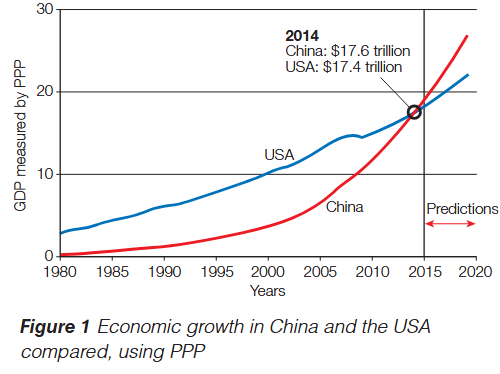
Over the last three decades, China has experienced remarkable economic expansion. When measured by GDP (Gross Domestic Product), China ranks as the world's second-largest economy after the United States. However, when economists use purchasing power parity (PPP) as a measure, China has already overtaken America as the world's largest economy.
Note
Understanding PPP vs GDP
Purchasing Power Parity (PPP) provides a more accurate reflection of actual wealth than GDP because it accounts for what money can actually buy in different countries. For example, $100 might buy more goods and services in China than in the USA, making PPP a better measure of real economic power.
Using this measure, China surpassed the USA in 2014, reaching a PPP of $17.6 trillion compared to the USA's $17.4 trillion. The graph below shows this historic crossover point and projects continued growth for China's economy.
Important
This economic transformation represents one of the most significant shifts in global economic power in modern history. The rapid expansion has not only changed China's position in the world but has also had far-reaching effects on the global economy.
Changes in China's economic system
China's economy has undergone a fundamental transformation over the past seven decades. Understanding this change is crucial to explaining China's current economic success.
From 1949 to 1978, China operated as a centrally planned economy under communist government control. In this system, the state made all major economic decisions about production, distribution, and pricing. Individuals and private companies had minimal economic freedom.
In 1978, the Chinese government implemented sweeping economic reforms, transitioning to a market-based economy. This new system gave companies and individuals much greater control over economic decisions. Businesses could respond to market demands, set their own prices, and compete for customers. While the government maintained significant influence, the economy became increasingly driven by market forces rather than central planning.
Note
Economic Classification Change
This economic transformation changed China's development status:
- 1978: Classified as a LIDC (Low Income Developing Country)
- Present day: Recognised as an EDC (Emerging and Developing Country)
This reflects China's rapid industrialisation and rising living standards over the past four decades.
The impact on poverty has been dramatic. More than 500 million people have been lifted out of poverty since the economic reforms began. However, development remains uneven - approximately 100 million people still live in poverty, highlighting the ongoing challenges China faces in achieving inclusive growth.
China's economic growth rates
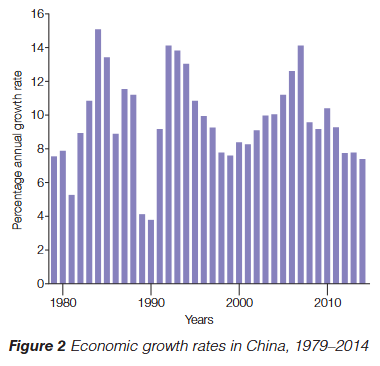
Since the 1978 economic reforms, China has maintained extraordinary growth rates that have transformed the country. Economic growth in China has averaged approximately 10% per year since 1978. To put this in perspective, the average growth rate in the UK over the same period was below 1%. This means China's economy has been growing roughly ten times faster than developed economies like Britain.
Example
Comparing Growth Rates: China vs UK
To understand the significance of these growth rates:
- China: ~10% annual growth
- UK: <1% annual growth
- Difference: China's economy grows approximately 10× faster
Over 30 years, this difference is transformative. An economy growing at 10% per year will double in size roughly every 7 years, while an economy growing at 1% takes about 70 years to double.
The bar chart above illustrates China's annual growth rates from 1979 to 2014. Several patterns are visible in the data. Growth rates have fluctuated considerably, ranging from around 3-4% in some years to peaks of 14-15% in others. Despite these variations, the overall trend shows consistently strong growth, particularly in the 1980s, early 1990s, and mid-2000s. Even during global economic downturns, China has typically maintained positive growth, demonstrating the resilience of its economy.
Challenges of rapid economic growth
While China's economic expansion has brought tremendous benefits, it has also created significant challenges that the country must address to ensure sustainable development.
Growing inequality has become a major concern. The gap between rich and poor has widened considerably, creating social tensions. This inequality exists both between wealthy and poor individuals and between prosperous urban areas and struggling rural regions. Coastal cities have benefited disproportionately from economic growth, while inland rural areas have often been left behind.
Rapid urbanisation has placed enormous pressure on China's cities. Millions of people have migrated from rural areas to cities seeking employment and better opportunities. This mass movement has strained urban infrastructure, housing, transport systems, and public services. Many cities struggle to provide adequate facilities for their rapidly expanding populations.
Important
Environmental Crisis
Environmental pollution has reached critical levels in many parts of China. The rapid industrialisation and heavy reliance on coal for energy have resulted in:
- Severe air pollution in major cities affecting public health
- Water pollution from industrial discharge threatening agriculture
- Soil contamination affecting food safety
- Long-term sustainability concerns
These environmental challenges pose serious risks that China must address to maintain sustainable growth.
Imbalances in the world economy have emerged as China's growth has outpaced other major economies. China has become the manufacturing centre for much of the world, creating trade imbalances with other countries. This rapid growth has disrupted traditional global economic patterns and created tensions with trading partners.
Summary
Key Points to Remember:
- China is the world's largest economy when measured by PPP (overtaking the USA in 2014 at $17.6 trillion) but second-largest by GDP
- China transitioned from a centrally planned economy (1949-1978) to a market-based economy (1978-present), transforming from a LIDC to an EDC
- China's economy has grown at an average of 10% per year since 1978, compared to below 1% in the UK
- Over 500 million people have been lifted out of poverty, though 100 million remain poor
- Major challenges include growing inequality, rapid urbanisation, environmental pollution, and global economic imbalances