Human Causes of Climate Change (OCR GCSE Geography B (Geography for Enquiring Minds)): Revision Notes
📚Revision Notes
Human Causes of Climate Change
The natural greenhouse effect
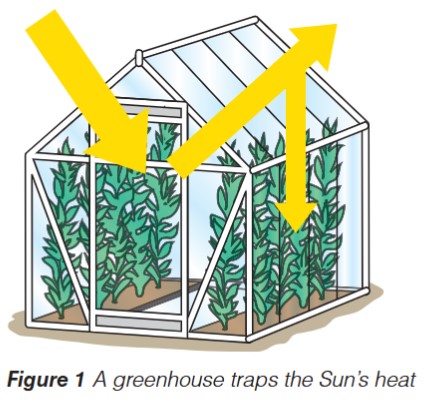
The Earth's atmosphere contains naturally occurring gases that play a vital role in maintaining temperatures suitable for life. Carbon dioxide and water vapour are examples of these greenhouse gases. These gases function similarly to the glass panels of a greenhouse, allowing sunlight to enter while preventing heat from escaping back into space.
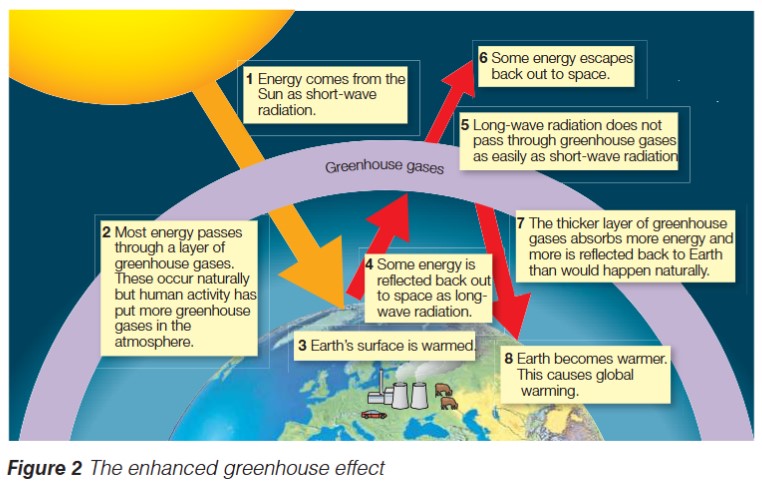
When solar radiation reaches Earth, the surface absorbs this energy and warms up. The warmed surface then releases heat as longwave radiation. Greenhouse gases in the atmosphere absorb this longwave radiation and redirect some of it back towards Earth's surface. This natural process keeps our planet approximately 33°C warmer than it would be without these gases. Without this natural greenhouse effect, Earth would be far too cold to support life as we know it.
Note
The natural greenhouse effect is not harmful - it's actually essential for life on Earth. Without greenhouse gases trapping heat in our atmosphere, Earth's average temperature would be around -18°C, making it impossible for most life forms to survive.
The enhanced greenhouse effect
Human activities over the past 200 years have significantly altered the natural greenhouse effect. Through industrialisation, deforestation, and increased fossil fuel consumption, humans have increased the concentration of greenhouse gases in the atmosphere. This means that more longwave radiation is trapped within the atmosphere rather than escaping to space.
The result of this increased trapping of heat is global warming – a measurable rise in average global temperatures. This human-caused change to the natural greenhouse effect is called the enhanced greenhouse effect. Unlike the stable natural process that has existed for millennia, the enhanced greenhouse effect represents a rapid and ongoing change to Earth's climate system.
Important
Critical Distinction:
The natural greenhouse effect has existed for billions of years and maintains Earth's temperature at levels suitable for life. The enhanced greenhouse effect is the additional warming caused by human activities increasing greenhouse gas concentrations beyond natural levels. This enhancement is causing global warming and climate change.
Main greenhouse gases and their sources
Carbon dioxide (CO₂)
Carbon dioxide is the most significant greenhouse gas contributing to the enhanced greenhouse effect. It accounts for the largest proportion of additional greenhouse gases released by human activities. The primary sources of CO₂ emissions include:
- Burning fossil fuels such as coal, oil, and natural gas for electricity generation
- Vehicle emissions from cars, lorries, ships, and aeroplanes
- Industrial processes and manufacturing
- Deforestation, which removes trees that absorb CO₂
The concentration of CO₂ in the atmosphere has increased dramatically since the Industrial Revolution, rising from approximately 280 parts per million in 1800 to over 400 parts per million today.
Example
Understanding CO₂ Concentration Changes
To understand the scale of change:
- 1800: ~280 parts per million (ppm) of CO₂
- 2020: ~400 ppm of CO₂
- Increase: Over 40% rise in just 220 years
This represents a faster change than at any point in the past 800,000 years of Earth's history.
Other important greenhouse gases
While CO₂ is the most significant, several other greenhouse gases also contribute to global warming:
Methane is released from:
- Landfill sites where organic waste decomposes
- Cattle and other livestock during digestion
- Rice paddies and wetlands
- Natural gas extraction and distribution
Halocarbons are synthetic gases found in:
- Refrigerators and cooling systems
- Air conditioning units
- Some industrial processes
Nitrous oxide is produced by:
- Agricultural fertilisers
- Vehicle exhausts
- Industrial activities
Note
While CO₂ receives the most attention, methane is actually a much more powerful greenhouse gas - around 25 times more effective at trapping heat than CO₂ over a 100-year period. However, CO₂ is still considered the most significant because of the enormous quantities released by human activities and its long atmospheric lifetime (hundreds to thousands of years).
Evidence linking CO₂ emissions to temperature change
Scientific data provides clear evidence that human activities are driving climate change. When examining records of atmospheric CO₂ concentrations alongside average global temperatures over the past 1000 years, a strong correlation emerges.
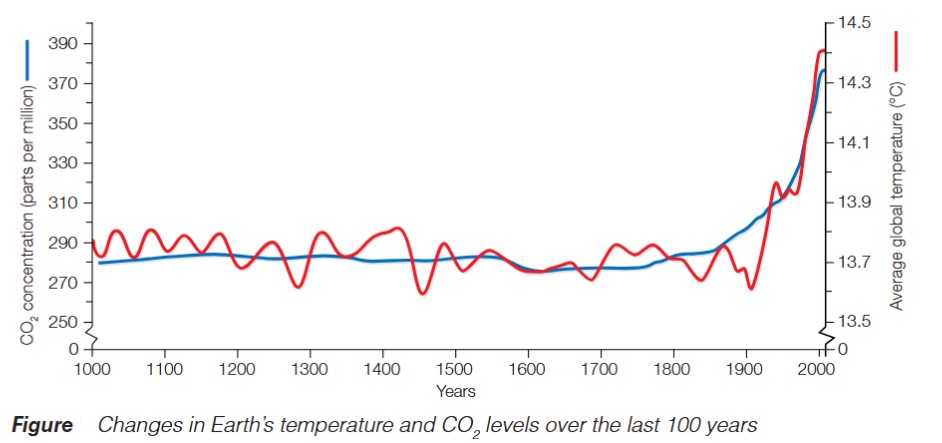
From approximately 1000 CE to 1800 CE, both CO₂ levels and global temperatures remained relatively stable, with only minor natural fluctuations. However, from around 1800 onwards – coinciding with the Industrial Revolution – both measurements show a dramatic increase.
The graph demonstrates that as CO₂ concentrations in the atmosphere have risen sharply (from about 280 parts per million to nearly 400 parts per million), average global temperatures have increased by approximately 0.8°C. This correlation, combined with our understanding of how greenhouse gases trap heat, provides compelling evidence that human emissions of CO₂ are causing global warming.
Important
The 1800 Turning Point
The year 1800 marks a critical transition in Earth's climate history. Before this date, CO₂ levels and temperatures were relatively stable for centuries. After 1800, both began rising sharply. This timing is not a coincidence - it directly corresponds to the start of the Industrial Revolution, when humans began burning fossil fuels on a large scale.
The particularly steep increases in both measurements since 1950 reflect the rapid industrialisation and increased fossil fuel consumption of the late 20th century. This acceleration continues into the 21st century.
The geography of carbon dioxide emissions
Total emissions by country
Not all countries contribute equally to global greenhouse gas emissions. China currently produces the largest amount of CO₂ emissions, accounting for approximately 28% of global total emissions. The United States ranks second, responsible for about 15% of global emissions. However, these figures alone do not provide a complete picture of responsibility for climate change.
China's large total emissions partly reflect its enormous population of 1.4 billion people, compared to approximately 320 million in the USA. This significant population difference means that analysing emissions per capita (per person) offers a more meaningful comparison of how individual lifestyles contribute to climate change.
Note
Total Emissions vs Per Capita Emissions
Both measurements are important for understanding climate change responsibility:
- Total emissions show which countries contribute most to the overall problem
- Per capita emissions show which populations have the most carbon-intensive lifestyles
China emits 28% of global CO₂ but has 1.4 billion people. The USA emits 15% but has only 320 million people - meaning each American, on average, is responsible for far more emissions than each Chinese citizen.
Per capita emissions and lifestyle factors
When examining CO₂ emissions per person, a different pattern emerges. Advanced Countries (ACs) such as the USA, Canada, and Australia emit the highest amounts of CO₂ per capita. In contrast, Low Income Developing Countries (LIDCs) like Ethiopia and Rwanda emit the lowest amounts per person.
This difference reflects the high-energy lifestyles typical in advanced countries. People in ACs generally:
- Own and regularly use private cars for transport
- Heat and cool larger homes with electrical appliances
- Consume more manufactured goods requiring energy-intensive production
- Eat diets with higher proportions of meat (particularly beef, which generates significant methane emissions)
- Use more electronic devices and appliances
- Travel more frequently, including international flights
Each of these activities requires substantial energy, most of which currently comes from burning fossil fuels. Therefore, while China emits the most CO₂ in total, individuals in advanced countries bear greater responsibility per person for greenhouse gas emissions. This distinction is crucial when considering international responses to climate change and questions of climate justice.
Important
Why High-Energy Lifestyles Matter
Every aspect of daily life in Advanced Countries contributes to greenhouse gas emissions:
- Driving a car: Burns petrol/diesel, releasing CO₂
- Heating homes: Usually powered by natural gas or electricity (often from coal/gas power stations)
- Using appliances: Refrigerators, washing machines, computers all require electricity
- Eating beef: Cattle produce large amounts of methane during digestion
- Flying: Aeroplanes burn enormous quantities of jet fuel
When these activities are multiplied across entire populations in ACs, they create the world's highest per capita emissions - even though total populations may be smaller than in countries like China or India.
Exam guidance
When answering questions about responsibility for climate change, always consider both total emissions and per capita emissions. Questions asking you to explain why advanced countries are responsible for climate change should reference high-energy lifestyles with specific examples. Questions asking you to assess responsibility may require you to consider both total emissions (China's large contribution) and per capita emissions (ACs' higher individual impact), then reach a balanced judgement.
Summary
Key Points to Remember:
-
The natural greenhouse effect is essential for life on Earth, keeping temperatures warm enough by trapping heat in the atmosphere through naturally occurring greenhouse gases.
-
The enhanced greenhouse effect occurs when human activities increase greenhouse gas concentrations, trapping extra heat and causing global warming.
-
Carbon dioxide (CO₂) from burning fossil fuels is the most significant greenhouse gas, with other contributors including methane, halocarbons, and nitrous oxide from various human activities.
-
Clear evidence shows CO₂ concentrations and global temperatures remained stable for centuries but both increased dramatically from 1800 onwards, demonstrating the link between human emissions and climate change.
-
While China emits the most total CO₂ (28% of global emissions), Advanced Countries have the highest per capita emissions due to high-energy lifestyles involving cars, heating, appliances, and energy-intensive consumption patterns.