Shaping Landscapes (OCR GCSE Geography B (Geography for Enquiring Minds)): Revision Notes
📚Revision Notes
Shaping Landscapes
Introduction to landscape change
The landscapes of the United Kingdom are not static – they undergo continuous transformation due to natural forces that have been at work for millions of years. Understanding these forces and the processes they create is essential for explaining why the UK has such diverse and distinctive landscapes. These physical processes shape everything from river valleys to coastal cliffs, creating the features we see today.
Agents of landscape change
Three main agents have been responsible for shaping UK landscapes over geological time. Each agent operates in different environments and has created distinctive landforms.
Rivers
Rivers are dynamic systems that flow across the land surface from their source (usually in upland areas) to the sea. As they flow, they have the power to erode rock and soil, transport material downstream, and deposit sediment to create new landforms. Rivers have carved out valleys, created floodplains, and shaped much of the UK's lowland landscapes.
Glaciers
During past ice ages, glaciers covered significant portions of the UK, functioning like enormous slow-moving rivers of ice. Although glaciers no longer exist in most of the UK, their past presence has left a lasting impact on the landscape. Glacial erosion created features such as U-shaped valleys, while glacial deposition formed features like drumlins and moraines.
The sea
The sea surrounds the UK coastline and is a powerful agent of change. Waves constantly attack the coast through erosion, while tides and currents transport sediment along the shore. The sea's action creates distinctive coastal features such as cliffs, beaches, and spits. Coastal processes continue to shape the UK's island geography.
Note
These three agents don't work in isolation. Rivers carry material to the sea, glaciers have shaped river valleys, and coastal processes continue to modify glacial features. Understanding how these agents interact helps explain the complexity of UK landscapes.
Understanding geomorphic processes
Geomorphology is the scientific study of how landscapes are formed and changed by physical processes. Similar processes operate in rivers, along coasts, and in glaciated environments. Understanding these processes helps explain how landscapes evolve over time.
The three main geomorphic processes
These three processes work together in a continuous cycle to shape landscapes:
Erosion is the process that gradually removes material from the land surface. Water, ice, and wind physically break down and wear away rock and soil. Erosion is particularly effective on steep slopes and where rock is exposed to powerful forces like fast-flowing water or crashing waves.
Transport is the process that moves weathered and eroded material from one location to another. Rivers carry sediment downstream, waves move material along the coast, and glaciers transport rock debris within the ice. The distance material travels depends on factors such as the energy of the transporting agent and the size of the particles.
Deposition occurs when transported material is released and accumulates to build new landforms. This happens when the transporting agent loses energy – for example, when a river enters a lake or the sea, or when waves lose power. Deposited material creates features such as beaches, river deltas, and floodplains.
Important
The ETD System: Erosion, Transport, and Deposition work as a connected system, not as separate processes. Material eroded in one location is transported and then deposited elsewhere. This cycle continuously reshapes landscapes over time. Understanding this connection is crucial for explaining landscape formation.
Weathering and mass movement
Weathering works alongside erosion to break down rock. Weathering weakens rock through physical, chemical, and biological processes, making it more vulnerable to erosion. When weathering and erosion combine on steep slopes, they can trigger mass movement – the downhill movement of material under gravity. Examples include landslides (rapid movement of rock and soil) and land slumps (slower rotational movement of material).
Note
Think of weathering as "preparing" the rock for erosion. Weathering creates cracks and weaknesses in rock, making it easier for erosion processes to break it down and remove it. Without weathering, erosion would be much less effective.
Types of erosion
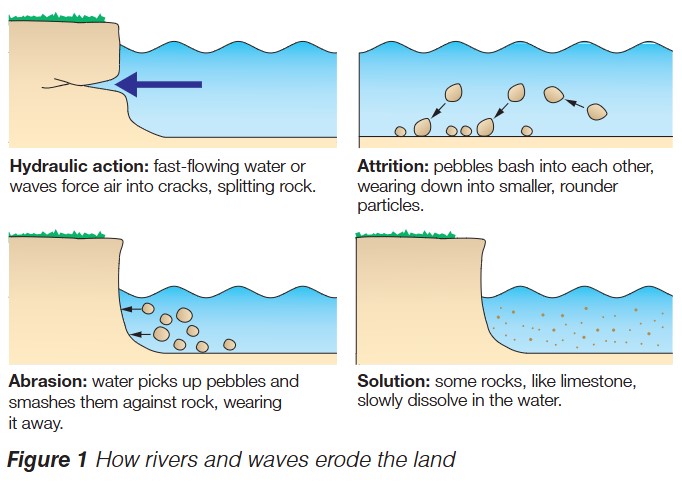
Four main types of erosion operate in rivers and coastal environments. Each process works in a different way to break down and remove rock.
Hydraulic action
Hydraulic action relies on the power of moving water. When fast-flowing water or waves hit rock, they force air into existing cracks and joints. As water repeatedly enters these cracks, it compresses the air inside. This compression creates pressure that gradually widens the cracks, eventually splitting and breaking apart the rock. Hydraulic action is particularly effective where rock is already fractured or where waves crash with great force against coastal cliffs.
Attrition
Attrition is a process of erosion that affects the transported material itself rather than the rock surface. As pebbles and stones are carried by water, they constantly collide and bash into each other. These repeated impacts chip off fragments, gradually wearing the particles down. Over time and distance, angular rocks become smaller, smoother, and more rounded. This explains why pebbles on beaches are typically round and smooth.
Abrasion
Abrasion is often described as natural sandpapering. Water picks up and carries pebbles, sand, and other particles. As these particles move, they scrape and smash against rock surfaces like natural tools. This grinding action physically wears away the rock surface, creating smooth surfaces and distinctive features. In rivers, abrasion deepens and widens channels. On coasts, it undercuts cliffs and creates wave-cut platforms.
Solution (corrosion)
Solution, also called corrosion, is a chemical form of erosion. Some rock types, particularly limestone and chalk, are vulnerable to chemical weathering. These rocks slowly dissolve when in contact with slightly acidic water. The dissolved rock is carried away invisibly in the water, with no visible particles. Over time, solution can create distinctive features such as caves in limestone areas.
Note
Remembering erosion types: Think "HAAS" - Hydraulic action (water pressure), Attrition (particles colliding), Abrasion (grinding), Solution (dissolving). Each process requires different conditions and affects different rock types in different ways.
Methods of transport
Rivers and waves transport eroded material in four different ways. The method depends on the particle size and the energy of the water.
Traction
Traction transports the largest and heaviest particles. Boulders and large stones are too heavy to be lifted by the water, so they are dragged and rolled along the riverbed or seabed. Traction requires high energy, so it typically occurs during floods in rivers or during storms in coastal areas. The transported material moves slowly and may only travel short distances before being deposited.
Saltation
Saltation is a bouncing or hopping motion. Pebbles and small stones are light enough to be temporarily lifted by the water's turbulence but too heavy to remain suspended. They are picked up momentarily, carried a short distance, then dropped back down. This creates a characteristic bouncing pattern as particles leap-frog along the river or sea floor.
Suspension
Suspension carries tiny particles of sand and silt within the water column. These particles are so small and light that they remain supported by the water's turbulence without settling to the bottom. Suspended sediment gives rivers and coastal water a cloudy or muddy appearance. Material in suspension can travel great distances, particularly during high-energy flow conditions.
Solution (in transport)
Some rocks, particularly those containing calcium carbonate like limestone, dissolve in water and are transported invisibly as dissolved chemicals. Unlike other transport methods, solution leaves no visible particles in the water. The dissolved material remains in solution until chemical conditions change, allowing it to precipitate out and be deposited as new rock.
Important
Particle size determines transport method:
- Largest particles (boulders) → Traction (rolling)
- Medium particles (pebbles) → Saltation (bouncing)
- Smallest particles (sand/silt) → Suspension (floating)
- Dissolved material → Solution (invisible)
As water energy increases, larger particles can be transported. When energy decreases, the largest particles are deposited first.
Exam guidance
Important
Critical Exam Skills for Landscape Processes:
When answering questions about landscape processes:
- Describe questions require you to state what happens without explanation
- Explain questions require you to say what happens and why (use connectives like "because", "this causes", "as a result")
- Always use correct geographical terminology (e.g., "hydraulic action" rather than "water hitting rocks")
- Use Figure 1 or similar diagrams to support your explanations in exam answers
- Link processes together – explain how erosion, transport and deposition work as a connected system
Common mistakes to avoid:
- Confusing erosion types (e.g., mixing up abrasion and attrition)
- Forgetting to explain WHY processes happen
- Using vague terms like "the water moves stuff" instead of proper terminology
Remember!
Summary
Key Points to Remember:
-
Three agents have shaped UK landscapes: rivers, glaciers, and the sea, each creating distinctive landforms through their unique processes
-
Geomorphic processes include: erosion (removing material), transport (moving material), and deposition (dropping material to build new features)
-
Four types of erosion work to break down rock:
- Hydraulic action (water pressure)
- Attrition (particles colliding)
- Abrasion (grinding)
- Solution (chemical dissolving)
-
Material is transported by four methods depending on particle size:
- Traction (rolling large stones)
- Saltation (bouncing pebbles)
- Suspension (carrying fine particles)
- Solution (dissolving rocks)
-
Weathering weakens rock and works with erosion to cause mass movement events like landslides on steep slopes