Constructive and Conservative Plate Boundaries (OCR GCSE Geography B (Geography for Enquiring Minds)): Revision Notes
📚Revision Notes
Constructive and conservative plate boundaries
What are plate boundaries?
Plate boundaries are the places where tectonic plates meet. Different types of movement at these boundaries create different geological features and hazards. Two important types are constructive and conservative boundaries, each with distinct processes and outcomes.
Constructive plate boundaries
How constructive boundaries work
Constructive boundaries occur where tectonic plates move apart from each other. These are also called divergent boundaries because the plates are diverging (moving away). The movement creates space between the plates, allowing material from below to rise up.
Note
The term "constructive" refers to the fact that new crust is being constructed (created) at these boundaries as magma rises and solidifies.
Oceanic constructive boundaries
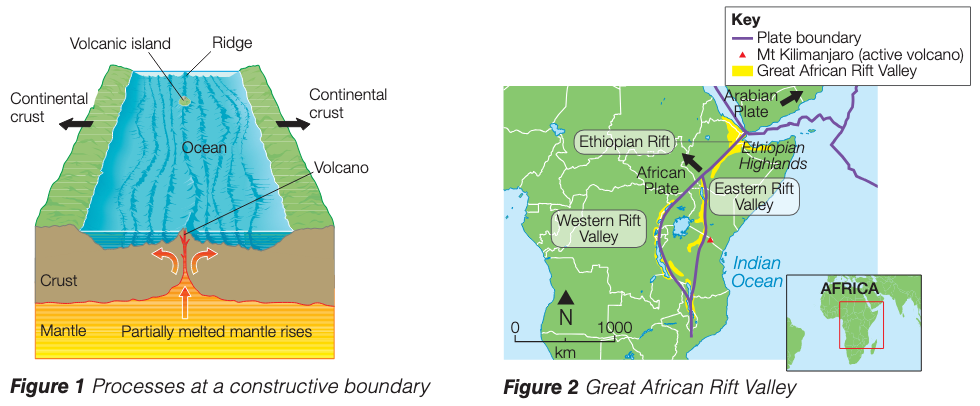
When oceanic plates pull apart beneath the ocean, something remarkable happens in the gap between them. The mantle layer beneath the crust is partially melted, and as the plates separate, this semi-molten material rises upward to fill the space.
As this hot mantle material reaches the cooler ocean water near the surface, it cools down and solidifies. This creates new oceanic crust along what we call a mid-ocean ridge. These ridges are like underwater mountain ranges that run along the ocean floor.
Sometimes, parts of the mid-ocean ridge build up so much that they rise above the ocean surface. When this happens, volcanic islands are formed. Iceland is a famous example of this process in action.
Continental constructive boundaries
When continental plates pull apart, the process is different from oceanic boundaries. As the plates separate, the mantle beneath rises upward, just like with oceanic plates. However, this rising mantle causes the continental crust above to heat up and expand.
The heating and expansion causes the crust to bulge upward, creating highland areas. As the plates continue to pull apart, the stretched crust cannot support its own weight. The crust then fractures and breaks into blocks. Some of these blocks drop down between parallel cracks, forming a rift valley - a long, deep depression in the land.
Important
The Formation Process: The crust doesn't simply split apart - it goes through stages of heating, bulging, stretching, and finally fracturing. This is why rift valleys have steep sides and raised highlands on either side.
Case study: Great African Rift Valley
Example
Case Study: The Great African Rift Valley
The East African Rift System is one of the best examples of a continental constructive boundary. This massive geological feature stretches for thousands of kilometres through East Africa, from Ethiopia in the north to Mozambique in the south.
The rift system consists of two main branches:
- The Western Rift Valley
- The Eastern Rift Valley (also called the Great African Rift Valley)
Between these rift valleys, the Ethiopian Highlands have formed as an uplifted area. The rifting process has also created volcanic activity, with Mount Kilimanjaro standing as an active volcano in the region.
This is where the African Plate is slowly splitting apart. The Arabian Plate has already separated from the African Plate in the north. Over millions of years, the continued splitting may eventually create a new ocean basin in this region.
Key features of the Great African Rift Valley:
- Plate boundary between sections of the African Plate
- Deep valley floors with steep sides
- Volcanic mountains including Mount Kilimanjaro
- Large lakes forming in the valley floors
- Highlands on either side of the rift
Conservative plate boundaries
How conservative boundaries work
Conservative boundaries are found where tectonic plates slide past each other horizontally. Unlike constructive boundaries, no new crust is created and no crust is destroyed. The plates are simply moving alongside one another, which is why they're called 'conservative' - they conserve the existing crust.
The movement at these boundaries is not smooth and steady. Instead, the plates move in sudden jerks. This happens because the plates can become locked together due to friction. Pressure builds up over many years as the plates try to move. Eventually, the stress becomes too great and the plates suddenly slip, releasing all the stored energy at once.
Important
Why Plates Lock Together: The rough surfaces of the plates create friction, causing them to stick together. This is like trying to slide two pieces of sandpaper past each other - they don't move smoothly but instead catch and release suddenly.
Earthquake activity
When the plates suddenly break free and slip, they cause earthquakes. Because there is no subduction (one plate going under another), the earthquakes occur close to Earth's surface. This shallow depth makes them particularly dangerous, as the seismic waves don't have far to travel before reaching buildings and infrastructure.
The earthquakes at conservative boundaries can be extremely powerful. Large earthquakes here often cause significant damage because:
- They occur near the surface
- The built-up pressure is released suddenly
- Urban areas are often located near these boundaries
Note
Shallow earthquakes (less than 70 km deep) release their energy closer to the surface, causing more intense shaking and greater damage to structures compared to deep earthquakes of the same magnitude.
Volcanic activity - or lack of it
An important characteristic of conservative boundaries is the absence of volcanic activity. Volcanoes form when magma from the mantle can reach the surface. At conservative boundaries, because plates are sliding past each other rather than pulling apart or colliding, there is no subduction and no gaps for magma to rise through. The crust remains intact, preventing volcanic eruptions.
Important
Remember: Despite high tectonic activity and powerful earthquakes at conservative boundaries, there are NO volcanoes because the crust isn't being pulled apart or pushed down into the mantle.
Case study: San Andreas Fault, California
Example
Case Study: San Andreas Fault, California
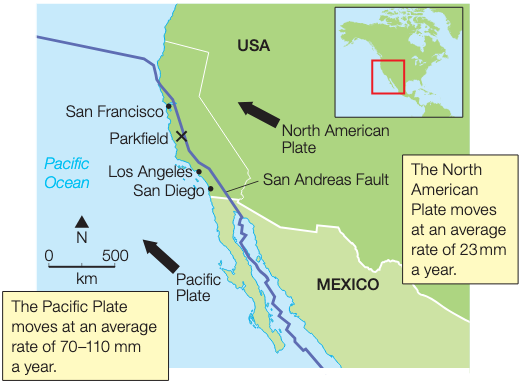
The San Andreas Fault in California, USA, is one of the world's most famous conservative plate boundaries. It marks the boundary between the Pacific Plate and the North American Plate.
The two plates are moving in the same general direction (both heading roughly northwest), but at different speeds:
- The Pacific Plate moves at an average rate of 70-110 millimetres per year
- The North American Plate moves much slower at approximately 23 millimetres per year
This difference in speed means the Pacific Plate is gradually sliding northward relative to the North American Plate. Major Californian cities including San Francisco, Parkfield, Los Angeles, and San Diego all lie close to this fault line, putting millions of people at risk from earthquake activity.
Key features of the San Andreas Fault:
- Total length of approximately 1,200 kilometres
- Runs through densely populated areas of California
- Responsible for numerous earthquakes including the devastating 1906 San Francisco earthquake
- Plates can be locked together for years before suddenly releasing
- No volcanic activity despite high tectonic activity
Exam guidance
Note
For 'describe' questions:
- State what happens at the boundary
- Include specific features that form
- Use geographical terminology correctly
For 'explain' questions:
- Give reasons WHY processes occur
- Link causes to effects
- Use examples to support your explanation
For case study questions:
- Name specific places
- Include facts and figures (e.g., movement rates)
- Explain both processes and impacts
- Link back to the theory
Summary
Key Points to Remember:
-
Constructive boundaries occur where plates move apart, creating new crust as mantle material rises and cools; volcanic islands form at oceanic boundaries, while rift valleys form at continental boundaries (e.g., Great African Rift Valley)
-
Conservative boundaries occur where plates slide past each other horizontally; no crust is created or destroyed, but friction causes plates to lock together
-
Earthquakes at conservative boundaries are particularly dangerous because they occur near Earth's surface when locked plates suddenly break free (e.g., San Andreas Fault)
-
Volcanic activity only occurs at constructive boundaries where magma can rise through gaps; conservative boundaries have no volcanoes because there is no subduction
-
Both boundary types create distinctive landforms and hazards that shape our world and affect human populations living nearby