Extreme Winds (OCR GCSE Geography B (Geography for Enquiring Minds)): Revision Notes
📚Revision Notes
Extreme Winds
What is wind?
Wind occurs when air moves from areas of high atmospheric pressure towards areas of low atmospheric pressure. The movement is driven by pressure differences in the atmosphere.
Note
The strength of wind depends directly on the pressure gradient. When there is a large difference in pressure between two areas, winds will be stronger. Smaller pressure differences result in lighter winds.
Why are some areas so windy?
Different parts of the world experience extreme winds due to various atmospheric processes and geographical factors. Understanding these helps explain the distribution of the world's windiest locations.
Types of extreme winds
Trade winds
Trade winds are persistent winds that blow from high pressure belts towards low pressure belts. They are part of the global atmospheric circulation system and blow consistently in tropical regions. These winds form a major component of Earth's wind patterns.
Katabatic winds
Katabatic winds form when cold, dense air flows downhill under the force of gravity. Antarctica provides a prime example of katabatic winds, where extremely cold air descends from the high ice plateau towards the coast, creating powerful downslope winds.
Note
Katabatic winds are particularly powerful in Antarctica because the extremely cold temperatures increase air density, making the descending air even heavier and faster-moving.
Jet streams
Jet streams are narrow bands of very strong winds located high in the atmosphere. These fast-flowing air currents can significantly affect weather patterns and influence conditions at high elevations. Mountain peaks such as Mt Everest experience the effects of jet streams, which contribute to the extreme wind conditions at high altitude.
Tornadoes
Tornadoes are violently rotating columns of air that form during severe thunderstorms. These intense vortices produce some of the strongest winds on Earth. The central United States, particularly an area known as 'Tornado Alley', experiences tornadoes regularly due to the collision of different air masses creating ideal conditions for tornado formation.
Tropical storms
Tropical storms (also called hurricanes or cyclones) are massive rotating storm systems that generate sustained high-speed winds over large areas. These powerful storms form over warm tropical oceans and can maintain wind speeds exceeding 250 km/h. The highest wind speed ever recorded occurred during Tropical Cyclone Olivia in 1996 on Barrow Island off the coast of Australia.
Important
Different types of extreme winds form through different mechanisms:
- Trade winds - global circulation patterns
- Katabatic winds - gravity-driven cold air descent
- Jet streams - high-altitude atmospheric currents
- Tornadoes - rotating air columns from severe storms
- Tropical storms - large-scale ocean-formed systems
Global distribution of extreme winds
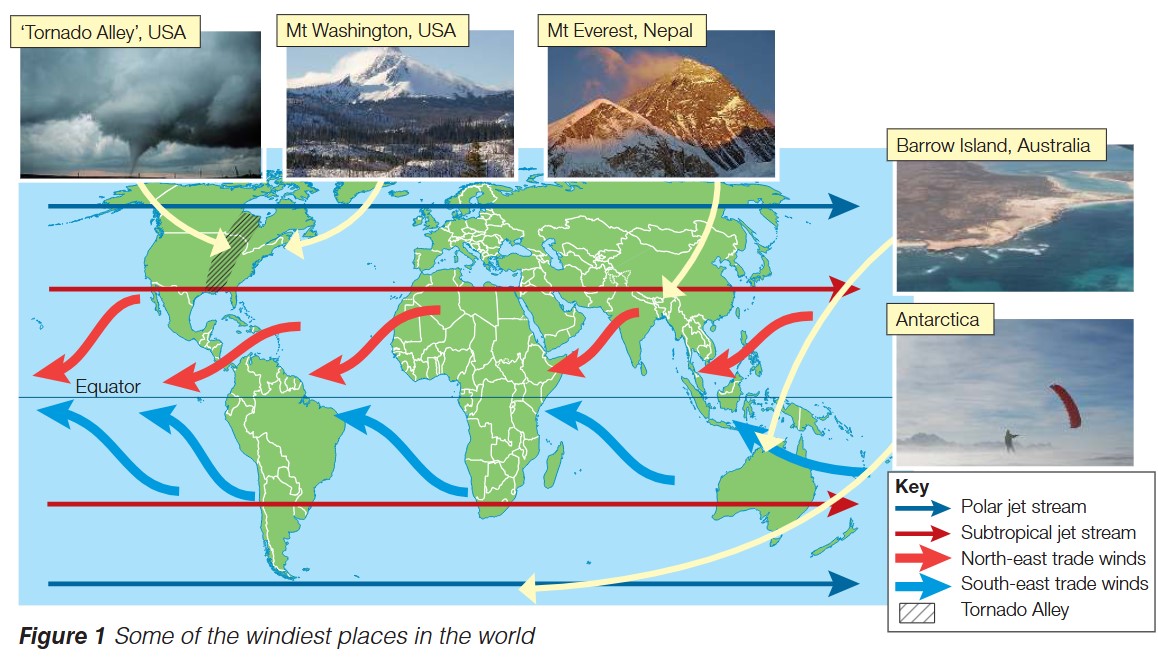
The diagram above shows how different wind systems operate across the planet, creating some of the world's windiest locations:
- Polar jet streams (shown in blue) flow at high latitudes in both hemispheres
- Subtropical jet streams (shown in red) occur in the mid-latitudes
- Trade winds blow from subtropical high pressure zones towards the equatorial low pressure zone
- Tornado Alley in the central USA marks a region particularly prone to tornado formation
Contrasting examples of extreme wind locations
Tornado Alley, USA
This region in the central United States experiences frequent tornadoes due to the interaction of warm, moist air from the Gulf of Mexico with cold, dry air from Canada. The flat terrain allows these air masses to collide, creating the rotating updrafts necessary for tornado development.
Mt Washington, USA
High mountain peaks like Mt Washington experience extreme winds due to their elevation placing them within or near jet stream paths. The lack of surface friction at altitude and the funnelling effect of mountain topography intensifies wind speeds.
Example
Worked Example: Mt Everest Wind Conditions
Mt Everest sits at 8,849 m elevation, placing it at the boundary of the troposphere where jet streams flow.
Step 1: Identify the wind system Jet streams are narrow bands of strong winds in the upper atmosphere.
Step 2: Explain the impact At this extreme altitude, winds regularly exceed 200 km/h at the summit, making it one of the most hostile wind environments on Earth. The mountain's height places it directly in the path of these high-altitude wind currents.
Barrow Island, Australia
This location holds the record for the strongest wind gust ever recorded (408 km/h during Tropical Cyclone Olivia in 1996). Its position in a cyclone-prone region of the Indian Ocean, combined with the island's exposure, creates conditions for extreme tropical storm winds.
Antarctica
The combination of katabatic winds flowing off the ice sheet and the lack of obstacles creates sustained high wind speeds. The extremely cold temperatures increase air density, making the descending winds even more powerful. Coastal Antarctica experiences some of the strongest average wind speeds on Earth.
The UK's wildest winds
The strongest winds in the UK typically occur in two main locations:
Mountain regions: The highest wind speeds are usually recorded on mountain summits in western areas, particularly in Scotland and Wales. Elevated terrain experiences stronger winds as there are fewer obstacles to slow air movement and mountains can be influenced by high-altitude wind systems.
Coastal areas: Coasts are also prone to high winds because there is much less friction when winds pass over the sea compared to land surfaces. Without trees, buildings, or terrain features to slow them down, winds maintain higher speeds as they move onshore. This is why exposed western and northern coasts often experience the most severe wind conditions during storms.
Note
The UK's strongest winds are concentrated in western and northern areas because these regions face prevailing winds from the Atlantic Ocean with minimal land barriers to reduce wind speed.
Exam guidance
Important
Command Word Approaches:
- Describe questions require you to state the characteristics or patterns shown (e.g., "Trade winds blow from high to low pressure belts")
- Explain questions need you to give reasons why something occurs (e.g., "Katabatic winds form in Antarctica because cold, dense air flows downhill under gravity")
- Use specific located examples to support your answers (e.g., Tornado Alley, Barrow Island)
- Link wind formation to pressure differences and atmospheric processes
Understanding how trade winds fit into the global circulation system is essential for explaining global wind patterns. Trade winds form part of the circulation cells that redistribute heat from the equator towards the poles, creating predictable wind belts.
Remember!
Summary
Key Points to Remember:
- Wind is the movement of air from high pressure to low pressure areas
- Greater pressure differences create stronger winds
- Trade winds blow from high pressure belts towards low pressure belts as part of global circulation
- Different types of extreme winds include katabatic winds (downslope), jet streams (high altitude), tornadoes (rotating), and tropical storms (large-scale)
- The world's windiest locations include contrasting environments: Tornado Alley (severe weather), high mountains like Everest (altitude/jet streams), Barrow Island (tropical cyclones), and Antarctica (katabatic winds)
- In the UK, the strongest winds occur on western mountain tops and exposed coastal areas due to reduced friction