How Earthquakes Happen (OCR GCSE Geography B (Geography for Enquiring Minds)): Revision Notes
📚Revision Notes
How Earthquakes Happen
What causes earthquakes
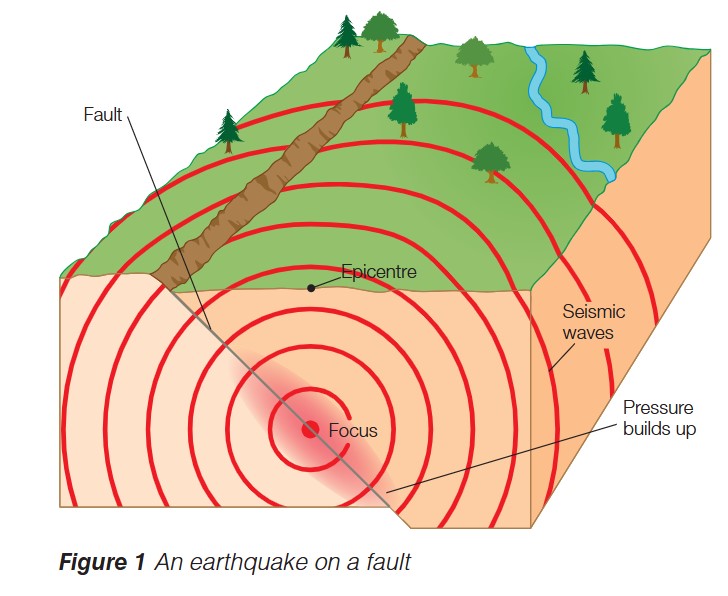
Earthquakes occur due to the movement of tectonic plates in the Earth's crust. When plates become locked together, immense pressure gradually accumulates at the boundary. Eventually, the plates break free or one plate shifts, and the sudden release of this stored energy triggers an earthquake.
The point underground where the earthquake originates is called the focus (or hypocenter). Directly above this, on the Earth's surface, is the epicenter. From the focus, energy waves called seismic waves spread outward through the Earth.
Note
Understanding Focus vs Epicenter:
The focus (hypocenter) is the actual point underground where the earthquake originates and energy is first released. The epicenter is the point on the Earth's surface directly above the focus - this is typically where the strongest shaking is felt and where damage is most severe.
Types of earthquakes by depth
Earthquakes are classified by how deep below the surface they occur. This depth affects their power and the area they damage.
Deep focus earthquakes
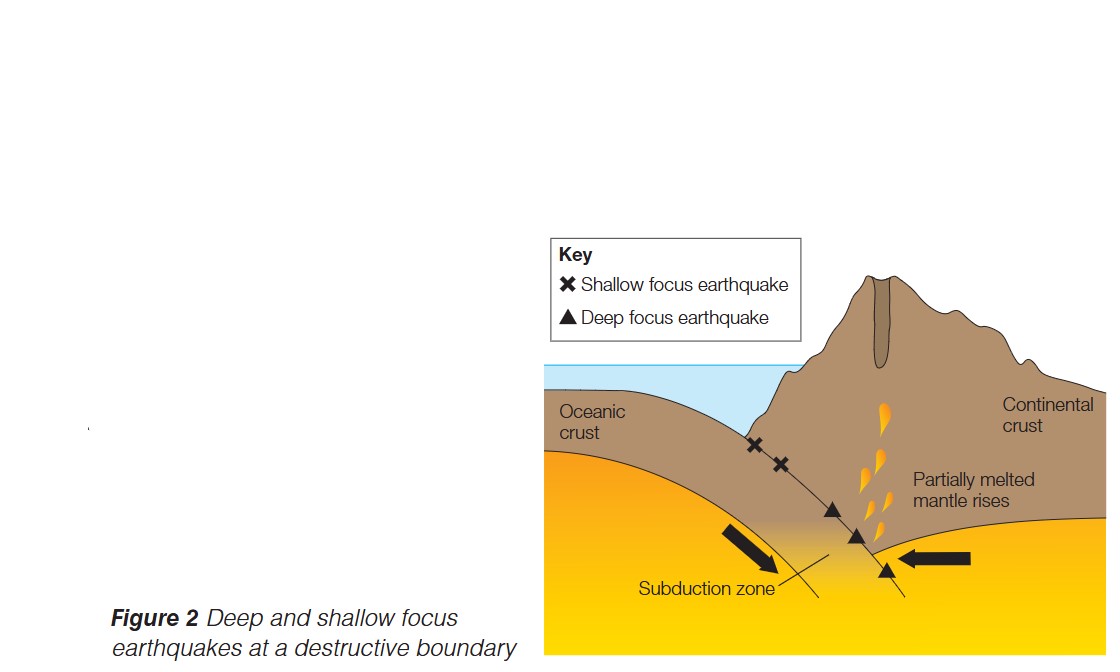
Deep focus earthquakes originate between 70 and 700 kilometres below the Earth's surface. They occur exclusively at destructive plate boundaries, where one tectonic plate is forced beneath another.
These earthquakes are extremely powerful because of the immense pressures at such depths. However, the seismic waves travel vertically upward through the Earth, meaning the surface area affected by damage is relatively small. Despite their power, the energy is concentrated in a smaller region directly above the focus.
Shallow focus earthquakes
Shallow focus earthquakes begin within 70 kilometres of the Earth's surface. They can occur at several types of plate boundaries:
- Conservative boundaries (where plates slide past each other)
- Collision boundaries (where plates push together)
- The upper part of destructive boundaries
Shallow focus earthquakes typically have a smaller magnitude, meaning they release less energy than deep focus earthquakes. However, their seismic waves spread out horizontally across the surface, which means they can cause damage over a much larger geographical area. This horizontal spread makes shallow earthquakes particularly dangerous to populated regions.
Important
Why Shallow Focus Earthquakes Are More Dangerous:
Although shallow focus earthquakes release less energy than deep focus earthquakes, they pose a greater threat to human populations. The horizontal spread of their seismic waves means they can damage infrastructure and communities across a much wider area, affecting more people and property even with lower magnitude.
Measuring and predicting earthquakes
Scientists have developed several tools and scales to monitor, measure, and predict earthquakes.
Seismometers are instruments that detect and record the seismic waves produced by earthquakes. Seismologists use networks of these devices to determine the location, depth, and magnitude of earthquakes worldwide.
Geographical Information Systems (GIS) are computer-based tools that can combine multiple layers of data. Scientists use GIS to map fault lines, population density, building types, and past earthquake activity. By analyzing this information together, they can identify which areas face the highest risk from future earthquakes, helping communities prepare and plan.
Measuring earthquake magnitude and impact
Two main scales are used to describe earthquakes:
The Richter scale measures the magnitude of an earthquake, which refers to the amount of energy released. This is an objective, scientific measurement based on seismometer readings. Each whole number increase on the Richter scale represents a tenfold increase in the amplitude of seismic waves.
The Mercalli scale measures the effects and damage caused by an earthquake. This scale is based on observations of how the earthquake affects people, buildings, and the landscape. It is more subjective but provides practical information about the earthquake's real-world impact.
Note
Richter vs Mercalli Scales:
- Richter Scale: Measures the magnitude (energy released) - objective and scientific
- Mercalli Scale: Measures the effects and damage - subjective but practical
A powerful earthquake (high Richter) in an unpopulated area might have a low Mercalli rating, while a moderate earthquake (lower Richter) in a densely populated city could have a high Mercalli rating due to extensive damage.
Summary
Key Points to Remember:
- Earthquakes occur when tectonic plates become locked, pressure builds up, and then the plates suddenly break free, releasing stored energy
- Deep focus earthquakes (70-700km depth) occur only at destructive boundaries and are very powerful, but their vertical seismic waves damage a smaller area
- Shallow focus earthquakes (within 70km depth) occur at conservative, collision, and upper destructive boundaries, and their horizontal seismic waves can damage a much larger area
- The Richter scale measures the magnitude (energy released) while the Mercalli scale measures the effects and damage of an earthquake
- Seismometers detect earthquakes and GIS technology helps predict which areas are most at risk