Saving Lives in Earthquake Zones (OCR GCSE Geography B (Geography for Enquiring Minds)): Revision Notes
📚Revision Notes
Saving lives in earthquake zones
Understanding earthquake protection
In earthquake-prone regions, saving lives depends on two key strategies: designing buildings that can withstand seismic activity and developing effective prediction and warning systems. The approach taken varies significantly between more economically developed countries (Advanced Countries - ACs) and less economically developed countries (Less Industrially Developed Countries - LIDCs).
Important
The fundamental difference between earthquake protection strategies in ACs and LIDCs comes down to available resources. Both approaches save lives, but wealthy nations can invest in advanced technology that prevents structural damage, while LIDCs focus on affordable designs that prioritize human survival.
Building to survive
Life-safe buildings in LIDCs
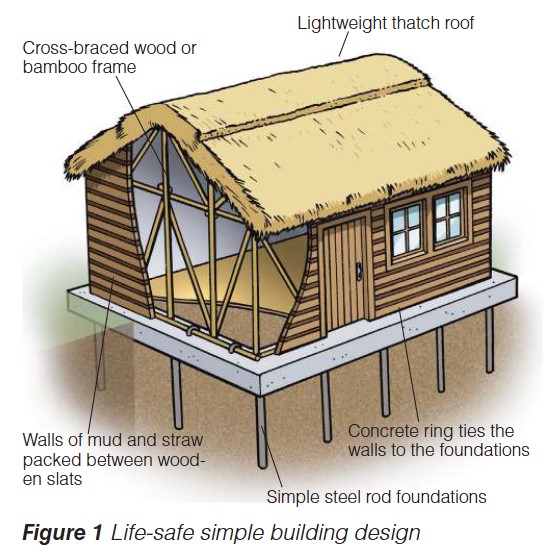
In countries with limited financial resources, the focus is on creating life-safe buildings. These structures are designed to protect people during an earthquake, even if the building itself sustains damage. The key principle is simple: keep people alive while keeping construction costs affordable.
Life-safe buildings incorporate several important features:
Structural elements:
- Lightweight thatched roofs that won't cause serious injury if they collapse
- Cross-braced wooden or bamboo frames that provide flexibility and strength
- Walls constructed from mud and straw packed between wooden supports on slats
- Simple steel rod foundations that allow slight movement
Foundation design:
- Concrete ring ties that secure walls to foundations, preventing them from sliding off during ground shaking
- Raised foundations that lift the structure above ground level, reducing direct contact with seismic waves
Note
Why lightweight materials matter: In life-safe design, the choice of lightweight roofing materials is crucial. If a thatched roof collapses during an earthquake, occupants are far more likely to survive compared to collapse under heavy concrete or tile roofing. This design philosophy accepts that buildings may be damaged or destroyed, but occupants have a much better chance of survival compared to poorly constructed buildings that collapse catastrophically.
Earthquake-proof buildings in advanced countries
Wealthier nations can invest in sophisticated engineering solutions to create buildings that not only protect lives but also minimise structural damage. This approach is called mitigation - actively reducing the potential harm from earthquakes through advanced design and technology.
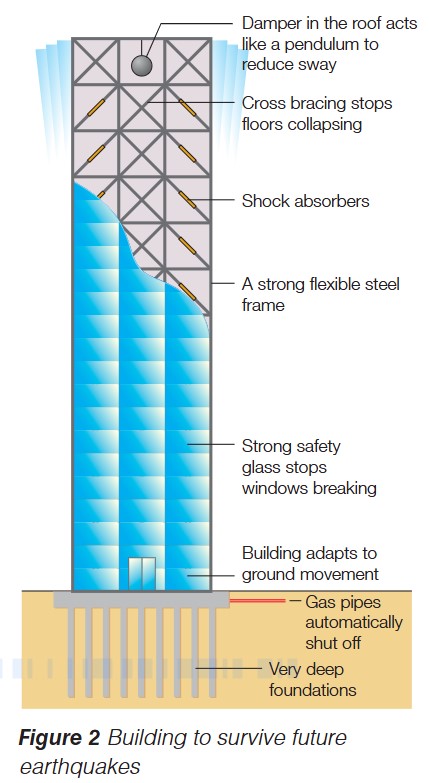
Modern earthquake-resistant buildings, particularly tall structures, incorporate multiple protective features:
Upper structure protection:
- Roof dampers that act like pendulums, counteracting building sway during seismic activity
- Cross-bracing throughout the entire structure, creating an X-pattern framework that distributes forces evenly
- Shock absorbers positioned at key points to reduce the transmission of seismic energy through the building
Mid-level design:
- Flexible steel frame construction that can bend and move without breaking
- Strong safety glass windows designed to resist shattering and prevent injuries from falling glass
Foundation systems:
- Buildings designed to adapt to ground movement rather than resist it rigidly
- Gas pipes with automatic shut-off systems to prevent fires following earthquakes
- Very deep foundations that anchor the structure securely while allowing controlled movement
Note
The philosophy of flexibility: Earthquake-proof buildings in ACs work on the principle of flexibility rather than rigidity. Instead of trying to resist seismic forces completely, these structures are designed to move with the earthquake, absorbing and dissipating energy through dampers and flexible materials. This approach significantly reduces both structural damage and the risk to occupants.
The fundamental difference between life-safe and earthquake-proof buildings is cost. Advanced countries can afford technology and materials that LIDCs simply cannot, but both approaches save lives through careful design appropriate to their economic context.
Prediction and warning systems
The challenge of earthquake prediction
Despite advances in technology, seismologists cannot accurately predict when an earthquake will strike. This makes preparation and warning systems crucial for saving lives in earthquake zones.
Important
A critical limitation: The inability to predict earthquakes accurately means that communities cannot evacuate before seismic events. This fundamental constraint makes building design and emergency preparedness even more essential for saving lives. Communities must be ready to respond immediately when earthquakes occur with no advance warning.
Seismic gaps
Scientists have identified a useful concept called seismic gaps. These are areas along fault lines where earthquakes haven't occurred for an extended period. The concerning aspect is that tectonic pressure continues to build in these zones. When pressure reaches a critical point, it's likely to be released suddenly, potentially causing a major earthquake.
Monitoring seismic gaps helps authorities identify high-risk areas, but it still doesn't provide precise timing for when earthquakes will occur.
Note
Identifying high-risk zones: Think of seismic gaps like a stretched rubber band - the longer the gap since the last earthquake, the more energy has accumulated. While this doesn't tell us exactly when the "band will snap," it does help authorities prioritize which areas need the strongest building codes and most comprehensive emergency preparedness programs.
Early warning systems
Once seismic waves begin travelling through the Earth's crust, detection equipment can identify them and send out warnings. However, these warnings only provide approximately 30 seconds of advance notice - a very short window for action.
Important
30 seconds can save lives: While 30 seconds might seem impossibly short, this brief warning time allows for critical protective actions:
- Taking cover under sturdy furniture
- Moving away from windows and heavy objects
- Exiting buildings if close to exits
- Stopping elevators at the nearest floor
- Automatically shutting down critical infrastructure like gas supplies to prevent fires
Emergency preparedness
Because prediction remains impossible and warning times are minimal, preparation becomes vital for saving lives. Communities in earthquake zones must be ready to respond immediately.
Regular earthquake drills:
Frequent practice sessions ensure people know exactly what to do when an earthquake strikes. These drills become automatic responses that don't require conscious thought during the panic of a real event.
'Go bags' for emergencies:
Prepared emergency kits should include essential survival items:
- First aid supplies for treating injuries
- Bottled water (minimum three days' supply)
- Non-perishable food items
- Battery-powered or wind-up radio for emergency broadcasts
- Torch with spare batteries
- Mobile phone with backup charging options
- Essential medicines
- Warm blankets
- Whistle and face mask
Note
Why 'go bags' matter: Having these supplies readily accessible means families can survive the immediate aftermath of an earthquake when rescue services may be overwhelmed or unable to reach all affected areas quickly. The three-day supply guideline is based on typical emergency response times in major disasters.
Exam guidance
When answering questions about earthquake protection:
For 'describe' questions:
- Identify specific features of building design
- Name the types of buildings (life-safe vs earthquake-proof)
- State what warning systems can detect
For 'explain' questions:
- Show how building features reduce damage (e.g., "Cross-bracing distributes seismic forces evenly throughout the structure, preventing collapse")
- Link economic development to building design choices
- Explain why prediction is difficult despite technology
For 'assess' or 'evaluate' questions:
- Compare effectiveness of different approaches in LIDCs vs ACs
- Consider limitations (e.g., cost, short warning times)
- Weigh up which strategies have greatest impact on saving lives
Summary
Key Points to Remember:
-
Building design varies by wealth: LIDCs use life-safe designs with lightweight materials and flexible structures, while ACs can afford earthquake-proof buildings with advanced technology like dampers, shock absorbers, and flexible steel frames
-
Mitigation means reducing damage: Through careful design and engineering, particularly in wealthier countries
-
Seismic gaps are warning signs: Areas without recent earthquake activity where pressure is building, indicating future risk
-
Warning times are extremely short: Only 30 seconds after seismic waves are detected
-
Preparation saves lives: Regular drills and emergency 'go bags' are essential because earthquakes cannot be accurately predicted
Summary box
Summary
Key points to remember:
- Life-safe buildings in LIDCs prioritise survival over structural integrity using affordable materials
- Earthquake-proof buildings in ACs use sophisticated engineering to minimise both casualties and damage
- Seismic gaps identify high-risk zones but cannot predict exact timing
- Early warning systems provide only 30 seconds' notice
- Emergency preparedness through drills and go bags is vital because accurate prediction is impossible
Key terms:
- Mitigation - reducing earthquake damage through design and engineering
- Advanced Countries (ACs) - wealthier nations that can afford earthquake-proof buildings
- LIDCs - Less Industrially Developed Countries using life-safe building approaches
- Seismic gaps - fault line areas where earthquakes haven't occurred recently and pressure is building
- Life-safe buildings - structures designed to protect people even if the building is damaged
Critical processes:
- Building design must match economic capabilities and seismic risk
- Warning systems detect seismic waves but provide minimal advance notice
- Community preparedness through education and emergency supplies saves lives when prediction and warning systems have limitations