Zambia’s Zigzag Path to Development (OCR GCSE Geography B (Geography for Enquiring Minds)): Revision Notes
📚Revision Notes
Zambia's Zigzag Path to Development
Introduction
Zambia is a landlocked country in southern Africa that gained independence in 1964. At the time of independence, there were high expectations that Zambia would follow the same development path as more advanced countries (ACs). The country had significant natural resources, particularly copper, and ambitious infrastructure projects like the Kariba Dam on the Zambezi River demonstrated its development goals.
However, Zambia's actual development journey has been far more complex than originally expected. Rather than following a smooth, upward path towards becoming a more developed nation, Zambia's economy and society have experienced significant fluctuations, creating what geographers call a "zigzag pattern" of development.
Note
Understanding Zambia's development story helps illustrate an important geographical principle: not all countries follow the same development path. While some theories suggest linear progress, real-world examples like Zambia show that development can be much more complex and unpredictable.
Understanding development patterns
The Rostow model of economic development suggests that countries progress through development in a linear fashion, moving through predictable stages from traditional society to high mass consumption. This model, based on the experiences of advanced countries, shows development as a straight line moving steadily upwards.
However, Zambia's experience since independence challenges this simple model. Instead of steady progress, Zambia's economy has gone through multiple periods of growth and decline. This zigzag pattern means that sometimes the country moved forward in its development, while at other times it experienced setbacks that reduced living standards and economic output.
Important
Critical Concept: The Rostow model assumes all countries will develop in the same way, following a predictable straight line. However, Zambia's experience demonstrates that development is actually influenced by many complex factors, both within and outside a country's control. This makes the zigzag pattern more realistic for many LIDCs.
Understanding why Zambia followed this zigzag pattern rather than a straight line helps us recognize that development is influenced by many complex factors, both within and outside a country's control.
The Kariba Dam
One of the most significant early development projects was the Kariba Dam, a large hydro-electric power facility built on the Zambezi River. This dam became a powerful symbol of Zambia's ambitions for industrial development after independence.
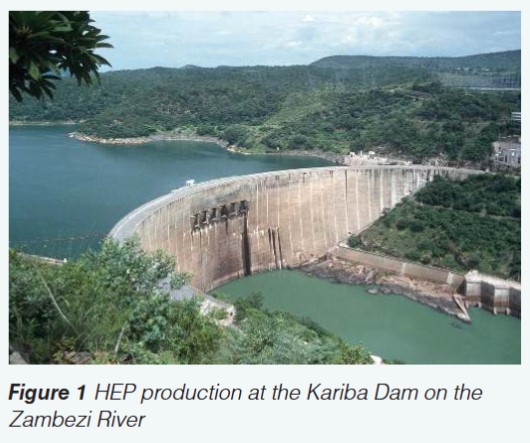
The dam was designed to generate electricity to power Zambia's important copper mining industry. By providing reliable and cheaper electricity, the dam helped support one of Zambia's key economic activities. However, as we will see, reliance on a single industry like copper mining would later create significant challenges for Zambia's development.
Note
The Kariba Dam represents both the opportunities and risks in development. While it provided essential infrastructure, it also reinforced Zambia's dependence on copper mining by making that industry more efficient. This would later prove problematic when copper prices fell.
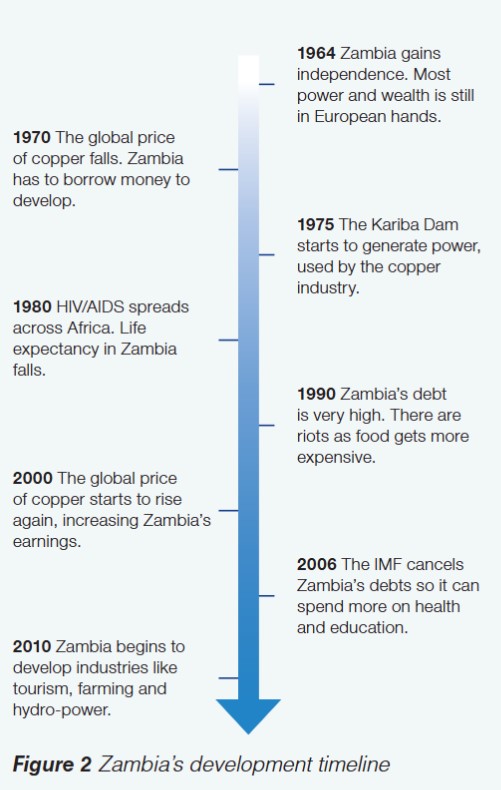
Zambia's development timeline (1964-2010)
1964: Independence and colonial legacy
When Zambia gained independence from British colonial rule, most of the country's power and wealth remained in European hands. The new government faced the challenge of taking control of the economy while developing the country for the benefit of all Zambians. Despite these challenges, there was optimism about the country's future based on its copper resources.
1970: Falling copper prices
The global price of copper fell dramatically, creating Zambia's first major economic crisis since independence. Because copper exports were Zambia's main source of income, falling prices meant the government earned much less money. To continue development projects and maintain services, Zambia had to borrow money from international sources, beginning a cycle of debt that would affect the country for decades.
Important
First Major Setback: The 1970 copper price crash revealed a critical vulnerability in Zambia's economy - over-dependence on a single commodity. This event marked the beginning of Zambia's zigzag development pattern, as the country shifted from growth to decline.
1975: Power generation begins
The Kariba Dam started generating hydro-electric power, providing electricity for the copper industry. This represented a positive step in Zambia's development, as locally-generated power reduced energy costs and demonstrated the country's growing infrastructure. The dam showed that Zambia could complete major engineering projects and reduce dependence on imported energy.
1980: The HIV/AIDS crisis
The HIV/AIDS epidemic began spreading rapidly across Africa during this period. In Zambia, this had devastating effects on life expectancy, which fell significantly. The disease particularly affected working-age adults, reducing the available workforce and putting strain on healthcare services. This health crisis hindered development by reducing productivity and increasing healthcare costs.
1990: Debt crisis and food riots
By 1990, Zambia's national debt had become very high due to years of borrowing and economic difficulties. The government struggled to repay loans while maintaining services and subsidies. When food prices rose, riots broke out as people struggled to afford basic necessities. This period represented one of the lowest points in Zambia's post-independence development, with economic hardship affecting most of the population.
Note
Development Pattern: Notice how the timeline shows clear ups and downs - the dam brought hope in 1975, but the AIDS crisis in 1980 and debt crisis in 1990 created severe setbacks. This illustrates the zigzag pattern rather than steady progress.
2000: Copper prices recover
The global price of copper began rising again, bringing new income to Zambia's economy. This marked the beginning of a recovery period, as higher copper prices meant more export earnings. The government could collect more tax revenue from mining companies, providing funds for development projects. This demonstrated how dependent Zambia remained on global commodity prices.
2006: Debt cancellation
The International Monetary Fund (IMF) cancelled much of Zambia's debt, removing a major burden on the economy. Debt cancellation meant the government no longer had to spend large amounts of its budget on loan repayments. Instead, this money could be redirected towards essential services like healthcare and education. This decision by international lenders represented a significant turning point in Zambia's development prospects.
2010: Economic diversification
Zambia began developing industries beyond copper mining, including tourism, commercial farming, and expanding hydro-power generation. This diversification was important because it reduced the country's dependence on a single commodity whose price could fluctuate dramatically. By spreading economic activity across multiple sectors, Zambia aimed to create more stable and sustainable development.
Example
Timeline Pattern Analysis:
Examining Zambia's timeline reveals the zigzag pattern clearly:
Upward movements:
- 1964: Independence brings hope
- 1975: Kariba Dam generates power
- 2000: Copper prices rise
- 2006: Debt cancelled
- 2010: Economy diversifies
Downward movements:
- 1970: Copper prices fall
- 1980: HIV/AIDS crisis begins
- 1990: Debt crisis peaks
This pattern of alternating progress and setbacks contrasts sharply with the Rostow model's prediction of steady, linear development.
Factors affecting Zambia's development
Factors that helped development
Infrastructure investment: The construction of the Kariba Dam and other infrastructure projects provided essential services like electricity that supported economic activity.
Natural resources: Zambia's copper deposits provided a valuable export commodity that generated income during periods when global prices were high.
Debt relief: The 2006 debt cancellation freed up government funds that could be spent on health, education, and development rather than loan repayments.
Rising commodity prices: When copper prices increased in the 2000s, Zambia's export earnings grew, providing resources for development.
Economic diversification: Developing multiple industries reduced dependence on copper and created new employment opportunities in tourism, farming, and energy.
Factors that hindered development
Falling commodity prices: When global copper prices fell in 1970, Zambia's income dropped dramatically, forcing the government to borrow money and creating long-term debt problems.
Debt burden: High levels of national debt meant that much of the government's budget went to loan repayments rather than development projects or services.
Health crises: The HIV/AIDS epidemic reduced life expectancy, decreased the working-age population, and increased healthcare costs, all of which hindered economic development.
Colonial legacy: At independence, most power and wealth remained in European hands, making it difficult for the new government to control the economy and direct development.
Over-reliance on single commodity: Depending heavily on copper made Zambia vulnerable to global price fluctuations that were beyond the country's control.
Food insecurity: Rising food prices and shortages caused social unrest and made it harder for people to maintain their standard of living, even during periods of economic growth.
Important
Key Development Lesson: Notice how several hindering factors are related to external forces beyond Zambia's control (global copper prices, international debt). This highlights why LIDCs often struggle to achieve stable development - they are vulnerable to decisions and market forces in other countries.
Exam guidance
When answering questions about Zambia's development, you need to demonstrate different skills depending on the command word used:
Describe questions require you to identify and explain features of Zambia's zigzag development pattern, using specific examples from the timeline. Focus on what happened and when, using concrete details like dates and events.
Explain questions need you to show how factors caused development to increase or decrease, using clear cause-and-effect reasoning. For example, explain how falling copper prices led to borrowing, which created debt problems, which reduced funds available for development.
Assess or evaluate questions require you to weigh up the relative importance of different factors, considering both those that helped and hindered development, and reaching a supported conclusion about which were most significant.
Important
Exam Success Tip: Always support your points with specific evidence from Zambia's timeline, such as dates, events, and consequences. Generic statements about development won't earn full marks - you need to show detailed knowledge of the Zambian case study.
Remember!
Summary
Key Points to Remember:
- Zambia gained independence in 1964 with expectations of following a straight-line development path like advanced countries
- Instead, Zambia's development followed a zigzag pattern with periods of growth and decline
- The Kariba Dam symbolized Zambia's development ambitions and provided hydro-electric power for industry
- Falling copper prices in 1970 forced Zambia to borrow money, creating long-term debt problems
- The HIV/AIDS crisis from 1980 onwards reduced life expectancy and hindered development
- Debt cancellation in 2006 allowed Zambia to spend more on health and education
- Economic diversification into tourism, farming, and hydro-power has helped create more stable development since 2010
Highlighted Key Terms:
- LIDC - Low Income Developing Country
- Rostow model - theory of development as a straight line through stages
- Zigzag development - pattern of ups and downs rather than steady progress
- Hydro-electric power (HEP) - electricity generated from water
- Debt cancellation - international lenders writing off money owed by a country
- Economic diversification - developing multiple industries rather than depending on one
Critical Frameworks:
- Development can follow different patterns - not all countries follow the same straight-line path
- Dependency on a single commodity makes countries vulnerable to global price changes
- External factors (like global prices and international debt relief) significantly affect LIDCs' development
- Infrastructure projects like dams can support development but cannot guarantee it without broader economic stability