Small Scale Approaches to Food Security (OCR GCSE Geography B (Geography for Enquiring Minds)): Revision Notes
📚Revision Notes
Small Scale Approaches to Food Security
Introduction
Small-scale approaches to food security focus on community-led, locally managed food production systems. These strategies aim to provide sustainable alternatives to large-scale intensive agriculture. Two key examples are urban gardens and permaculture, both representing bottom-up approaches where local communities take initiative to address food security challenges.
Note
Bottom-up vs Top-down Approaches: Bottom-up approaches are community-led initiatives where local people identify problems and develop solutions themselves. This contrasts with top-down approaches, where governments or large organizations plan and implement food security strategies from above.
Urban gardens
What are urban gardens?
Urban gardens are a form of community-led food production in cities and towns. They provide an alternative to intensive agriculture by enabling food to be grown on a smaller scale in built-up areas.
Where can urban gardens be created?
Urban gardens can be established in various locations, including:
- Back gardens
- Allotments
- Shared community spaces
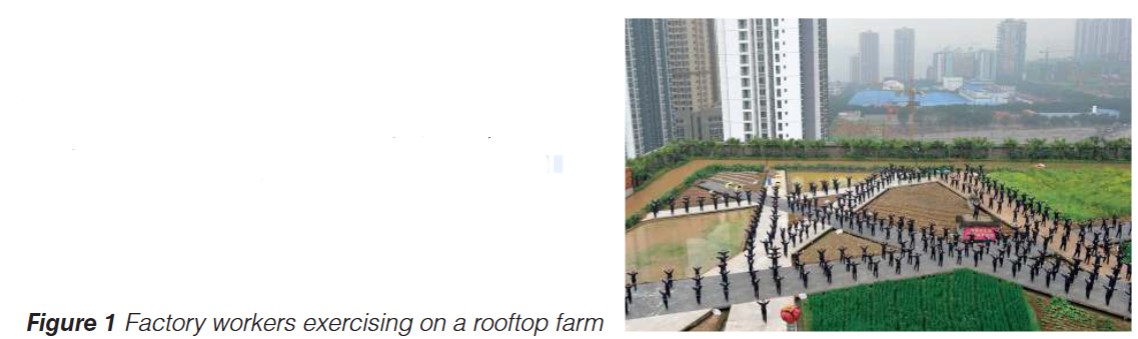
- Factory rooftops
Example
Real-World Example: Rooftop Farms
The image above shows factory workers tending a rooftop farm in urban China. This demonstrates how unused urban spaces can be converted into productive food-growing areas. Rooftops are particularly valuable in dense cities where ground-level space is limited, turning otherwise wasted space into sustainable food production sites.
While urban gardens offer sustainable food production methods, their ability to supply adequate food quantities to meet population needs remains uncertain.
Impacts of urban gardens
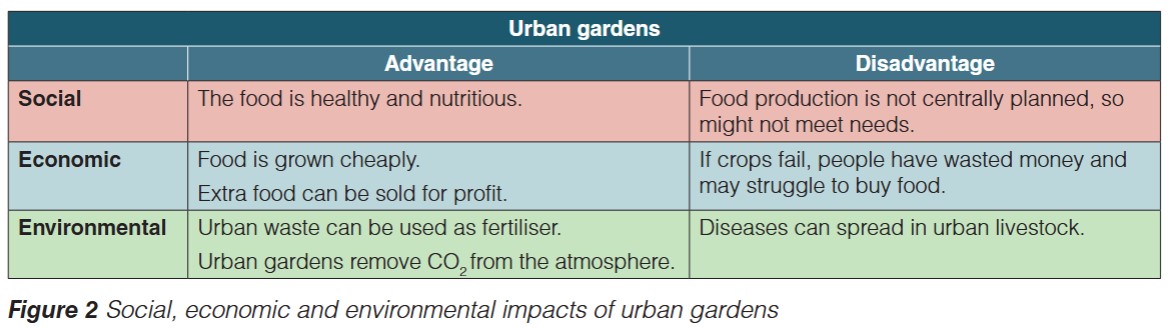
Urban gardens generate both positive and negative impacts across social, economic and environmental dimensions.
 Social impacts
On the positive side, urban gardens provide communities with access to healthy and nutritious fresh food. However, because production is not centrally coordinated, there is no guarantee that these gardens will meet the food needs of the local population.
Economic impacts
Urban gardens offer economic benefits by allowing people to grow food cheaply, reducing household food costs. Surplus produce can be sold to generate income. The downside is that crop failure represents a financial loss, and people may then struggle to afford food from other sources.
Important
Risk of Crop Failure: Unlike large-scale farms with insurance and backup systems, individual urban gardeners bear the full risk if their crops fail. This can create food insecurity if people have invested money and time but have no harvest to show for it.
Environmental impacts
Environmentally, urban gardens offer sustainability benefits. They can use urban waste as fertiliser, creating a closed-loop system. They also remove carbon dioxide from the atmosphere through plant growth. However, keeping livestock in urban areas can lead to disease transmission risks.
Permaculture
What is permaculture?
Permaculture means 'permanent agriculture'. It is a bottom-up approach to food security that mimics natural ecosystems. The system aims to create self-sustaining food production by copying how plants grow together in nature.
Key features of permaculture
Permaculture is environmentally sustainable. Similar to urban gardens, food is produced on a small scale, which means many permaculture farms are needed to ensure social sustainability across communities. One challenge is that establishing permaculture gardens can be expensive initially.
Note
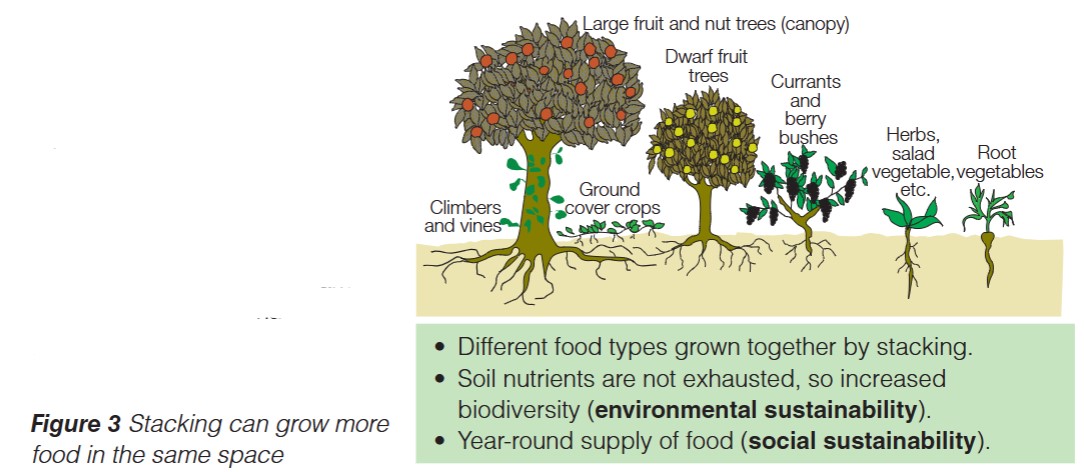
Understanding the Food Forest: The diagram above illustrates the multiple layers in a permaculture system. Just as in a natural forest, different plants occupy different heights - from tall fruit trees at the canopy level down to root crops below ground. This vertical arrangement is the essence of the stacking technique.
Stacking technique
A central feature of permaculture is stacking – growing different food types together in layers.
Example
How Stacking Works in Permaculture:
Imagine a vertical cross-section of a garden:
- Top layer: Fruit trees (apples, pears)
- Middle layer: Shrubs (berries, currants)
- Ground layer: Vegetables and herbs
- Below ground: Root crops (potatoes, carrots)
Each layer uses different soil nutrients at different depths, so the soil is not exhausted by intensive growing.
This approach offers several benefits:
- Soil nutrients are not exhausted because different plants use different nutrients at different depths
- Increased biodiversity as multiple species grow together, supporting environmental sustainability
- Year-round supply of food becomes possible, contributing to social sustainability
The stacking system allows more food to be grown in the same space compared to traditional monoculture farming.
Evaluating sustainability
When assessing small-scale approaches to food security, it is important to consider their long-term sustainability. Both urban gardens and permaculture offer environmental benefits, but questions remain about whether these strategies can scale up sufficiently to feed growing global populations.
Important
Critical Sustainability Questions:
When evaluating these approaches, consider:
- Can these methods produce enough food to meet demand?
- Are they economically viable for communities to maintain?
- Do they protect environmental resources for future generations?
- Will they work as global population reaches 9 billion by 2050?
Environmental sustainability means meeting current needs without harming future environmental resources. Social sustainability means ensuring reliable year-round food supply for communities.
Exam guidance
Note
Command Words to Watch For:
- Describe: State the features of urban gardens or permaculture systems
- Explain: Give reasons why these approaches contribute to food security
- Assess/Evaluate: Weigh up the advantages and disadvantages, considering sustainability
Exam Tips:
- Use specific examples such as rooftop farms when describing urban gardens
- Always consider social, economic AND environmental impacts - don't forget one category
- Link sustainability to the concept of meeting present needs without compromising future generations
- Remember that both strategies are "bottom-up" (community-led) rather than "top-down" (government-led)
- When comparing advantages and disadvantages, show balance by discussing both sides
Remember!
Summary
Key Points:
- Urban gardens and permaculture are small-scale, bottom-up approaches to food security
- Urban gardens can be created in back gardens, allotments, shared spaces and rooftops
- Both approaches have social, economic and environmental advantages and disadvantages
- Permaculture uses stacking to grow multiple food types together, mimicking natural ecosystems
- These strategies are sustainable but may struggle to meet the food needs of large populations
Key Terms:
- Bottom-up approach: Community-led initiatives rather than government-directed programmes
- Permaculture: Permanent agriculture that copies natural growing patterns
- Stacking: Growing different food types together in layers
- Biodiversity: Variety of plant and animal species
- Environmental sustainability: Meeting current needs without harming future environmental resources
- Social sustainability: Ensuring reliable year-round food supply for communities
Critical Processes:
- Urban gardens convert unused urban spaces into food production areas
- Permaculture stacking prevents soil nutrient depletion while increasing food output
- Both systems provide alternatives to intensive agriculture