Economic Fieldwork (OCR GCSE Geography B (Geography for Enquiring Minds)): Revision Notes
📚Revision Notes
Economic Fieldwork
Why conduct economic fieldwork?
The UK's economy is continuously evolving, which makes it an excellent focus for geographical fieldwork investigations. Economic fieldwork can be carried out in almost any location across the UK, including rural areas. However, urban environments often provide particularly rich opportunities for study because they contain the majority of employment and economic activity.
Understanding how local economies function, how they have changed over time, and what factors influence business decisions are all valuable areas of geographical enquiry that can be explored through fieldwork.
Note
Economic fieldwork is especially effective in urban areas because:
- Most UK employment is concentrated in towns and cities
- Urban areas typically contain diverse economic activities across multiple sectors
- Changes in the economy are often more visible and measurable in urban settings
- There is usually a greater variety of businesses and workplaces to study
Planning an economic fieldwork enquiry
A successful economic fieldwork investigation requires careful planning and preparation. The following steps will help you develop an effective enquiry:
Develop a clear focus
Begin by deciding on the specific topic you want to investigate. For example, you might choose to examine how economic activities have changed in your local area. Once you have identified your general topic, develop a focused research question or hypothesis that will guide your investigation.
A good research question might be: "How are economic activities in this area changing?" Alternatively, you could develop a hypothesis to test, such as "Retail employment has declined in the town centre over the past 20 years."
Select appropriate fieldwork methods
Choose fieldwork methods that will help you gather the information needed to answer your research question or test your hypothesis. These methods will allow you to collect primary data – information that you gather yourself through first-hand investigation.
Consider secondary data sources
Think about what secondary data you might need to support your investigation. Secondary data refers to information that already exists and has been collected by others. This might include historical maps, employment statistics, or company websites. Secondary data can provide valuable context and allow you to make comparisons with your primary data.
Important
Understanding Data Types
Primary data: Information collected firsthand during fieldwork using methods like questionnaires and surveys. This is data that you gather directly.
Secondary data: Existing information sources such as old maps, employment statistics, and company websites. This is data that someone else has already collected.
A strong fieldwork investigation combines both types of data for comprehensive analysis.
Economic fieldwork methods
There are several effective methods you can use to investigate economic change and activity:
Employment mapping
This method involves creating maps that show where people work within a specific area. By mapping employment locations, you can identify patterns such as concentrations of particular job types or variations between different parts of a settlement.
Changing workplaces
Using historical photographs and old maps, you can compare how workplaces and employment have changed over time. By examining images and maps from different time periods, you can identify what jobs existed in the past and compare them with current employment. This helps reveal how the local economy has evolved.
Note
When comparing historical and modern sources, look for:
- Changes in building use (e.g., factories converted to apartments)
- Disappearance of traditional industries (e.g., textile mills, docks)
- Emergence of new economic activities (e.g., technology parks, service centers)
- Shifts in employment patterns across different sectors
Employment questionnaire
Questionnaires allow you to gather detailed information about people's employment by asking them directly about the work they do. A well-designed employment questionnaire can collect data on various aspects of work including gender, age groups, workplace type, and employment characteristics.
Example
Example Employment Questionnaire Structure
An employment questionnaire typically includes sections for:
| Category | Data collected |
|---|---|
| Gender | Male or Female |
| Age groups | Under 25, 25-40, 40-55, 55+ |
| Workplace type | Office, Shop, Factory, Public service, At home |
| Type of work | Full-time employment, Self-employment, Part-time employment, Voluntary work |
| Job title | Specific occupation |
| Location | Where the survey is conducted |
This structured approach ensures you collect consistent, comparable data from all respondents, making analysis easier and more reliable.
Job classification
This method involves categorizing different types of work into sectors based on the nature of the economic activity. Jobs are typically classified as:
- Primary activities: Extraction of raw materials (farming, fishing, mining)
- Secondary activities: Manufacturing and construction
- Tertiary activities: Services (retail, healthcare, education)
- Quaternary activities: Knowledge-based services (research, information technology)
By classifying jobs you observe or record through surveys, you can analyze the economic structure of an area and identify which sectors dominate local employment.
Note
Helpful Mnemonic: Remember the four job sectors with "Please Stay Two Quarters" – Primary, Secondary, Tertiary, Quaternary.
Most developed economies like the UK show a pattern where tertiary and quaternary activities dominate, while primary and secondary activities have declined over time.
Environmental impact assessment
This method examines both the positive and negative effects that workplaces and economic activities have on the surrounding environment. Consider factors such as traffic congestion, noise, air quality, visual impact, and effects on local wildlife and green spaces. This helps you understand the broader consequences of economic activity beyond just employment numbers.
Decision-making fieldwork exercise
Economic fieldwork can take the form of a decision-making exercise, where you use geographical information and fieldwork data to make informed choices about economic matters. This approach applies geographical skills to real-world business and planning decisions.
Business location example
A practical decision-making exercise might involve choosing the most suitable location for a new business, such as a café in Cambridge. To make this decision effectively, you would need to investigate and compare several potential locations.
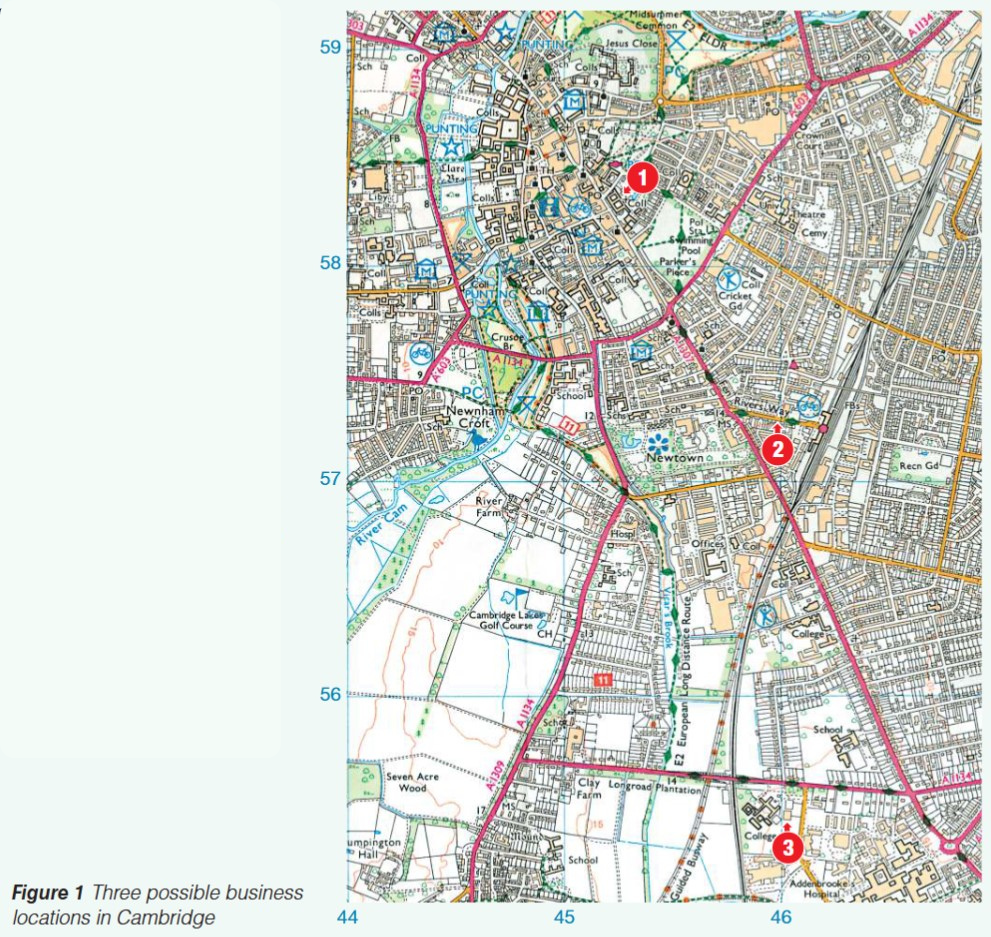
Factors to consider for business location
When evaluating possible sites for a business, multiple geographical and economic factors must be considered:
Land and property factors:
- Land availability: Is suitable land or property available at each location?
- Suitable buildings: Are there appropriate buildings, or would new construction be required?
- Cost of land and rent: What are the financial implications of each location?
Accessibility factors:
- Transport for workers: How easily can employees reach the location?
- Transport for customers: Can customers access the site conveniently?
- Transport for goods: If applicable, how easily can supplies be delivered and products distributed?
Market factors:
- Who will work there: Is there an appropriate labor force available locally?
- Who will buy the goods or services: Are there sufficient potential customers in the area?
Competition and cooperation:
- Competition or co-operation with other businesses: Will nearby businesses be competitors or could they attract more customers to the area?
Environmental factors:
- The surrounding environment: What is the character of the area? Is it attractive to customers and appropriate for the business type?
Note
Mnemonic for Business Location Factors: Use "LBRT WWCE" to remember the key considerations:
- Land, Buildings, Rent, Transport
- Workers, Who buys, Competition, Environment
Fieldwork activities for investigation
To investigate these various factors and gather evidence for your decision, you can use several fieldwork techniques:
- Interviews: Speak with local business owners, residents, and other stakeholders to gather their perspectives
- Transport surveys: Record traffic flows, public transport access, and parking availability
- Land use surveys: Map what types of activities and buildings currently exist in each location
- Pedestrian counts: Measure how many people pass through each potential location to assess potential customer numbers
By systematically investigating each factor at each potential location, you can build up an evidence base to support a well-reasoned decision about the best site for the business.
Important
Critical Success Factor
When conducting a decision-making exercise, you must investigate all potential locations using the same methods and criteria. This ensures a fair comparison and allows you to make evidence-based decisions rather than relying on assumptions or personal preferences.
Summary
Key Points to Remember:
- Economic fieldwork investigations must begin with a clear research question or hypothesis to provide focus and direction
- Choose fieldwork methods that are appropriate for your enquiry, such as employment questionnaires, job classification, or environmental impact assessments
- Combine primary data and secondary data for a comprehensive investigation – primary data is collected through your own fieldwork, while secondary data comes from existing sources like maps, statistics, and websites
- Decision-making exercises apply fieldwork skills to real scenarios, such as choosing business locations based on factors including land availability, transport access, potential customers, and environmental considerations
- Different fieldwork activities like interviews, surveys, and pedestrian counts can investigate different aspects of economic geography
- Job classification divides employment into four sectors: primary, secondary, tertiary, and quaternary – understanding these helps analyze the economic structure of an area