Economic Hubs in the UK (OCR GCSE Geography B (Geography for Enquiring Minds)): Revision Notes
📚Revision Notes
Economic Hubs in the UK
Understanding economic hubs
The UK's economy is not evenly distributed across the country. Instead, certain cities have emerged as economic hubs where economic growth is particularly strong. These cities act as engines for the wider UK economy, attracting businesses, skilled workers, and investment.
Note
Economic hubs are defined as cities where economic growth is strongest. These locations concentrate business activity, skilled employment, and investment, making them crucial to understanding the UK's economic geography.
Economists classify economic hubs into two main categories based on their growth characteristics. Understanding this distinction is important because it helps explain why different cities contribute to the UK economy in different ways. The two categories are:
- High growth cities – those experiencing rapid expansion now
- Dynamic growth cities – those with greatest potential for future growth
Some cities, like London, fall into both categories, making them especially significant to the UK's economic development.
High growth cities
High growth cities are defined by economists as those that have experienced the fastest growth since 2008. Manchester is a key example of this type of economic hub. These cities are characterized by rapid expansion across several measures.
The criteria that identify a high growth city include:
- Economic growth – A substantial increase in the number of businesses and jobs available in the city. This reflects growing economic activity and investment.
- Demographic growth – Population expansion, particularly among young, educated workers. This creates a workforce that can support continued economic development.
- Place growth – Physical expansion through the construction of new homes and office buildings. This infrastructure development accommodates the growing workforce and business activity.
Important
These three factors work together to create a cycle of growth. More businesses attract more workers, who in turn need more housing, which stimulates construction and further economic activity. Understanding this interconnection is crucial for explaining how high growth cities develop.
Example
High Growth City Example: Manchester
Since 2008, Manchester has demonstrated all three high growth criteria:
- Economic growth: Major expansion in financial services, media, and creative industries
- Demographic growth: Significant influx of young graduates and professionals
- Place growth: Extensive construction of new residential and commercial developments
This combination has established Manchester as one of the UK's leading high growth cities.
Dynamic growth cities
Dynamic growth cities are characterized by their potential for future expansion rather than just current rapid growth. Cambridge is a prime example of this category. These cities are positioned to drive innovation and high-value economic activity in the coming decades.
The criteria for dynamic growth cities focus on quality and potential:
- Knowledge-intensive business – Companies focused on innovation, research, and high-value services, with significant potential for expansion. These businesses drive long-term economic development.
- Highly skilled workforce – Workers educated to degree level or above, providing the expertise needed for advanced industries and innovation.
- New business formation – A strong entrepreneurial environment where new companies regularly form, with potential to grow into larger businesses. This creates jobs and drives innovation.
- Good transport connections – Excellent links by rail, road, and air, enabling businesses to connect with markets, suppliers, and talent across the UK and internationally.
Note
Dynamic growth cities are particularly valuable for the UK's future economy because they support high-value industries that can compete globally. Their focus on innovation and skilled employment creates sustainable long-term growth.
Example
Dynamic Growth City Example: Cambridge
Cambridge exemplifies all four dynamic growth criteria:
- Knowledge-intensive business: World-renowned technology cluster ("Silicon Fen") and biotechnology companies
- Highly skilled workforce: University graduates and research professionals
- New business formation: Strong start-up culture with regular formation of technology companies
- Good transport connections: M11 motorway to London, rail links, and proximity to airports
These characteristics position Cambridge for continued future economic expansion.
London as a leading economic hub
London occupies a unique position in the UK economy because it demonstrates both high growth and dynamic growth characteristics simultaneously. This makes it the country's most significant economic hub.
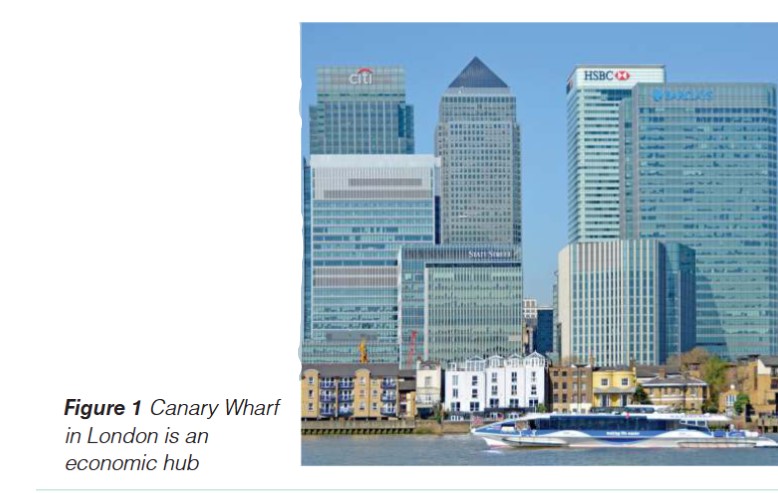
The city experiences rapid current growth (high growth criteria) while also possessing exceptional potential for future expansion (dynamic growth criteria). Areas like Canary Wharf exemplify London's role as a major financial and business center.
Note
Canary Wharf in London demonstrates the physical infrastructure of a major economic hub, with modern office towers housing financial services and knowledge-intensive businesses. The combination of commercial development and transport connections illustrates how London functions as both a high growth and dynamic growth city.
Growth corridors
Growth corridors are geographic zones that link major economic hubs, particularly connecting cities to London. These corridors are important because they extend economic benefits beyond traditional city boundaries, spreading growth across wider regions.
Growth corridors connect economic hubs through major transport routes. For example, the M11 motorway creates a growth corridor linking London and Cambridge. These corridors are influenced by transport infrastructure including motorways, rail lines, and other connections that enable the movement of workers, goods, and services between economic hubs.
Important
The significance of growth corridors lies in how they allow economic activity to spread outward from major hubs. Towns and smaller cities along these corridors benefit from their proximity to major economic centers, attracting businesses and workers who value access to multiple hubs.
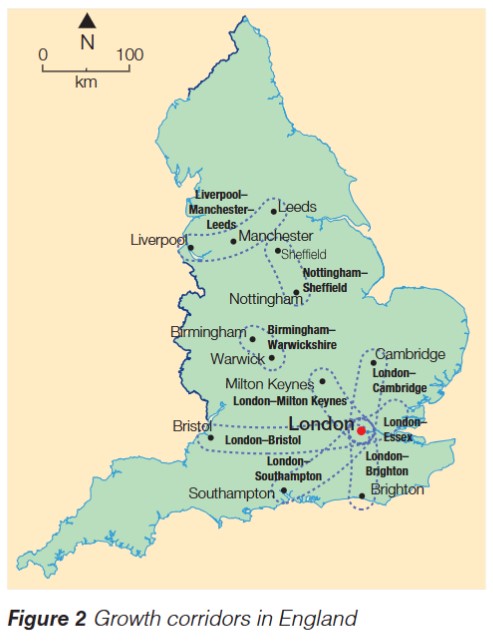
The map above shows how growth corridors connect major economic hubs across England. Notice how multiple corridors radiate from London, linking it to cities like Cambridge, Birmingham, Bristol, Southampton, and Brighton. Other corridors connect northern economic hubs such as Liverpool, Manchester, and Leeds, creating regional networks of economic activity.
These corridors demonstrate that the UK's economic geography is increasingly interconnected, with transport infrastructure playing a crucial role in shaping where economic growth occurs.
Exam guidance
When answering questions about economic hubs:
- Describe questions: Focus on specific characteristics (e.g., types of businesses, workforce qualifications, transport links) and use named examples
- Explain questions: Connect factors together to show cause and effect (e.g., how skilled workers attract knowledge-intensive businesses)
- Assess/evaluate questions: Consider both positive impacts and limitations, and discuss how growth corridors affect different areas unequally
Important
Always support your points with specific place examples such as Manchester, Cambridge, London, or named growth corridors. Examiners reward detailed geographical knowledge.
Remember!
Summary
Key Takeaways:
-
Economic hubs are cities where economic growth is strongest, and they drive the wider UK economy forward.
-
High growth cities (like Manchester) have experienced the fastest growth since 2008, showing expansion in economic activity, population, and physical development.
-
Dynamic growth cities (like Cambridge) have the greatest potential for future growth, characterized by knowledge-intensive businesses, highly skilled workers, entrepreneurship, and excellent transport links.
-
London is unique as it demonstrates both high growth and dynamic growth characteristics, making it the UK's most important economic hub.
-
Growth corridors link economic hubs through major transport routes (such as the M11 linking London and Cambridge), extending economic benefits beyond city boundaries and creating regional networks of growth.