Our Ageing Population (OCR GCSE Geography B (Geography for Enquiring Minds)): Revision Notes
📚Revision Notes
Our Ageing Population
Introduction
The UK is experiencing significant demographic change in the 21st century. One of the most important trends is the ageing of the population, driven by improvements in healthcare and living standards. Understanding this change is crucial for planning future services and resources.
Note
Population ageing affects nearly every aspect of society, from healthcare provision to economic policy. As geographers, we need to understand both the causes of this change and its wide-ranging impacts on communities and services.
Understanding life expectancy in the UK
Life expectancy refers to the average number of years a person is expected to live. In the UK, life expectancy has been steadily increasing due to better healthcare provision, improved living conditions, and medical advances.
Current statistics
The UK population is living considerably longer than previous generations. Key facts include:
- Average life expectancy for men is 79 years
- Average life expectancy for women is 83 years
- Over 3 million people in the UK are now aged 80 or above
These figures demonstrate a significant shift in the age structure of the UK population.
Healthy life expectancy
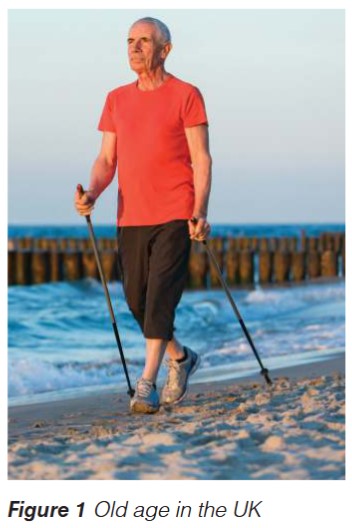
Healthy life expectancy is the age up to which people remain physically fit and active, able to live independently without significant health problems. This is an important measure because it shows not just how long people live, but how many of those years are spent in good health.
Note
Healthy life expectancy is often shorter than overall life expectancy. This means people may live for many years but require care and support during their final years. This distinction is crucial when planning healthcare and social services.
As people age, they typically move through three distinct stages:
- Active retirement - People remain fit, independent and able to pursue leisure activities
- Semi-independence - Some health issues emerge, requiring occasional support but maintaining overall independence
- Dependence - Significant health decline requiring regular or full-time care and support
The dependency ratio
Understanding the dependent population
The UK's dependent population consists of two groups:
- Children under 16 - Not yet of working age
- Older people over 65 - Past retirement age
These groups depend on the working population (aged 16-64) to generate wealth through taxation and economic activity.
Calculating the dependency ratio
The dependency ratio is a numerical measure showing the proportion of the dependent population compared to the working population.
Important
The Dependency Ratio Formula:
This ratio helps governments and planners understand the economic pressure on the working population. A higher ratio means more dependents per working person, creating greater economic strain.
Example
Worked Example: Calculating the Dependency Ratio
A town has the following population structure:
- Children under 16: 15,000
- Working population (16-64): 50,000
- Older people over 65: 10,000
Step 1: Add the dependent groups together
Step 2: Divide by the working population
Step 3: Multiply by 100 to express as a ratio
Answer: The dependency ratio is 50, meaning there are 50 dependents for every 100 working people.
Exam tip: Working with the dependency ratio
When asked to calculate or describe the dependency ratio:
- Show your working clearly
- Remember to multiply by 100 to express as a percentage
- Explain what the ratio means in context (e.g., "For every 100 working people, there are X dependents")
- Link to economic impacts when evaluating the ratio
Costs of an ageing population
Changes in the UK's age structure
While the number of children in the UK has fallen, the number of older people has increased substantially. This creates an ageing population where a growing proportion of residents are elderly.
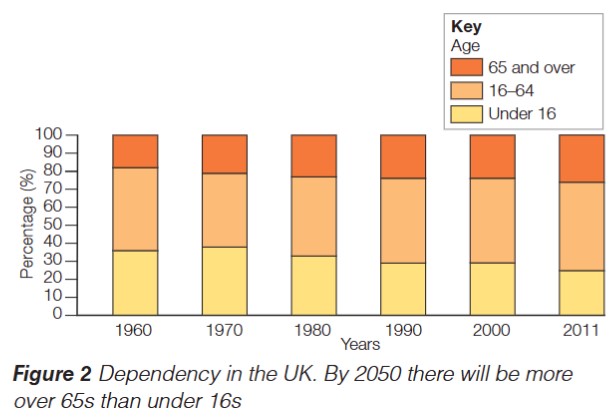
Figure 2 clearly shows the changing balance between age groups from 1960 to 2011. The proportion of people aged 65 and over (shown in dark orange) has grown significantly, while the proportion of under 16s (pale yellow) has declined. Projections suggest that by 2050, there will be more people over 65 than under 16 in the UK.
Economic and social costs
An ageing population creates substantial costs for both government and families:
Government costs:
- Pensions and benefits - More people claiming state pensions and old age benefits
- NHS spending - Healthcare services spend significantly more on elderly patients who typically require more medical treatment
- Social care - Funding for care homes, home care services, and support for the elderly
- Reduced revenue - Fewer working-age people means less income tax collected
Family costs:
- Lost earnings - Family members may reduce working hours or leave employment to care for elderly relatives
- Care expenses - Families may need to contribute to care home fees or home adaptations
- Emotional strain - Caring responsibilities create stress alongside financial pressure
Important
Service implications:
Money spent on elderly care means less available for other services such as education, transport, or defence. This creates difficult choices for government budget allocation. Understanding these trade-offs is essential when evaluating the impacts of an ageing population.
Exam tip: Explaining costs
When explaining costs of an ageing population, use the SEE structure:
- State the cost (e.g., increased NHS spending)
- Explain why it occurs (e.g., elderly people require more healthcare)
- Expand the impact (e.g., this means less money for other services)
Remember!
Summary
Key Points to Remember:
-
Life expectancy in the UK is increasing: Men average 79 years, women 83 years, with over 3 million people now aged 80+
-
The dependency ratio shows the proportion of dependents (under 16 and over 65) compared to the working population (16-64) and is calculated using:
-
The UK has an ageing population: The proportion of elderly people is growing while the proportion of children is falling
-
Costs are significant: Increased spending on pensions, NHS, and social care places pressure on government budgets and family finances
-
Healthy life expectancy matters: Not just living longer, but remaining fit and independent through stages of active retirement, semi-independence, and eventual dependence