The UK’s Changing Economy (OCR GCSE Geography B (Geography for Enquiring Minds)): Revision Notes
📚Revision Notes
The UK's Changing Economy
Introduction to economic change
The UK economy has experienced dramatic transformation over the past two centuries. Workers today are employed in very different sectors compared to their counterparts in previous centuries. Understanding these changes is essential for explaining how the UK has developed into a modern, post-industrial economy.
Note
Economic change doesn't happen in isolation. The shift between employment sectors reflects broader changes in technology, society, and global trade patterns. Understanding these connections helps explain both historical development and current economic challenges.
Understanding economic sectors
The economy is divided into four main employment sectors, each representing different types of work:
Primary sector: This involves extracting raw materials directly from the earth or sea. Activities include farming, fishing, forestry, and mining. Workers in this sector produce the basic resources needed by other industries.
Secondary sector: This sector focuses on manufacturing and construction. Workers transform raw materials into finished products. Examples include factory production, engineering, and building.
Tertiary sector: This is the service sector, providing services rather than physical goods. It includes retail, education, healthcare, tourism, banking, and entertainment. Workers deliver services directly to consumers or businesses.
Quaternary sector: This is the newest sector, emerging in the late 20th century. It involves knowledge-based activities and research. Workers in this sector include scientists, IT professionals, consultants, and researchers developing new technologies and ideas.
Note
Sector Interdependence
These sectors don't operate independently. The primary sector provides raw materials for secondary manufacturing, the tertiary sector services both primary and secondary industries, and the quaternary sector drives innovation across all other sectors. This interconnection means changes in one sector inevitably affect the others.
Historical changes in UK employment
The UK has passed through three distinct economic periods, each characterized by different employment patterns:
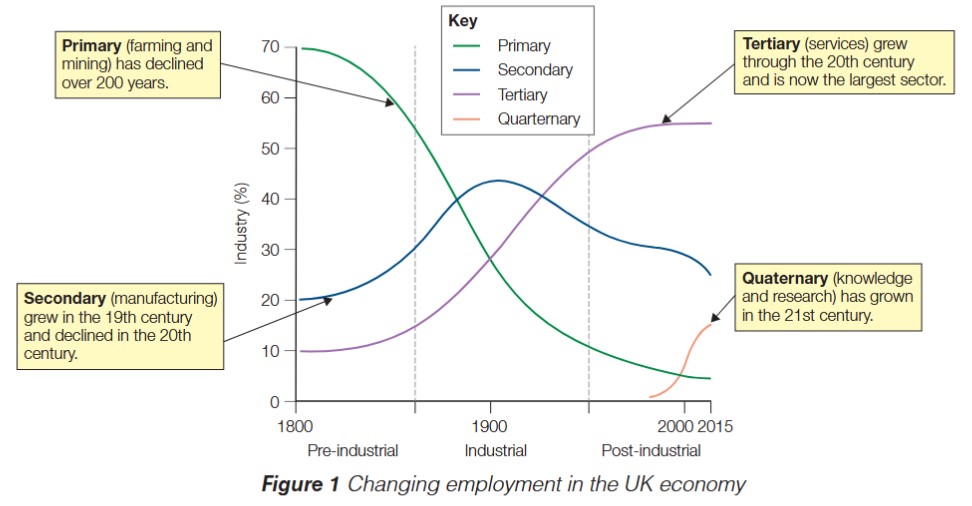
Pre-industrial period (before 1800)
In 1800, the UK economy was dominated by the primary sector. Approximately 70% of workers were employed in farming and mining. This reflected a largely agricultural society where most people worked on the land to produce food and extract basic resources.
Industrial period (1800-1900)
During the 19th century, the UK underwent rapid industrialization. The secondary sector grew dramatically as factories and manufacturing expanded. By 1900, manufacturing employment had increased significantly, rising to around 40-45% of the workforce. The primary sector began its long decline as mechanization reduced the need for agricultural workers and people moved from rural areas to industrial towns and cities.
Important
The Industrial Revolution's Impact
The shift from primary to secondary sector dominance wasn't gradual—it was revolutionary. This period saw massive social upheaval as rural populations migrated to urban industrial centers, fundamentally changing where and how people lived and worked. Understanding this dramatic transition helps explain many modern regional economic differences.
Post-industrial period (1900-present)
From 1900 onwards, the tertiary sector began its steady growth. Services expanded throughout the 20th century, eventually becoming the largest employment sector. By 2015, approximately 55% of workers were employed in the tertiary sector.
Meanwhile, the secondary sector peaked around 1900 and then declined throughout the 20th century. This process, known as deindustrialization, saw manufacturing employment fall as factories closed and production moved overseas. By 2015, secondary sector employment had dropped to around 25-30%.
Note
Why Did Deindustrialization Occur?
Several factors drove the decline of UK manufacturing: cheaper production costs overseas (particularly in Asia), automation reducing labor needs, exhaustion of natural resources like coal, and global competition. Many UK factories couldn't compete with lower-cost foreign producers, leading to widespread closures particularly from the 1970s onwards.
The primary sector continued its decline, falling to just 5% of employment by 2015. Modern farming requires fewer workers due to mechanization, while many mines have closed as resources became exhausted or uneconomical to extract.
The quaternary sector emerged in the late 20th and early 21st centuries. Although still relatively small, it has grown rapidly as the UK economy has become increasingly knowledge-based and technology-focused.
The UK as a post-industrial economy
The UK is now classified as a post-industrial economy. This term describes an economy where the majority of workers are employed in the service sector (tertiary) rather than manufacturing (secondary) or agriculture (primary). In a post-industrial economy, wealth is generated primarily through services, knowledge, and information rather than producing physical goods.
Key characteristics of the UK's post-industrial economy include:
- Service sector dominance (over 50% employment)
- Declining manufacturing base
- Growth in knowledge-based industries
- Minimal agricultural employment
- Increasing importance of technology and research
Note
What Does This Mean for Workers?
In a post-industrial economy, the skills workers need have changed dramatically. Instead of manual manufacturing skills, employers increasingly demand qualifications in services, technology, and knowledge work. This shift has created challenges for workers in declining manufacturing regions who may lack the education or training needed for new service sector jobs.
Unemployment in the UK
While more people are employed in the UK than ever before, unemployment remains a significant issue. Unemployment refers to people who are able and willing to work but cannot find jobs.
Important
Why Unemployment Matters
Unemployment represents more than just economic statistics—it affects individuals, families, and entire communities. High unemployment leads to reduced living standards, social problems, and wasted human potential. Regional variations in unemployment contribute to economic inequality across the UK.
Regional variations in unemployment
Unemployment rates vary considerably across different regions of the UK. This variation reflects the uneven impact of economic change, particularly deindustrialization.
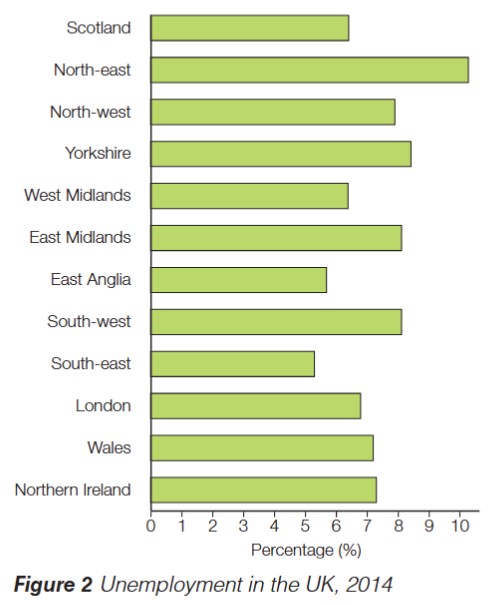
In 2014, unemployment rates showed clear regional patterns:
Highest unemployment regions:
- North-east England experienced the highest unemployment at approximately 10%
- North-west England had around 8% unemployment
- These regions were historically dependent on heavy manufacturing industries such as shipbuilding, steel production, and coal mining
Lowest unemployment regions:
- South-east England had approximately 5% unemployment
- East Anglia showed similar low rates around 5-6%
- These regions have more diverse economies with strong service sectors
Other notable patterns:
- Scotland, Wales, and Northern Ireland all experienced unemployment rates between 6-8%
- London, despite being a major economic center, had around 6-7% unemployment
The link between deindustrialization and unemployment
The highest unemployment levels are found in regions that once relied heavily on manufacturing industries. As factories closed during deindustrialization, many workers lost their jobs. These former industrial regions often struggled to replace manufacturing jobs with equivalent opportunities in the service sector. Workers with manufacturing skills sometimes found it difficult to transition to service sector employment, and new service industries didn't always locate in the same areas as the old factories.
Regions with more diverse economies, particularly those with strong tertiary sectors, have generally experienced lower unemployment. The South-east, for example, benefits from London's financial services, technology sector, and diverse service economy.
Note
The Geography of Economic Change
The regional unemployment patterns reflect economic geography. Former industrial regions in the North and Midlands face structural unemployment—their traditional industries have disappeared, and replacement industries have concentrated elsewhere, particularly in London and the South-east. This contributes to the "North-South divide" in UK prosperity.
Summary
Key Points to Remember:
-
The UK economy has four sectors: primary (farming, mining), secondary (manufacturing), tertiary (services), and quaternary (knowledge, research)
-
The UK has transformed from a pre-industrial economy (primary sector dominant in 1800) through an industrial economy (secondary sector peak around 1900) to a post-industrial economy (tertiary sector dominant by 2015)
-
In a post-industrial economy, most people work in services rather than manufacturing or agriculture
-
Unemployment rates vary by region, with former manufacturing areas experiencing the highest levels (North-east ~10%) and service-based regions the lowest (South-east ~5%)
-
Deindustrialization (the decline of manufacturing) has contributed to higher unemployment in regions that previously relied on secondary sector industries