The UK’s Global Role (OCR GCSE Geography B (Geography for Enquiring Minds)): Revision Notes
📚Revision Notes
The UK's Global Role
Introduction
The United Kingdom's position on the world stage has changed significantly over the past century. Once the centre of a vast global empire, the UK now maintains its international influence through membership of key international organizations and diplomatic relationships. Understanding this transition helps explain the UK's current role in global affairs.
The British Empire and Commonwealth
The British Empire
At its peak, the British Empire represented one of history's largest empires. The Empire historically controlled approximately one-third of the world's land surface, earning it the nickname "the Empire on which the Sun never sets." This phrase reflected how the Empire spanned so many time zones that it was always daytime somewhere within British-controlled territories.
Britain established colonial rule over these territories primarily to extract valuable resources and raw materials. These resources supported British economic growth and industrial development during the 18th and 19th centuries.
Important
The Complex Legacy of Empire
The Empire created a complex legacy with very different impacts:
- Benefits for Britain: Economic and strategic advantages including access to raw materials, new markets for British goods, and naval bases around the world
- Costs for colonized peoples: Loss of political autonomy, cultural suppression, and economic exploitation
This contrast is essential for understanding why decolonization movements emerged in the 20th century.
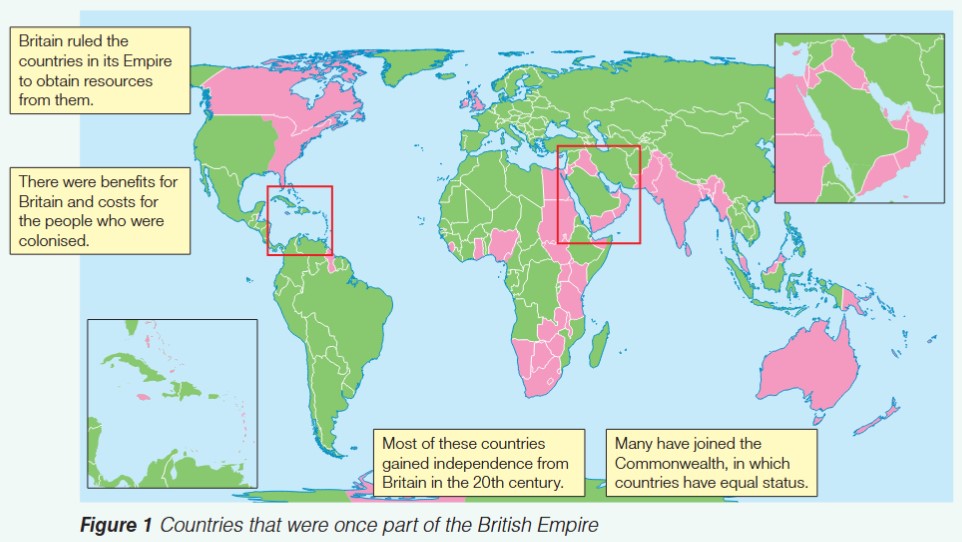
From Empire to Commonwealth
During the 20th century, most countries within the British Empire gained their independence through decolonization movements. Former colonies sought self-governance and the right to control their own resources and futures. This process fundamentally transformed Britain's global relationships.
Many of these newly independent nations chose to maintain connections with Britain through the Commonwealth. The Commonwealth is a voluntary organization that brings together 53 nations, most of which were formerly part of the British Empire. Crucially, the Commonwealth operates on the principle of equal status among all member countries—Britain holds no special authority over other members. This represents a fundamental shift from the hierarchical structure of the Empire to a more equitable international partnership.
Note
Exam tip: When discussing the transition from Empire to Commonwealth, explain both the causes (independence movements, changing attitudes toward colonialism) and the outcomes (formation of voluntary association with equal status).
The UK's membership of international organizations
The UK maintains its global influence through active participation in major international organizations. These memberships allow Britain to shape international policy, contribute to global security, and maintain diplomatic relationships worldwide.
United Nations (UN)
The United Nations includes 193 member countries and serves as the world's primary forum for international cooperation on peace, security, and development issues. The UK holds a particularly influential position within the UN as one of five permanent members of the UN Security Council.
The Security Council has primary responsibility for maintaining international peace and security. Its five permanent members—the United Kingdom, United States, Russia, China, and France—each hold veto power over Security Council resolutions. This permanent seat gives the UK significant influence over global security decisions and international interventions.
Note
Exam tip: Remember the five permanent members of the UN Security Council: UK, USA, Russia, China, and France. This is a key fact for exam questions about the UK's global influence.
North Atlantic Treaty Organization (NATO)
NATO functions as a military alliance of 28 countries across North America and Europe. The organization was originally established during the Cold War to provide collective defence—an attack on one member is considered an attack on all members.
The UK's NATO membership remains central to British defence policy and military strategy. Through NATO, the UK participates in joint military exercises, shares intelligence with allies, and contributes to international security operations. This membership reinforces Britain's position as a major military power with global reach.
European Union (EU)
The European Union represents both a political and economic union of 28 countries. EU members cooperate on trade policy, have freedom of movement between member states, and coordinate on many policy areas including environmental protection and workers' rights.
The UK joined what was then the European Economic Community in 1973. However, following a 2016 referendum, the UK voted to leave the EU. The UK departed from the EU in 2019 (though the formal exit process extended into 2020). This departure, commonly called Brexit, represented a significant change in the UK's relationship with its European neighbors and its approach to international cooperation.
Note
Exam tip: When discussing the EU, note that the UK was a member but left in 2019. This demonstrates how the UK's global relationships continue to evolve.
Key case study: The UK's changing global role
| Period | UK's Global Position | Key Features |
|---|---|---|
| 19th–early 20th century | Imperial power | Controlled ~1/3 of world's land surface; extracted resources from colonies; "Empire on which the Sun never sets" |
| Mid–late 20th century | Decolonization | Former colonies gained independence; Commonwealth formed as voluntary association; UK maintained influence through new partnerships |
| 21st century | International organization member | Permanent UN Security Council seat; NATO member; Former EU member (left 2019); Global influence through diplomacy rather than direct control |
Summary
Key Points to Remember
Major Historical Facts:
- The British Empire once controlled approximately one-third of the world's land surface and was known as "the Empire on which the Sun never sets"
- Britain ruled colonies primarily to obtain resources, creating benefits for Britain but imposing costs on colonized peoples
- Most colonies gained independence during the 20th century; many joined the Commonwealth, a voluntary association of 53 countries with equal status
Current Global Influence:
- The UK maintains global influence through membership in major international organizations
- The UK holds one of five permanent seats on the UN Security Council (alongside USA, Russia, China, and France), giving it significant influence over international security decisions
- The UK is a member of NATO, a 28-country military alliance
- The UK left the European Union in 2019 (Brexit)
Key Terms:
- British Empire: Historical colonial territories controlled by Britain
- Commonwealth: Voluntary association of 53 nations, mostly former British colonies, operating on equal status
- Decolonization: Process of colonies gaining independence from imperial control
- UN Security Council: UN body responsible for international peace and security; UK holds permanent seat with veto power
- NATO: Military alliance of 28 North American and European countries providing collective defence
- Brexit: The UK's departure from the European Union in 2019
Critical Process: The transformation from Empire to Commonwealth represents a shift from direct colonial control to voluntary international cooperation based on shared history and equal status among member nations.