Sustainable Birmingham (OCR GCSE Geography B (Geography for Enquiring Minds)): Revision Notes
📚Revision Notes
Sustainable Birmingham
Introduction: Birmingham's journey towards sustainability
In the past, Birmingham was a major global centre for manufacturing and industry. The city's industrial activities resulted in disproportionately high carbon emissions compared to other places. Today, Birmingham is transforming itself into a green city by adopting more sustainable practices.
Adopting sustainable practices creates benefits in three key areas: the economy, society, and the environment. These changes bring new opportunities for the city and improve quality of life for residents.
Note
A sustainable city is one that meets present needs without compromising the ability of future generations to meet their own needs. This requires careful balance between economic growth, social wellbeing, and environmental protection.
What does it mean to be a sustainable city?
Important
Definition: Sustainable City
A sustainable city meets the needs of people today without damaging the environment or reducing opportunities for future generations. This involves balancing three interconnected pillars:
- Economic growth - creating jobs and prosperity
- Social wellbeing - improving quality of life for residents
- Environmental protection - conserving resources and reducing pollution
Birmingham's sustainability opportunities
Birmingham's transformation to a more sustainable city creates opportunities in several areas:
Economic opportunities:
- Developing a new green economy that specialises in low-carbon technology
- Creating jobs in environmental industries and sustainable construction
- Reducing long-term costs through efficient resource use
Social opportunities:
- Improving urban planning to use fewer resources and create better spaces
- Helping people become fitter and healthier by encouraging more sustainable lifestyles
- Creating better-connected communities with improved public transport
Environmental opportunities:
- Reducing carbon emissions through energy-efficient buildings
- Conserving resources through recycling and reuse
- Protecting and enhancing biodiversity in urban areas
Note
The transition to sustainability isn't just about environmental benefits - it creates economic opportunities through new industries and social improvements through better quality of life.
Case study: The Library of Birmingham
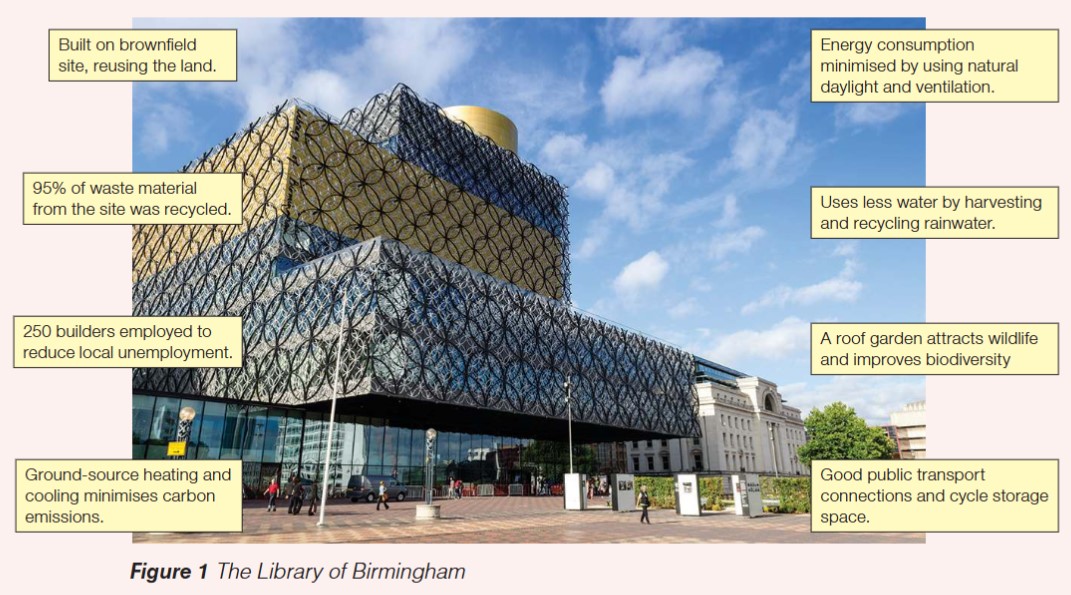
The Library of Birmingham, which opened in 2013, serves as a flagship example of sustainable development in the city. This modern building demonstrates how sustainability principles can be applied across economic, social, and environmental dimensions.
Economic sustainability features
Example
Economic Benefits of the Library of Birmingham
The library project brought significant economic advantages to Birmingham:
Local employment:
- 250 builders were employed during construction
- Reduced local unemployment
- Kept money within the community
Brownfield redevelopment:
- Built on a brownfield site (previously developed land)
- Gave the site a new purpose rather than using valuable greenfield land
- More sustainable than developing on undeveloped land
Resource efficiency:
- 96% of waste material from construction was recycled
- Reduced costs and environmental impact
- Demonstrated circular economy principles
Social sustainability features
The library improves quality of life for Birmingham residents through careful planning and accessible design:
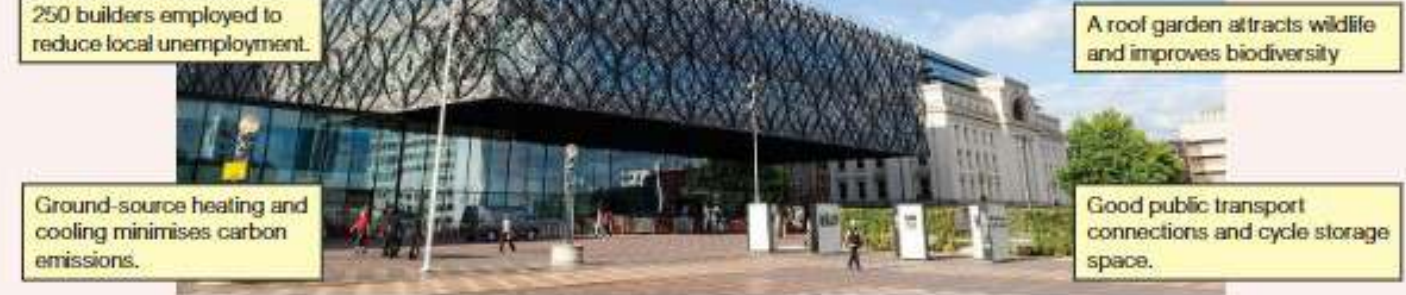
- Accessibility: Good public transport connections make the library easy to reach without a car
- Cycle storage: Dedicated facilities encourage healthy, low-carbon travel
- Community space: The building provides a valuable public facility that brings people together
Environmental sustainability features
The library incorporates numerous environmentally friendly features that significantly reduce its environmental impact:
Example
Environmental Features in Action
Energy efficiency:
- Natural daylight and ventilation minimise energy consumption for lighting and air conditioning
- Ground-source heating and cooling systems use the earth's stable underground temperature to heat and cool the building
- Result: Significantly reduced carbon emissions
Water conservation:
- Rainwater harvesting and recycling systems reduce water consumption
- Collected rainwater used for toilets and landscape irrigation
Biodiversity:
- A roof garden attracts wildlife and improves urban biodiversity
- Provides habitats for birds, insects, and plants
- Creates valuable green space in the urban environment
Note
How does ground-source heating and cooling work?
The temperature underground (about 2-3 metres deep) stays relatively constant throughout the year - around 10-15°C. Ground-source systems use pipes buried underground to transfer heat:
- In winter, they extract heat from the ground to warm the building
- In summer, they transfer heat from the building into the cooler ground
This is much more energy-efficient than conventional heating and air conditioning systems.
The four key themes of sustainability
Important
The Four Key Themes Framework
Urban sustainability can be understood through four main themes - remember ERTB:
E - Energy R - Resources T - Transport B - Biodiversity
These four themes provide a useful framework for assessing how sustainable a city or building is.
1. Energy
- Reducing energy consumption through efficient design
- Using renewable energy sources where possible
- Minimising carbon emissions from heating, cooling, and electricity use
2. Resources
- Recycling and reusing materials
- Reducing waste sent to landfill
- Using sustainable materials in construction
3. Transport
- Providing good public transport connections
- Encouraging cycling and walking
- Reducing reliance on private cars
4. Biodiversity
- Creating green spaces and wildlife habitats
- Supporting urban nature
- Protecting and enhancing local ecosystems
The three pillars of sustainability
Important
The Three Pillars of Sustainability
Sustainability initiatives must balance three interconnected pillars - remember ESE:
- Economic: Creating jobs, supporting businesses, and ensuring financial viability
- Social: Improving quality of life, health, and community wellbeing
- Environmental: Protecting natural resources, reducing pollution, and conserving biodiversity
All three pillars are equally important. A project that only focuses on environmental benefits while ignoring economic costs or social impacts is not truly sustainable.
The Library of Birmingham demonstrates how a single project can deliver benefits across all three pillars simultaneously. It created jobs (economic), provided community facilities (social), and reduced environmental impact (environmental).
Exam guidance
Note
Exam Command Words
When answering questions about sustainable cities, pay attention to the command word:
Describe questions require you to give characteristics or features:
- For Birmingham's Library, you could describe specific sustainable features like ground-source heating or rainwater harvesting
- Include specific facts and figures (e.g., 96% waste recycled, 250 builders employed)
Explain questions need you to give reasons why something happens:
- For example, explain why Birmingham is developing a green economy (to reduce carbon emissions, create jobs, and improve environmental quality)
- Use connectives like "because", "therefore", "this leads to"
Assess or evaluate questions require you to consider different viewpoints and make judgements:
- You might assess whether Birmingham's sustainability initiatives are sufficient to make it truly sustainable
- Consider advantages and disadvantages, then reach a balanced conclusion
Always support your answers with specific facts, figures, and place details from case studies like the Library of Birmingham.
Remember!
Summary
Key Points to Remember:
Birmingham's Transformation:
- Birmingham has transformed from a major manufacturing city with high carbon emissions into a green city focused on sustainability
- This transformation creates opportunities across economic, social, and environmental dimensions
The Library of Birmingham (opened 2013):
- Built on a brownfield site (previously developed land)
- 96% of construction waste was recycled
- 250 builders employed locally during construction
- Uses natural ventilation and daylight to minimise energy consumption
- Ground-source heating and cooling reduces carbon emissions
- Rainwater harvesting conserves water
- Roof gardens support biodiversity
Three Pillars of Sustainability (ESE):
- Economic: green economy, local jobs, reduced costs
- Social: better planning, healthier lifestyles, improved accessibility
- Environmental: reduced emissions, resource efficiency, biodiversity protection
Four Key Themes (ERTB):
- Energy - efficient use and renewable sources
- Resources - recycling and sustainable materials
- Transport - public transport, cycling, walking
- Biodiversity - green spaces and wildlife habitats
Core Concept: Sustainable development balances meeting today's needs with protecting opportunities for future generations across all three pillars.