Hostilities: the capture and death of Moctezuma, and the Spanish flight from the city on 1 July 1520 (OCR GCSE History B (Schools History Project)): Revision Notes
📚Revision Notes
Hostilities: the capture and death of Moctezuma, and the Spanish flight from the city on 1 July 1520
Note
As Cortés marched to Tenochtitlan, he observed internal hostilities and tension under Moctezuma's rule, and used it to his advantage. Cortés was able to establish an alliance with the people of Tlaxcala, who were at constant war with the capital.
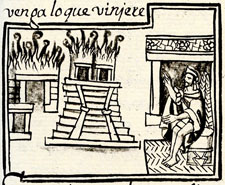
Image depicting the prediction of the burning of the Aztec temple prior to the conquest of the Spanish based in the Florentine Codex
Captive: With the evidence of great wealth, Cortės was planning to capture Moctezuma until reinforcements arrived. On November 14, 1519, his plans materialised when some Aztec natives attacked a Spanish garrison located on the coast. Cortės then accused Moctezuma of treason.
Moctezuma Style: Moctezuma agreed to be taken captive thinking he could tell his own side of the story if he voluntarily accompanying the Spaniards. He befriended Cortės and betrayed his nephew Cacama, lord of Texcoco, who was planning a plot against his captor. As per Cortės orders, more and more gold and silver were collected from vassal states.
Note
Spanish v. Spanish. In May 1520, Cortês and a few of his men left the city to attend a Spanish threat led by another conquistador Panfilo de Narvaez that was ordered by Governor Velazquez. Cortês was able to defeat Narvaez and returned to Tenochtitlan on June 24. In addition, Cortês found out that Moctezuma had had secret correspondence with Narvaez, which laid Moctezuma under suspicion.
Massacre of Toxcatl: While Cortês was dealing with Narvaez, Pedro de Alvarado heard of a plot against the Spanish. As a result, he ordered his men to attack Toxcatl during a religious festival, killing unarmed members of the nobility. The people of Tenochtitlan responded furiously and the Spanish barricade themselves inside the palace.
Note
Return of Cortes: Cortês returned to the city under siege. He ordered Moctezuma to reopen the marketplace to feed his starving men, but Moctezuma argued that nobody would listen to him as a captive. Instead, he referred Cortês to his brother Cuitlahuac who was an experienced warrior. Cuitlahuac was released, and he organised an attack instead of opening the market.
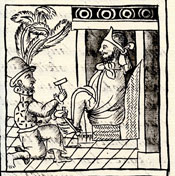
Florentine Codex depicting the Spanish shackle Moctezuma
Clavijerosolemn account on Moctezuma's funeral rites:
Cortés informed Cuitlahuatzin of Moctezuma's death through the offices of two high-ranking prisoners who had witnessed his end. He ordered six Mexican nobles accompanied by a group of priests who were also in prison to dispose of the royal corpse.
With no other way to restore order, Cortês forced Moctezuma to be hauled onto the roof and order the people to stop attacking the Spaniards. The enraged people of Tenochtitlan threw stones and spears, wounding Moctezuma. Opposing accounts suggest that Moctezuma died several days later because of the wounds, while others believe the Spaniards killed him.
Note
After the death of Moctezuma, Cortês planned to exit Tenochtitlan over the Tacuba causeway, but vigilant Mexica warriors spotted them fleeing. The Spanish called this fateful retreat as the Night of Sorrows or Night of Tears. The following events took place:
- Fierce Mexica warriors killed almost half of the conquistadors along with two of Moctezuma's children.
- Some Spanish were captured alive and sacrificed to the gods.
- All the treasures they seized from the empire were nearly gone.
- The Spanish were driven out of the city. Cortês and his surviving men retreated to Tlaxcala to rest, regroup, and prepare.