The Spanish in Tenochtitlan and the relationship between Cortés and Moctezuma (OCR GCSE History B (Schools History Project)): Revision Notes
📚Revision Notes
The Spanish in Tenochtitlan and the relationship between Cortés and Moctezuma
Note
On November 8, 1519, after besieging Cholula, Cortés and his men reached the Aztec capital of Tenochtitlan. According to Bernardino de Sahagún, Cortés was welcomed by Moctezuma II along with other chiefs. The conquistador was adorned personally by the Aztec emperor with feather-work, golden necklaces, and a garland of flowers.
In a number of Spanish accounts, Moctezuma pledged his loyalty to the king of Spain on his second meeting with Cortés. According to historian Diaz in his book The Conquest of New Spain (1963), Moctezuma said "As for your great King, I am in his debt and will give him of what I possess."
Historians suggest reasons for Moctezuma's relationship with Cortés:
Superstitious Belief: Even prior to Cortés arrival in Tenochtitlan, Moctezuma had been sending gifts and emissaries to negotiate. Moctezuma believed that Cortés was a god who would bring the downfall of the empire. Premonitions of comets and eclipses prior to the Spanish conquest weakened Moctezuma's leadership.
Fear of a trap: As Cortés and his men stayed in the city for months, they witnessed the grandeur and horrors of the Aztecs through lavish palaces and temples plus the ritual of sacrifice, which Cortés condemned as an evil practice.The city was surrounded by thousands of warriors, and the conquistadors began to fear a trap.
Note
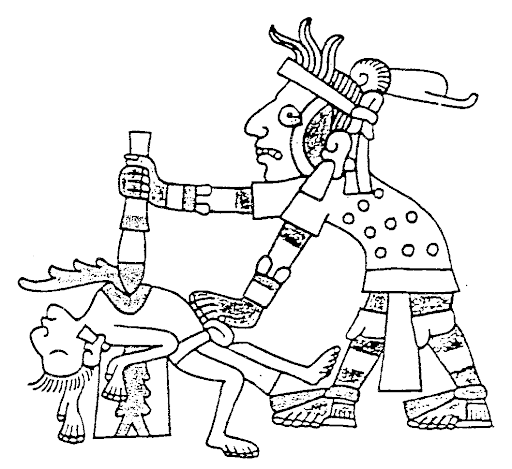
Spanish Revulsion at human sacrifice: As devout Catholic Christians, Cortés and his men believed that the Aztecs practice of human sacrifice was evil, as stated in his letter to Charles V. Some historians suggest that this revulsion at human sacrifice was purely in order to justify the Spanish invasion and conquest.
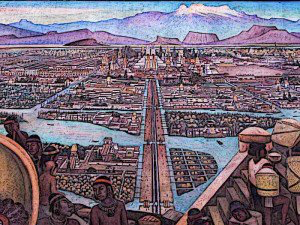
Depiction of the Aztec city Murales Rivera Market in Tlatelolco
Years prior to the arrival of the conquistadors, the Aztecs had heard of bad omens that showed the collapse of their civilisation. One of these omens that later came to be associated with the coming of Cortés was the belief that one of the idols they worshipped the most sent men from a distant land who would conquer and rule them. However, the time that these accounts of omens were written is still subject to debate. Others believed that they were written after the conquest in 1521 and writers were most likely under the guidance of Spanish priests.