Cortés: his expedition to Mexico and first encounter with the Aztecs, February 1519 to April 1519 (OCR GCSE History B (Schools History Project)): Revision Notes
📚Revision Notes
Cortés: his expedition to Mexico and first encounter with the Aztecs, February 1519 to April 1519
Note
Born in Medellin, Spain, Hernan Cortés led an expedition which overthrew the Aztec Empire and colonised Mexico under the Spanish Crown. In 1504, he sailed to Santo Domingo to seek fortune and settled in the town of Azúa where he worked as a notary for years.
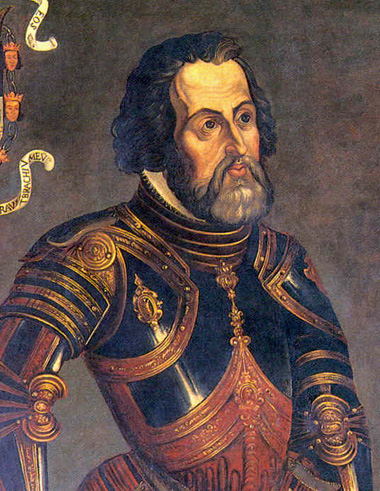
Image of Hernan Cortés
A few years after arriving in the New World, Hernan Cortés signed on for the conquest of Cuba under Velazquez. In 1514, the two developed a bitter relationship when Cortés decided to represent disgruntled settlers against Velazquez.
Soon after, they reconciled their differences and in 1518, Velazquez chose Cortés to lead an expedition to the mainland. Despite the orders, Cortés intended to conquer the land. Upon knowing the hidden agenda, Velazquez replaced Cortés. However, Cortés managed to sail immediately.
Among his goals was to observe the coastlines, make contact with the natives, and look for the missing Grijalva expedition.
Note
On November 18, 1518, Cortés set sail, leaving his properties and wife behind. Velazquez underestimated him and believed that he could punish him once he returned to Cuba.
On March 24, 1519, Cortés won his battle against the Maya of Potochan. As a gift, Cortés received gifts and a slave woman named Malinche, who would later become his interpreter.
Note
In April, Cortés reached San Juan de Ulua. By July 26, he sent a treasure ship and a letter to Spain. As the ship stopped in Cuba, colonial administrators and colonists heard about the wealth he discovered in Mexico.
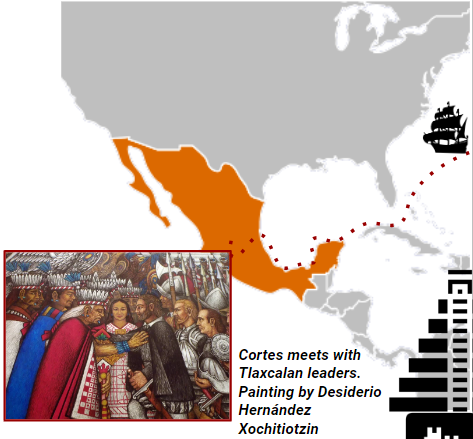
Note
Learning about the alliance and plan of rebellion against the Aztec emperor, more emissaries bearing gifts were sent. Lavish gold and cloth as gifts was an attempt by the Aztecs to dissuade Cortés and his men from marching to Tenochtitlan.
Foundation of Veracruz
In April 1519, Cortés and his crew landed in present-day Veracruz. They were welcomed by emissaries sent by Moctezuma II, the Aztec emperor. Both parties exchanged gifts.
Cortés named the settlement La Villa Rica de la Vera Cruz, or simply Vera Cruz, which meant the True Cross.
Cortés reached an indigenous settlement called Cempoala. Cempoala was among the subjugated and tributary cities of the Aztec Empire. The Totonacs were unhappy being ruled by Montezuma II and so they opted to make an alliance with Cortés.
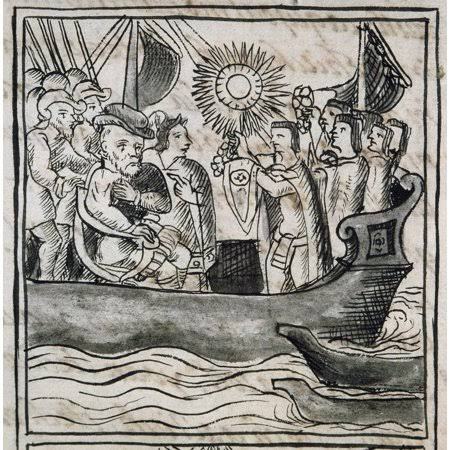
Image depicting the arrival of Cortés at Veracruz in 1519, Codex Florentino
The cacique of Cempoala advised him to take the eastern road passing the town of Zacatula and Tlaxcala. With the help of the natives, Cortés and his men found the best yet hardest route to the capital city.