The nature and impact of Spanish rule (OCR GCSE History B (Schools History Project)): Revision Notes
📚Revision Notes
The nature and impact of Spanish rule
Note
Upon Spanish conquest of the Aztec capital, Cortés oversaw the establishment of Mexico City. Over time, the pre-Columbian population in Mesoamerica changed along with their culture, wealth, and identity. The merging of Mexican-Spanish heritage produced a new society seen in the modern-day nation of Mexico.
Historical Context of Spanish Exploration and Conquest
Christopher Columbus lands in Hispaniola.
Columbus founded Santo Domingo, the last of the first three Spanish settlements in the Americas.
Hernan Cortés captured Tenochtitlan.
Cortés conquered the Aztec Empire and established Mexico City.
1492
Christopher Columbus lands in Hispaniola.
1494
Pope Alexander VI issued the Treaty of Tordesillas dividing newly discovered lands between Portugal and Spain.
1498
Columbus founded Santo Domingo, the last of the first three Spanish settlements in the Americas.
1501
The encomienda system was introduced to Spanish colonies and natives in Hispaniola.
1519
Hernan Cortés captured Tenochtitlan.
Magellan led an expedition to circumnavigate the globe by sailing the Pacific Ocean.
1521
Cortés conquered the Aztec Empire and established Mexico City.
1532
Francisco Pizarro invaded the Inca Empire and started the conquest of Peru.
Impact of the Conquest
Note
Spread of Diseases According to historians, smallpox was introduced to Central Mexico between April and May 1520 during the Narvaez expedition. It spread to the mainland, reaching Tenochtitlan.
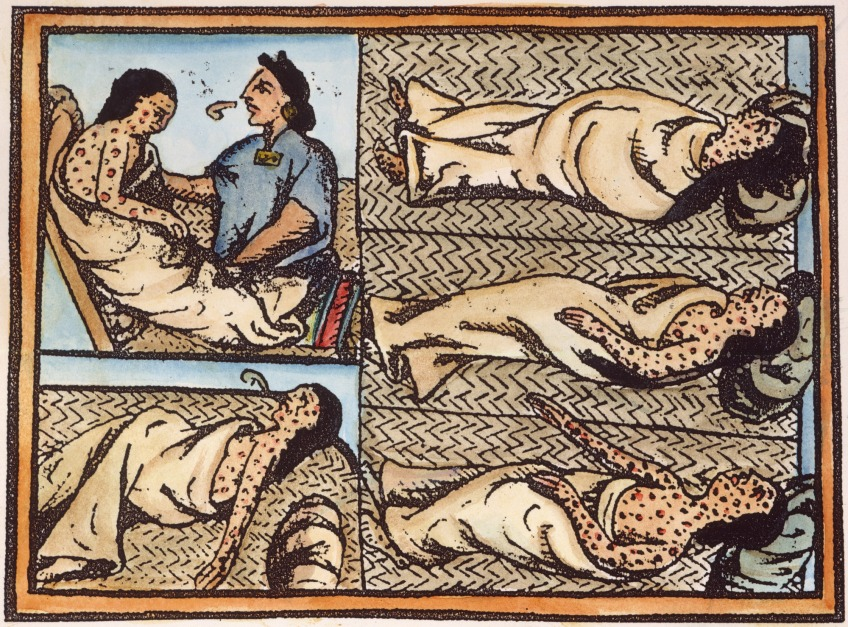
Illustrated panel from the Florentine Codex by Bernardino de Sahagún, a 16th-century Spanish Franciscan missionary, showing Mesoamerican infected with smallpox
"many chieftains were dying and they wished that by my hand and with your approval and mine others be put in their place."
From the letter of Cortés to King Charles V on May 15, 1522
Many historians suggest that about 90% of the Mesoamerican native population died of diseases brought by European explorers.
During Cortés' conquest of Tenochtitlan, the spread of smallpox among the Aztecs helped him defeat the city. In addition to smallpox, other European diseases included influenza, measles, malaria, chickenpox, and yellow fever to which the native population had no immunity.
Note
The Aztecs were susceptible to the worst effects of smallpox as they lacked immunity from such a disease. Smallpox had the largest impact on the native population of Mesoamerica, especially the Aztecs between September and November 1520.
Note
Deterioration of Aztec Culture and Rise of Spanish Influence The Nahuatl spoken language died naturally. The ritual of human sacrifice was prohibited. The belief that rulers were descendants of the gods, thus possessing supreme power mixed with predictions and religion, also died out.
After the conquest, the Aztec native population dramatically decreased due to diseases and warfare. Then, many Spanish settled in Central Mexico after the success of Cortés in changing the landscape of Aztec culture. The Spanish language spread, while Christianity excluded Aztec gods and deities from the local culture. Moreover, pre-Columbian codices were destroyed.
Note
Introduction of the encomienda system In 1509, Cortés himself received encomiendas in Hispaniola, followed by another in Cuba. By the time he conquered the Aztecs, Cortés and other conquistadors were rewarded with land or encomiendas. Those who were entrusted with land were called encomenderos.
Spanish encomenderos used the natives to provide labour, pay taxes, or tributes in the form of crops, animals, gold and silver. In addition to the Spanish, a few members of the indigenous elite became encomenderos who were obliged to pay taxes to the crown.
Encomienda was a Spanish institution imposed on the New World, which established obligations between land, grantee, and people tilting.
The reorganisation of the tribute system
Among the effects of the encomienda system was the spread of Christianity and control of the Church over the natives. Moreover, the system made allowance for abuses. A number of scholars, including Fray Bartolome de Las Casas, considered the system as a brutal form of slavery. In addition to forced labour, the natives became subjects of genocide and sexual abuse of women. In 1542, under the New Laws, the system of encomienda was gradually abolished in Spanish colonies in the Americas. However, by the mid-16th century, the system was replaced by repartimiento.
In 1524, Charles I of Spain created the Council of the Indies. Initially, New Spain was ruled by Cortés. In the following years, an Audiencia and the viceroyalty were established to govern the Spanish colonies in America.
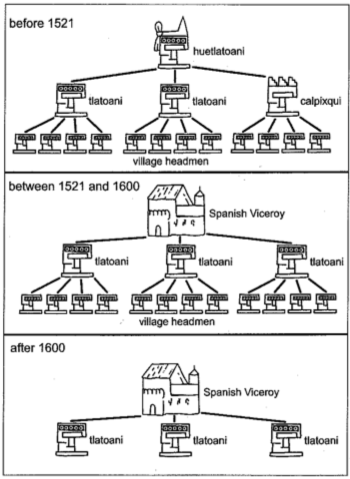
Illustration showing the changes in Central Mexico's political structure
Note
CHANGE IN POLITICAL STRUCTURE In 1521, the Spanish preserved parts of the Aztec political structure. They only replaced the highest rulers with themselves instead of indigenous Aztecs.
Note
At the height of the Aztecs in 1519, the empire was organised into about 450 altepetl categorised into 55 provinces. Each conquered land became a tributary province, which was economically useful to the Aztecs. Tributes paid were recorded in codices, like the Codex Mendoza. When the Spanish conquered Tenochtitlan, Cortes ruled the Aztecs for three years.
Commissioned by Viceroy Antonio de Mendoza for King Charles V of Spain, Codex Mendoza recorded the earlier practices and tribute demands of the conquered Aztecs. Usually, tributary items pictured in codices included a large numbers of textiles, precious stones, and featherwork. At the time of Spanish rule, conquistadors favoured precious materials like gold and silver as tribute.
At the time of Cortés rule, the people of Tepetlaoxtoc were required to pay annual tribute of gold (40 pieces), goldwork, textiles, and large quantities of crops, specifically maize.
The encomenderos themselves did not escape taxation from the Spanish Crown: imperial tax was also paid annually.
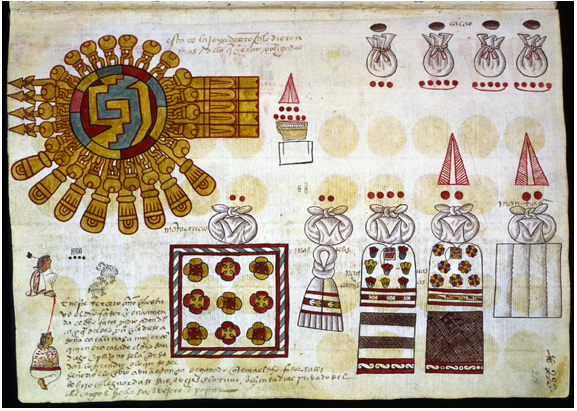
Image showing Codex Tepetlaoxtoc, 1554
The people of Tepetlaoxtoc who were subjects of the former Aztec Empire were required to pay tribute by the encomenderos.