Britain since c.1900 (OCR GCSE History A (Explaining the Modern World)): Revision Notes
📚Revision Notes
Changes in punishment
Note
During the 20th century, more and more alternatives to prison became available. Some of these arose as a result of new technology, such as electronic tagging. Some of them were a result of the fact that the prison population had increased dramatically and there was simply no room in prison for everyone found guilty of a crime.
Additionally, changing attitudes about the purpose of punishments have also led to a focus on what the offender can do for society, rather than the individual simply being punished by being gaoled.
Open, or Category D, prisons came into use after 1934. They gave non-violent offenders more freedom, allowing them to leave the prison, and were often used for first-time offenders.
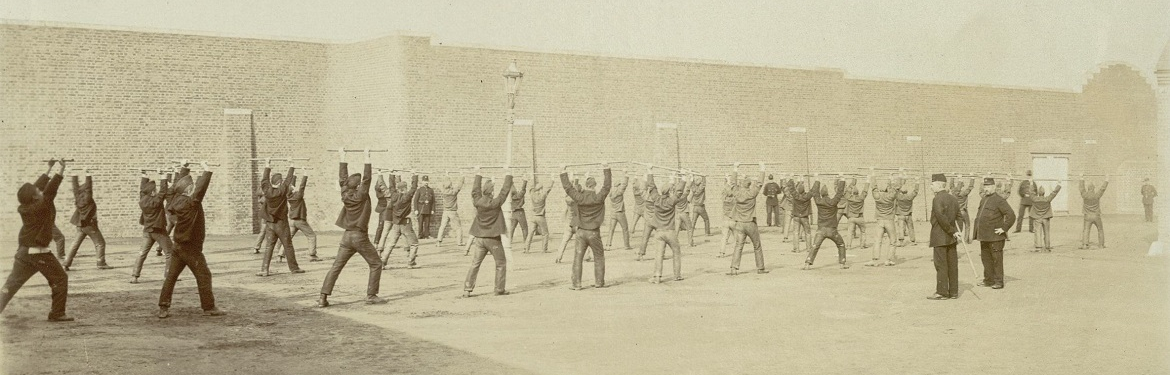
1902 juvenile detention centre
Prisoners who were nearing the end of their sentences were given the opportunity to go on day release, to begin to get used to the world outside of prison.
In 1902, the first borstal was opened for young prisoners. Up until this point, young people in prisons had been treated in the same way as adults. The borstals were run as strict schools with an emphasis on sport and physical activity.
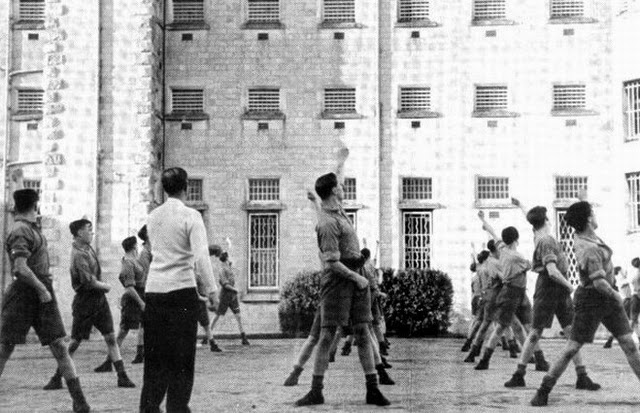
Young offenders in a borstal in the 1940s
- Solitary confinement was ended in 1922, allowing the majority of prisoners to associate with each other.
- Prisoners were given more opportunities in jail to prepare for a life away from crime when they were released. This led to educational programmes and the chance to learn a trade.
- A focus on rehabilitation rather than deterrence or retribution has led to a change in how prisoners are treated in jail. The Criminal Justice Act of 1948 banned hard labour and flogging.
- Some people who are found guilty of a crime are given a suspended sentence. If they do not reoffend during the term of the sentence, they will avoid prison.
- An offender may be given a Community Service Order as an alternative to a prison sentence, meaning they need to complete a programme of unpaid work designed to give something back to the community.
- A prisoner could be paroled, which means they are released part-way through their sentence. They will return to prison if they break the terms of their parole

An electronic tag in operation
Note
Today, modern prisons are categorised into four types, all depending on the severity of the crime, age, risk of escape and possible threat to the public.
| Category | Type of prison | Type of prisoner |
|---|---|---|
| A | Most secure, closed prison | Violent and dangerous to the public |
| B | Traditional, closed prison | Serious crimes but do not require maximum security |
| C | Traditional, closed prison | Not likely to escape but not appropriate for open prisons |
| D | Open prison | Minor crimes, low risk and first-time offenders |
Note
By the second half of the twentieth century, there was a debate over whether or not the death penalty should be abolished. Many people wanted to see it remain as the ultimate sanction for criminal behaviour.
Note
Arguments in favour of capital punishment
- It served as a powerful deterrent to possible criminals and serious crimes, including murder, which some feared would increase if the death penalty was abolished.
- Imprisoning a person for life was a huge financial burden on the state.
- It was possible that someone found guilty of murder would be released and would go on to kill again. Executing murderers would, therefore, protect society.
- Taking an innocent life was such a terrible act that only executing the guilty person was a fair punishment, allowing the life of the victim to be avenged and bringing closure to the victim's loved ones.
Note
Arguments against capital punishment
- Innocent people might be found guilty of murder and there would be no future opportunity to make amends for these mistakes if the person was executed.
- There had been no increase in the murder rate in countries that had already abolished the death penalty.
- There was no proof that the death penalty deterred people from committing murder.
- The death penalty went against the idea of the sanctity of all human life and meant there was no chance of rehabilitation for the criminal.
By the time the Second World War ended in 1945, the death penalty was used very infrequently. After the end of the Bloody Code in around 1840, there were only 15 executions per year on average (all for murder).
By 1957, a person could only be sentenced to death for certain crimes:
- Murder of a police officer or prison officer
- Murder by shooting or explosion
- Murder whilst resisting arrest
- Murder while carrying out a theft
- Murder of more than one person.
Four people on average faced the death penalty each year.
To many people, it seemed as though the law no longer served a purpose. It was hardly used and it also seemed unfair. The impact of the Second World War also made people question the death penalty. Britain had fought the evils of Nazism and did not want to use methods similar to that regime. Britain had also signed the United Nations Declaration of Human Rights, which stated that 'everyone has a right to life.' All of these factors put pressure on the government to abolish the death penalty.
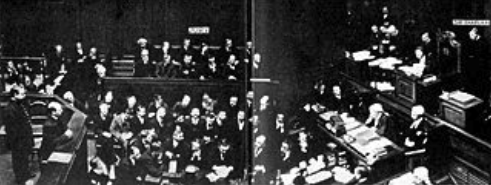
The only known photograph of the death sentence being given in an English court, to Frederick Seddon in 1912.
In the 1950s, there were several high profile cases that contributed to public opinion turning against capital punishment. Timothy Evans was hanged in 1950 for the murder of his wife. He was pardoned in 1966 when it became clear that the real killer was the Evans's landlord, the serial killer John Christie.
He had killed Mrs. Evans and had told Evans that she had died after a botched abortion. Evans blamed himself and so confessed to being responsible for her death.
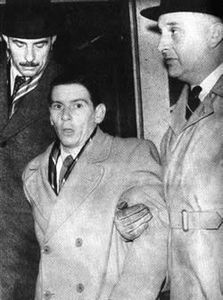
Timothy Evans being escorted by police officers after being charged with murder
Ruth Ellis was hanged in 1956 after shooting her lover dead. Her guilt was not in question but it was well known that the dead man, David Blakely, was both physically and emotionally abusive towards her, making a murder conviction and the death penalty seem too harsh to many. Ruth Ellis was the last woman to be hanged for murder in Britain.
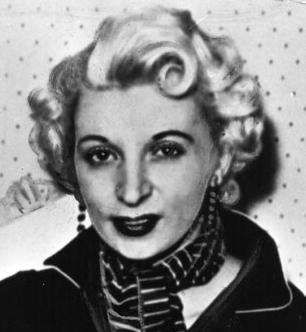
Ruth Ellis, hanged for murder in 1955
Note
Glossary of Terms:
CYBERCRIME
Type of crimes committed through computer technology.
BORSTAL
A prison for young offenders introduced in 1902.
TERRORISM
The use of violent means, usually involving attacks on civilians, to generate terror and achieve political or ideological aims.
DEATH PENALTY
A capital punishment through execution.
OPEN PRISON
Also known as Category D prison which allowed more freedom to first-time offenders. It was introduced in 1934.
NEIGHBOURHOOD WATCH
A scheme which encourages ordinary people to be on the lookout for crime and to report anything suspicious.
Note
Assessment 1: ANALYSIS Given your understanding of the historical context and examination of the source, answer the questions provided.
SOURCE A
"We have an awful lot of children and teenagers who are living in deprivation and whatever way they can find to earn money and support households, legally and illegally, they are doing it. That includes drugs and knives," — Ashley Hackett, chief executive of Blackpool Football Club Community Trust .
- What is the cause of crime?
- Discuss the implication of the statement on the following:
- Youth
- Violent crime
- Poverty
Note
Assessment 2: CASE STUDY Choose and substantially discuss a 20th-century crime using the guidelines provided.
GUIDELINES
- Nature of crime
- Causes of crime
- Method of combating the crime
- Form of punishment
- Crime rate
Note
Assessment 3: DISCUSSION Given your understanding of the historical context, substantially answer the questions provided.
- How effective was death penalty as a method of combating crimes and a form of punishment?
- Do you agree/disagree to its abolition? Justify your answer.
- What are your thoughts on juvenile justice today?