Large-scale migration from Ireland and the growth of Irish communities (OCR GCSE History A (Explaining the Modern World)): Revision Notes
📚Revision Notes
Large-scale migration from Ireland and the growth of Irish communities
Note
18th Century In the 18th century, Irish people started to leave Ireland because of religious and political discrimination against the established Church of England.
Note
19th Century In the 19th century, with the Great Revolution and the Great Famine, many more people left for America and Canada to escape catastrophe.
The Irish migrants had a lot of difficulty in settling in the cities of America, and the majority became inmates in prisons, hospitals and poorhouses. Coming from a more traditional and communal culture in Ireland, many found the individualistic and innovative culture of America hard to keep up with.
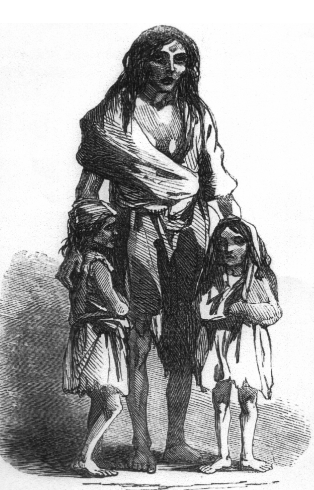
Ireland suffered the Great Famine in the 19th century
- Ireland and Great Britain have a long history of migration due to their proximity. Since the earliest records up to today, migration has occurred in response to religion, politics, economics and social conditions of both places.
- In the 19th century, the biggest factor in Irish migration to Britain was the Great Famine of 1845-52.
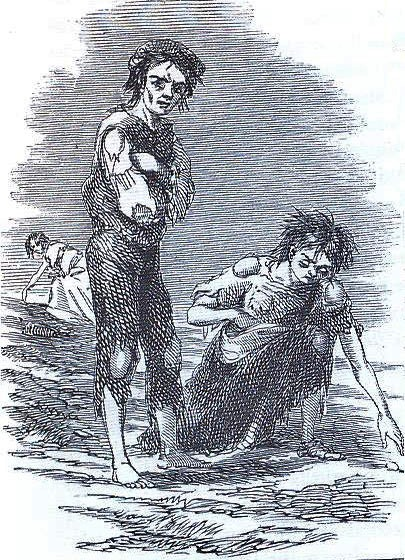
Illustration of Skibbereen, West Cork, in 1847, by James Mahony
Note
The Great Famine was a period of mass starvation, disease and emigration as a consequence of potato crops failing due to blight. Ireland was treated like a colony of Great Britain and much of its farmland was used for growing crops like barley that were exported to mainland Britain.
Potatoes were grown by Irish tenant farmers as a staple food and when these crops failed, coupled with the laissez-faire economics prevalent at the time, nearly 1 million Irish people died of starvation and a further million migrated.
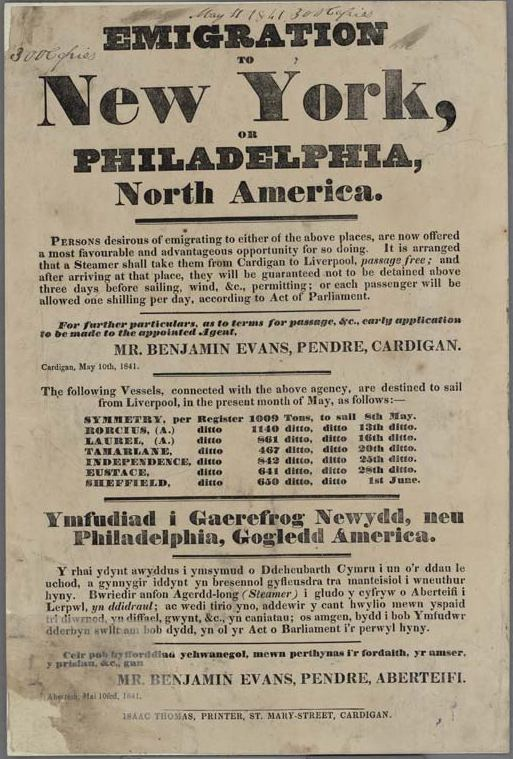
Advertisement of the passage from Wales to New York or Philadelphia, 1841
America at the time was rapidly growing in its industrialisation and urbanity, which rural Ireland did not prepare the Irish for.
Soon, Irish communities with shared parishes and close-knit neighbourhoods started to thrive. Their nationalism strongly helped the Irish American life as they showed support for Ireland's freedom from Britain in the mid-1900s.
The hot climate in South America was a different environment to that of the native Wales. By the 1980s the Welsh in Argentina had established several Welsh-language towns, which was legally impossible for them to do in their homeland. They were able to thrive by ensuring marriage between people from Welsh-speaking families.

Burgeoning populations in industrial cities meant that living conditions, particularly for the poor, were grim. They were overcrowded, sanitation was poor, and many fell ill or died from water-borne diseases like cholera.
In 1842, the life expectancy for migrant labourers was 17 years old.
Irish migrant workers also experienced prejudice for the following reasons:
POVERTY AND CRIME Since many Irish migrant workers were very poor, some would turn to crime to survive. English people blamed the Irish for their own circumstances and crime didn't help improve attitudes towards them.
JOB DISCRIMINATION Desperate for work, Irish labourers accepted lower wages. This undercut other labourers and caused resentment. They would also serve as strikebreakers.
RELIGION By the 19th century, England was predominantly Protestant, while many Irish migrant labourers were Catholic.
NATIONALISM Like the Scots, the Irish opposed British Rule. Some Irish workers joined or supported groups that carried out attacks in the name of nationalism.
RACISM Victorian England had become fixated with scientific classification. Ideas from thinkers like Charles Darwin saw people, particularly non-white and non-English, classified as inferior.