The diversity of European migrants (OCR GCSE History A (Explaining the Modern World)): Revision Notes
📚Revision Notes
The diversity of European migrants
Note
There were many European migrants coming into Britain in the 19th century due to extreme poverty and the effects of civil war. For these migrants, industrial Britain offered a renewed sense of hope and a decent chance of survival.
ITALIANS
Italians found jobs in the textile and road construction industries as they migrated to large cities such as London, Manchester and Glasgow. In London, an area was dubbed as Little Italy as Italians set up businesses there. Industrial Britain during this period was the right place for enterprise.
EASTERN EUROPEAN JEWS
In the 19th century, the attitudes towards Jewish immigrants in Britain improved, as well as their legal and social status. From 1830, Jews were allowed to engage in free trade. After being subject to pogroms in eastern Europe, Jews there began to seek refuge in Britain, increasing the Jewish immigrant population to approximately 140,000 at the start of the 1880s. These Jewish refugees settled mainly in urban areas such as East London, Leeds and Manchester.
ATTITUDES TOWARDS MIGRANTS
European migrants such as Italians, eastern European Jews and Germans faced more favourable treatment and attitudes compared to lascars or Irish immigrants.

- The first Jews in Britain arrived in the 1070s. Their numbers remained small (less than 10,000) at the start of the 19th century.
- As the Russian empire grew in the late 18th and 19th centuries, the tsars who were Orthodox Christians afforded the more than 5 million Jews no protection. The state supported persecutions known as pogroms.
- When Tsar Alexander II was assassinated in 1881, suspicion fell on the Jews.
- This persecution set in motion a great human migration out of eastern Europe. Those who could afford the boat trip migrated to America, while poorer Jews settled in western Europe and Britain in particular.
- Most Jewish communities established themselves near the docks, such as London's East End.
- Though they weren't persecuted like in Russia, British Jews still experienced discrimination and were poorly paid.
Glossary of key terms:
Industrialisation
The wide-scale development of industries in a region or nation.
Lascar
An Indian seaman who would work on British ships for terms of up to three years.
Ayah
Indian nannies that looked after children of their masters in India.
Refugee
A person who has been forced to leave their country in order to escape war, persecution or natural disaster.
Pogrom
An organised massacre of Jews, particularly in Russia.
Note
Assessment #1 SOURCE A:
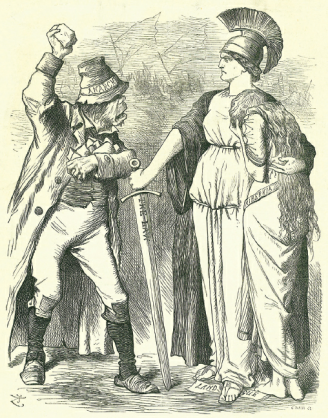
Examine the political cartoon entitled 'Two forces' from Punch magazine in 1881.
Who is being depicted in the cartoon? What does it suggest about the attitudes towards the Irish in the late 19th century?
Note
Assessment #2 SOURCE B:
Our attention will focus on the institutional context of technological innovation rather than the technology itself. We shall view technology as a social product and shall not be over much interested in the priority claims of individual inventors, for the actual course of work that leads to the conception and use of technology always involves a group that has worked for a considerable period of time on the basic idea before success is achieved. — Anthony F. C. Wallace__, The Social Context of Innovation: Bureaucrats, Families, and Heroes in the Early Industrial Revolution as Foreseen in Bacon's New Atlantis (1982, 2003).
Study the source and then do the following task.
Explain how Antony F.C. Wallace's statement provides a certain perspective about industrial workers. Provide your own thoughts about his statement in line with what you have learned about migrant workers. Additionally, identify specific technological innovations which emerged in the 19th century.