The enforcement of Elizabeth’s religious settlement after 1580 (OCR GCSE History A (Explaining the Modern World)): Revision Notes
📚Revision Notes
The enforcement of Elizabeth's religious settlement after 1580
Elizabeth I had inherited a predominantly Catholic nation. Two-thirds of the nobility were Catholic and the majority of the gentry were too. Elizabeth therefore needed to tread carefully and take a cautious approach early in her reign.
- Elizabeth I's Religious Settlement of 1559 aimed to provide religious stability by finding a middle ground for both Catholics and Protestants.
- She faced considerable Catholic opposition to the Settlement, particularly from nobles in the House of Lords. As such, Catholicism was tolerated provided it was practised in private, Catholics outwardly conformed to the new religion, and loyalty was promised.
- Catholic families had priest holes to aid them in practising their religion safely.
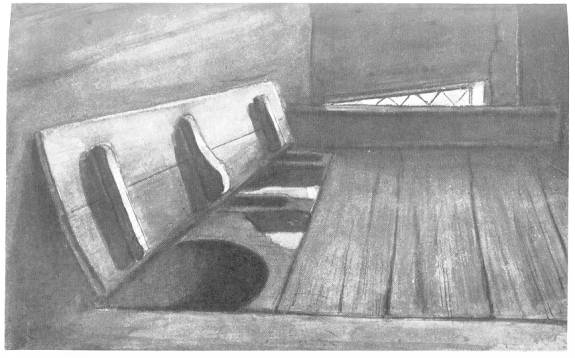
Illustration of a priest hole
Note
Priest holes were hiding places built into houses of Catholic families for a priest to hide in. Persecution of priests increased with subsequent Catholic plots against Elizabeth I. Many priest holes/closets were designed and built by Jesuit Nicholas Owen who was captured, tortured and killed.
It can be argued that Elizabeth's aims with the 'Middle Way' were as much political as they were religious. Religious unrest could lead to civil war, which was costly and disruptive. By taking control of the Church, Elizabeth would also gain financially and maximise her power.
Elizabeth made some changes when reinstating the AoS. She declared herself the Supreme Governor of the Church of England, rather than the divisive title of Supreme Head like her father and brother. The aim was to pacify Catholics who believed the Pope to be the Head of the church.
She instituted an Oath of Supremacy. This required anyone taking public or church office to swear allegiance to the monarch as Governor of the Church and State. Refusing was treason. She did, however, keep the pre-Reformation episcopal structure of two archbishops.
Act of Supremacy
This Act replaced the Pope as the head of the English church, with the monarch. It gave legal sovereignty of civil laws over the laws of the Church of England
1534
Henry VIII designated himself head of the Church of England through the Act of Supremacy
1553
Mary took the throne, revoked the Act of Supremacy and reinstated Catholicism
1559
Elizabeth acceded the throne and reinstated the Act of Supremacy
To implement the Middle Way, Elizabeth passed a second act in May 1559: The Act of Uniformity. The aim of this legislation was to bring an end to conflict between Catholics and Protestants by declaring exactly what the Church of England believed in. In July, a royal injunction was issued and the Thirty-Nine Articles of Religion followed in 1563 detailing the doctrines and practices of the Church of England.
Act of Supremacy, 1558
- All clergy and members of the government had to swear an oath of allegiance to her.
- This was important as it meant the clergy were first and foremost responsible to her and not the Pope.
- The Ecclesiastic High Commission was set up to ensure everyone was doing as they were told.
Act of Uniformity, 1559
- It governed the way churches looked (some decoration retained) and how services were held (English and no mass, a set service and use of the Book of Common Prayer).
- Attendance every Sunday was compulsory and skipping was punishable with a fine.
- Books and prayers were in English.
- Catholic practices like pilgrimages and saints' images were banned.
Note
AIM: Create a religion that suited Catholics and Protestants.
Since Elizabeth was not a radical, some viewed the changes brought about by the Religious Settlement to be insufficient, while others believed them to be extreme. Below were some significant changes along with Catholic and Protestant responses.
| CHANGES | CATHOLIC RESPONSE | PROTESTANT RESPONSE |
|---|---|---|
| Book of Common Prayer wording ambiguous / deliberately vague. | E.g. Communion sacrament. Catholic transubstantiation meant bread and wine was literally the body and blood of Christ. | E.g. Communion sacrament. Protestants could regard communion as an act of remembrance. |
| Elizabeth banned pilgrimages to and monuments of fake miracles. | Catholics were pleased because it still meant there were real miracles. | Protestants were pleased because it stopped money-makers duping people with fake miracles. |
| Use of Catholic elements allowed in the Church. | Catholics were pleased. | Protestants wanted much less but could deal with elements. Puritans were very unhappy. |
Note
Catholics who refused to adapt became known as recusants and practised in secret.
Was the Religious Settlement a success?
- The majority of the clergy in England accepted the terms of the Religious Settlement and adapted.
- Catholic bishops, particularly those appointed by Mary I, that rejected the Settlement were removed and replaced with Protestant bishops loyal to Elizabeth.
- The majority of the people in England accepted the Religious Settlement and attended the church services (but with a fine for not attending, was it a choice?).
- A minority, known as recusants, worshipped in the Catholic way in secret.
- All clergy were required to teach Royal Supremacy and report those who didn't attend church to the Privy Council. Fines were a week's wages, making it fair across all classes.
- A war of religion was averted.
- Powerful Catholic enemies were created.
- Puritans grew in number and influence and wanted more radical reforms.
What happened to the enforcement of the Religious Settlement after 1580?
Whilst the Middle Way seemed to have worked, threats against the queen intensified by the 1580s. The events which followed contributed to this:
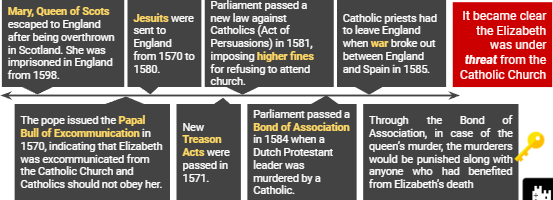
Main responses of Catholics to Elizabeth's religious laws by 1580
Conformers: A large proportion of English Catholics chose to become Protestants.
Church papists: Most English Catholics attended Protestant church services but kept Catholic beliefs and some loyalty to the Pope.
Recusants: Several thousands of usually wealthy English Catholics refused to attend Protestant church service and arranged their own Catholic mass at home.
Plotters: A small number of English Catholics refused to attend Protestant church services and were fiercely loyal to the Catholic beliefs and to the Pope.