More factorising - quadratics (OCR GCSE Maths): Revision Notes
📚Revision Notes
More factorising - quadratics
What is a Quadratic Expression?
A quadratic expression is any expression that includes a squared term, such as:
Where , and are constants.
Looking Back at Expanding Brackets
When we expanded the following expressions, we ended up with quadratic expressions:
Factorising Quadratics
Factorising quadratic expressions involves reversing the process of expanding brackets. This is a key skill in GCSE Maths and helps in solving quadratic equations by turning them back into their original binomial factors.
Factorising quadratics means you want to get from:

To do this you will need to solve a puzzle.
If you look back at the examples you will see that…
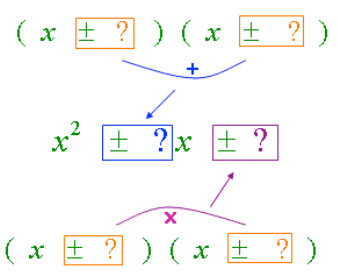
The Key to Factorising Quadratics
To successfully factorise a quadratic, you need to solve a little puzzle:
- The numbers and in the brackets must:
- Add together to give you the coefficient of (which is ).
- Multiply together to give you the constant term (which is ).
Understanding the Process
When you factorise a quadratic expression, you're aiming to rewrite it from this form:
into this form:
Where and are numbers that meet specific conditions.
Note
Example: Factorise
Step-by-Step Process
Step 1: Identify the Coefficients
- The quadratic expression is
- Here, and .
Step 2: Find Two Numbers that Work
- We need to find two numbers that:
- Add together to give (the coefficient of ).
- Multiply together to give (the constant term).
- The numbers and work because:
Step 3: Write the Factorised Form
- We can now write the quadratic as:
Final Answer:
Worked Examples
Note
Example 1: Factorise
Step 1: Identify the Coefficients
- The quadratic expression is .
- Here, and .
Step 2: Find Two Numbers that Work
-
We need to find two numbers that:
-
Multiply together to give (the constant term).
-
Add together to give (the coefficient of ). List the Possible Pairs:
-
and (because ) ← doesn't work
-
and (because ) ← doesn't work
-
and (because and )
Step 3: Write the Factorised Form
- We can now write the quadratic as:
Final Answer:
Double-check by expanding:
- Expanding gives:
- This confirms that our factorisation is correct.
Note
Example 2: Factorise
Step 1: Identify the Coefficients
- The quadratic expression is
- Here, and .
Step 2: Find Two Numbers that Work
- We need to find two numbers that:
- Multiply together to give (the constant term).
- Add together to give (the coefficient of ).
List the Possible Pairs:
- and (because and ← doesn't work
- - and (because and ) ← doesn't work
- and (because and ) ← doesn't work
- and (because and )
Step 3: Write the Factorised Form
- We can now write the quadratic as:
Final Answer:
Double-check by expanding:
- Expanding gives:
- This confirms that our factorisation is correct.
Note
Example 3: Factorise
Step 1: Identify the Coefficients
- The quadratic expression is .
- Here, and .
Step 2: Find Two Numbers that Work
- We need to find two numbers that:
- Multiply together to give (the constant term).
- Add together to give (the coefficient of ).
List the Possible Pairs:
- and because and ← doesn't work
- and because and
Step 3: Write the Factorised Form
- The factorised form of the quadratic is:
- or equivalently:
Final Answer:
Double-check by expanding:
- Expanding gives:
- This confirms that our factorisation is correct.
Note
Example 4: Factorise
Step 1: Identify the Coefficients
- The quadratic expression is
- Here, and .
Step 2: Find Two Numbers that Work
- We need to find two numbers that:
- Multiply together to give (the constant term).
- Add together to give (the coefficient of ).
- Two negative numbers to get a positive .
List the Possible Pairs:
- and because and ← doesn't work
- and because and ← doesn't work
- and because and
Step 3: Write the Factorised Form
- The factorised form of the quadratic is:
or equivalently:
Final Answer:
Double-check by expanding:
- Expanding gives:
- This confirms that our factorisation is correct.
Understanding the Difference of Two Squares
A quadratic expression is a difference of two squares if it can be written in the form:
This expression can be factorised into:
Here, and are the square roots of the terms in the original expression, and the signs in the factors are opposite.
Worked Examples
Note
Example: Factorise
Step 1: Recognise the Structure
- The expression fits the pattern of a difference of two squares because:
This works because and add together to and cancel each other out.
You can think of the expression like this if it helps:
Step 2: Apply the Difference of Two Squares Formula
- Factorising gives:
Final Answer:
Double-check by expanding:
- Expanding gives:
- This confirms that the factorisation is correct.
Note
Other examples are:
Dealing with More Complex Quadratics
Now, let's consider quadratic expressions that are not immediately recognisable as the difference of two squares, but still can be factorised. These include expressions where the coefficient of the squared term is not .
Note
Example 1: Factorise
Step 1: Identify the Coefficients
- Here, the expression is .
- We need to find two numbers that multiply to give and add to give .
Step 2: Find Two Numbers
- The two numbers that work are and , because:
Step 3: Write the Factorised Form
- We rewrite the expression by splitting the middle term:
- Then, factorise by grouping:
Final Answer:
Note
Example 2: Factorise
Step 1: Identify the Coefficients
- The expression is .
- We need to find two numbers that multiply to give and add to give .
Step 2: Find Two Numbers
- The two numbers that work are and , because:
Step 3: Write the Factorised Form
- Rewrite the expression by splitting the middle term:
- Then, factorise by grouping:
Final Answer:
Note
Example 1: Factorise
Step 1: Set Up the Factor Pairs
- We start by identifying the terms that will go into our brackets.
- The first term in each bracket must multiply together to give , so the first terms must be and .
Step 2: Determine the Possible Factor Pairs for the Constant Term
- Next, we look at the constant term, . We need pairs of numbers that multiply to give .
- The pairs are and
Step 3: Multiply Diagonally to Check Which Pair Works

- We arrange the pairs in a table and perform diagonal multiplications to see which pair adds up to give the coefficient of in the original quadratic.
- The middle term in our expression is . We need a pair of numbers whose diagonal products add up to .
Step 4: Identify the Correct Pair
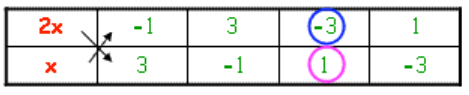
- We test the pairs:
- (No match)
- (No match)
- (This works!)
Step 5: Write the Factorised Form
- Now that we have identified the correct pair, we place these numbers into the brackets:
Final Answer:
Note
Example 2: Factorise Let's break down the process step by step.
Step 1: Identify Possible First Terms in the Brackets
- The first terms in our brackets must multiply to give . The possibilities could be:
- and
- and
Step 2: Consider the Constant Term
- Next, consider the constant term, . We need pairs of numbers that multiply to give . These pairs are:
Step 3: Use a Grid Method with Two Tables
-
To find the correct combination, we use two tables, testing the pairs of factors for each set of first terms:
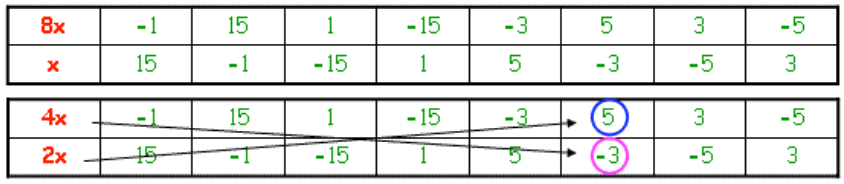
-
Now, we multiply diagonally to find the pair of numbers that adds up to the coefficient of the middle term,
-
From the second table: (This is the correct pair!)
Step 4: Write Down the Factors
- With the correct pair found, we can write the factors as:
Step 5: Check Your Answer
- It's essential to check by expanding the brackets:(
- This confirms the factorisation is correct.