Rules of algebra (OCR GCSE Maths): Revision Notes
📚Revision Notes
Rules of algebra
Introduction to Algebra
Algebra often seems daunting, but it isn't something to be afraid of. In fact, once you understand the basics, you might find that working with letters (which represent numbers) can actually be easier than dealing with numbers alone. Here's why:
- Letters in algebra often cancel each other out, simplifying the expressions as you work through them.
- By working with letters, you can find out for sure if your answers are correct.
What is Algebra and Why Do We Need It?
- On a simple level, Algebra is just maths with letters. These letters, known as variables, represent numbers that we might not know yet.
- By introducing letters along with numbers, we can solve problems that numbers alone can't handle. For example, if we need to figure out a general rule or pattern that works for any number, algebra is our tool.
- In Algebra, these letters are often called "Unknowns". They stand in for values that we don't know yet but need to find.
Note
Example: Consider trying to find out how many hours you spend watching TV in a week. Instead of adding up each day separately, you could use a formula where the letter represents the hours you watch each day. If you watch the same amount of TV each day, you could use the formula:
Here, is the unknown (the number of hours you watch each day), and this formula gives you a quick way to calculate the total.
- If we don't know what something is, we call it a letter. This helps us set up equations to solve problems where we can eventually figure out what the letter stands for.
Understanding Terms and Expressions
Before diving into simplifying algebraic expressions, it's important to understand some key vocabulary:
-
Term: A term is a single part of an expression or equation that involves a letter (variable). Examples include , , or .
-
Expression: This is a collection of terms, mixed with a few numbers or letters, but without an equals sign. Examples: , or
-
Equation: Similar to an expression, but with an equals sign included. Examples: , or
Rule 1: Adding and Subtracting Like Terms
Like Terms are terms that have the same letters (and corresponding powers). You can only add or subtract like terms. If the terms are different, they cannot be combined.
Note
Examples:
- → 3 lots of something, plus 2 lots of something, gives you 5 lots of something.
- → 16 lots of something, minus 4 lots of something, gives you 12 lots of something.
Non-Examples:
- does NOT → this cannot be simplified (because and are different).
- does NOT → this cannot be simplified (because and are different).
Simplifying Expressions
Once you understand Rule , you can start simplifying algebraic expressions by combining like terms. This process is called simplification.
Note
Example 1: Simple Simplification Problem: Simplify .
Solution:
- Step 1: Identify like terms. and are like terms. Similarly, and are like terms.
- Step 2: Combine the like terms.
- Final Answer:
Tip: If you cannot see a sign in front of a term, then just assume that it's a plus (+).
:::
Note
Example 2: Tricky Simplification Problem: Simplify $4t²−5t−2t+3t².
Solution:
- Step 1: Identify like terms. and are like terms. Similarly, and are like terms.
- Step 2: Combine the like terms.
- Final Answer:
Tip: It is important to remember how to work with NEGATIVE (-) NUMBERS.
:::
Rule 2: Multiplying with Algebra
When multiplying algebraic terms, remember these steps:
- You CAN multiply different terms and like terms together.
- Always multiply the numbers (coefficients) together first.
- Put the letters (variables) in alphabetical order.
- Leave out the multiplication sign.
Worked Examples
Note
Example 1: Simple Multiplication Problem: Simplify .
Solution:
- Step 1: Each term here is different, but that's fine because we're multiplying.
- Step 2: Multiply the numbers (coefficients) together first.
- Step 3: Now deal with the letters. Write them in alphabetical order and leave out the multiplication sign.
- Step 4: Put the numbers and letters together to form the final answer.
Note
Example 2: Multiplying with Negative Numbers Problem: Simplify .
Solution:
- Step 1: No problem with the different terms. We can still multiply them.
- Step 2: Multiply the numbers (coefficients) together first. Be very careful with the negatives!
Note: There was no number in front of , so it's just .
- Step 3: Now deal with the letters. Multiply them and arrange in alphabetical order.
Remember, if you multiply something by itself (like ), it just means you are squaring it.
- Step 4: Put the numbers and letters together to form the final answer.
Rule 3: Dividing with Algebra
When dividing algebraic terms, keep these key points in mind:
- The rules are just the same as when multiplying, but instead of using a multiplication sign, you write the division as a fraction.
- Always divide the numbers (coefficients) first.
- Cancel out any common factors in the variables (letters).
- Watch out for terms that completely cancel out (they become 1).
Worked Examples
Note
Example 1: Simple Division Problem: Simplify→
Solution:
- Step 1: Different terms are no problem, just like in multiplication.
- Step 2: Divide the numbers (coefficients) first.
- Step 3: Now deal with the letters. Here, in the numerator and denominator can cancel each other out.
What happened here? When you divide the on the top by the z on the bottom, you're left with 1 (since anything divided by itself is 1). Multiplying by 1 doesn't change the value, so the effectively disappears.
Note
Example 2: Division with Fractions Problem: Simplify,
Solution:
- Step 1: Different terms are no problem.
- Step 2: Divide the numbers (coefficients) first.
Note: When you don't get a whole number, you need to use fractions!
- Step 3: Now deal with the letters. This requires some knowledge of indices (powers)
- The a on the bottom cancels out one a on the top, leaving a in the numerator.
- The on the bottom cancels out on the top, leaving in the denominator.
Forming Algebraic Expressions
When forming expressions, you use variables (letters) to represent unknown values. These variables are combined with numbers and operations (addition, subtraction, multiplication, division) to create expressions that model real situations.
Note
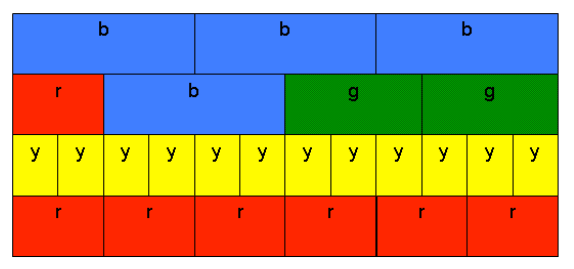
Example 1: Using a Diagram to Form Expressions Let's use a simple diagram to create expressions:
- Imagine we have a diagram where different blocks are labelled with letters representing different variables.
- We can form expressions by combining these letters according to their arrangements.
Diagram and Expressions:
-
-
-
-
-
Explanation:
-
These expressions come from observing the relationships between the blocks and how many of each block correspond to others. For instance, if two red blocks () equal one blue block (), then .
Forming Expressions from Word Problems
Sometimes, you'll be given a word problem and need to form an expression based on the information provided. Here's how to approach it.
Note
Example 2: Forming an Expression from a Story Problem: Phillip is going on a shopping trip. He needs to calculate the total cost of his items. He needs:
-
5 energy drinks
-
2 packs of coffee beans
-
1 box of chocolates He doesn't know the prices, so he uses letters:
-
for the price of an energy drink
-
for the price of a pack of coffee beans
-
for the price of a box of chocolates
Step 1: Write the initial expression for the total cost:
Step 2: Adjust the expression based on new information. For example, Phillip decides to buy two more tins of beans and one less pear. Update the expression:
Step 3: Consider another scenario where his friend Bruno is coming over to study, so he needs twice as much of everything:
Final Expression:
Understanding Substitution in Algebra
Substitution is a key skill in algebra that allows you to replace variables (letters) in an expression with numbers. This process is useful for evaluating expressions once specific values for the variables are known.
Substitution Basics
To substitute numbers into algebraic expressions:
- Identify the values given for each variable.
- Replace each variable in the expression with its corresponding value.
- Follow the order of operations (BODMAS/BIDMAS):
- Brackets
- Orders (powers and roots)
- Division and Multiplication (from left to right)
- Addition and Subtraction (from left to right)
- Be careful with negative numbers and multiplication involving negatives.
Worked Examples
Note
Example 1: Simple Substitution Problem: Evaluate the expression given and .
Solution:
- Step 1: Identify the values: and .
- Step 2: Substitute the values into the expression:
- Step 3: Multiply the numbers together:
- Final Answer:
Note
Example 2: Substitution with Multiple Variables Problem: Evaluate the expression given , , and .
Solution:
- Step 1: Identify the values: , , and .
- Step 2: Substitute the values into the expression:
- Step 3: Combine the results:
- Final Answer:
Note
Example 3: Substitution Involving a Square Problem: Evaluate the expression given and .
Solution:
- Step 1: Identify the values: and .
- Step 2: Substitute the values into the expression, remembering to square first:
- Step 3: Multiply the numbers together:
- Final Answer: