Single brackets (OCR GCSE Maths): Revision Notes
📚Revision Notes
Single brackets
Understanding Single Brackets in Algebra
When you encounter a single bracket in algebra, it's crucial to understand how to deal with it correctly. A useful way to think about this is to imagine the bracket as a "canoe" and the term outside the bracket as a "wave." Just like how a wave affects everything in the canoe, the term outside the bracket must be applied to everything inside the bracket.
Note
Key Rule: You must multiply EVERYTHING inside the bracket by the term on the outside.
This rule is the foundation of expanding single brackets and is essential for simplifying algebraic expressions.
Worked Examples
Note
Example 1: Expanding with Positive Numbers
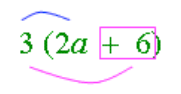
Problem: Expand .
Solution:
-
Step 1: Remember, the outside the bracket is multiplying both the and the .
-
Step 2: Multiply by
- Step 3: Multiply by :
- Final Answer:
Explanation:
- The term outside the bracket () is positive, and both terms inside the bracket are positive, so the final expression is simply .
Note
Example 2: Expanding with a Negative Number Inside the Bracket
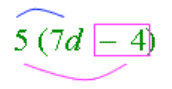
Problem: Expand .
Solution:
-
Step 1: The outside the bracket multiplies both the and the .
-
Step 2: Multiply by :
- Step 3: Multiply by :
- Final Answer:
Explanation:
- The key here is to pay close attention to the negative sign before the . When multiplying, a positive times a negative gives a negative, hence .
Note
Example 3: Expanding with a Negative Outside the Bracket
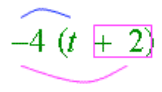
Problem: Expand .
Solution:
-
Step 1: The outside the bracket multiplies both the and the .
-
Step 2: Multiply by :
- Step 3: Multiply by :
- Final Answer:
Explanation:
- A negative number multiplied by a positive number results in a negative product. Here, times is , and times is .
Note
Example 4: Expanding with Two Negative Numbers
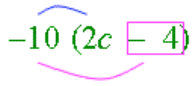
Problem: Expand .
Solution:
-
Step 1: The outside the bracket multiplies both the and the .
-
Step 2: Multiply by
- Step 3: Multiply by :
- Final Answer:
Explanation:
- Be careful with the signs: A negative times a positive gives a negative, but a negative times a negative gives a positive. Here, times is , and times is .
Note
Example 5: Expanding with a Negative Term Inside the Bracket
Problem: Expand .
Solution:
-
Step 1: The outside the bracket multiplies both the and the .
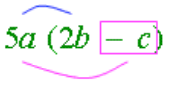
-
Step 2: Multiply by :
- Step 3: Multiply by :
- Final Answer:
Explanation:
- The term is distributed to both and , resulting in and . The negative sign is critical to include in the final expression.
Note
Example 6: Expanding with Three Terms Inside the Bracket
Problem: Expand 7ar$$(10st+2b−5).
Solution:
-
Step 1: The outside the bracket multiplies all three terms inside the bracket: , , and .
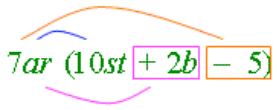
-
Step 2: Multiply by :
- Step 3: Multiply by :
- Step 4: Multiply by :
- Final Answer:
Explanation:
- The term is distributed to each term inside the bracket. Notice that the order of multiplication doesn't matter, but the signs and the arrangement of variables should be consistent.
Note
Example 7: Expanding with Variables and Squares
Problem: Expand .
Solution:
-
Step 1: The outside the bracket multiplies both the and the .
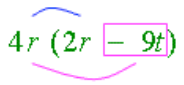
-
Step 2: Multiply by :
- Step 3: Multiply by :
- Final Answer:
Explanation:
- The term is distributed to each term inside the bracket. When is multiplied by , the result is because . The second multiplication involves a negative sign, leading to a negative result.
Note
Example 8: Expanding with Multiple Variables and Squares
Problem: Expand .
Solution:
-
Step 1: The outside the bracket multiplies both the and the .
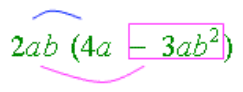
-
Step 2: Multiply by :
- Step 3: Multiply by :
- Final Answer:
Explanation:
- Here, the multiplication of by results in because . When multiplying by , we get because the powers of both and are added together.