Probability (OCR GCSE Maths): Revision Notes
📚Revision Notes
Probability
What is Probability?
Probability is the likelihood or chance of something happening.
Probability helps us to assess how likely an event is to occur. For example, "What is the chance that it will rain tomorrow?" or "What is the chance of flipping heads on a coin?"
Key Terms:
- Experiment: A situation where we observe or measure an event (e.g. rolling a die).
- Outcomes: These are the possible results of an experiment. For example, rolling a die gives six possible outcomes: .
- Event: This refers to the specific outcome we are interested in. For instance, rolling a on a die is an event.
- Equally Likely Outcomes: When each outcome of an experiment has the same chance of occurring. For example, rolling a fair die has six equally likely outcomes.
Probability Formula
The most important formula in probability is:
- (event): This stands for the probability of an event happening.
- The number of ways the event can happen is how many specific outcomes favour the event.
- The total number of possible outcomes is all the different outcomes that could happen in the experiment.
Note
Example 1: Picking a vowel from a bag of alphabet tiles
Imagine there are 26 tiles in a bag, each representing one of the 26 letters of the alphabet. Suppose you are asked to pick a vowel () at random from the bag.
There are 5 vowels: .
To calculate the probability of picking a vowel:
- The number of vowels (favourable outcomes) = 5
- The total number of tiles (possible outcomes) = 26 Using the probability formula:
Thus, the probability of picking a vowel is .
Note
Example 2: Probability of picking any letter
Next, consider the probability of picking any letter from the bag. Since the bag contains all 26 letters, the probability of picking any letter is:
- The number of letters to pick = 26
- The total number of tiles = 26 Thus, the probability of picking a letter is:
This means it is certain you will pick a letter.
Key Rule:
- If something has a probability of 1, it is certain to happen.
Note
Example 3: Probability of picking a number
Now, what is the probability of picking a number from the bag of alphabet tiles? There are no numbers in the bag, so the probability is:
- The number of favourable outcomes (numbers) = 0
- The total number of tiles = 26 Using the formula:
This means it is impossible to pick a number from the bag.
Key Rule:
- If something has a probability of 0, it is impossible to happen.
Conditional Probability Example
Note
Example 4: Picking the letter '' given it's a vowel
Now, let's say someone tells you that the tile you are about to pick is a vowel. What is the probability that it's the letter ''?
Since you now know you're only choosing from the vowels (), the total number of possible outcomes has reduced to 5 (the number of vowels). Only one of these is the letter ''.
So:
- The number of favourable outcomes
- The total number of vowels (possible outcomes) = 5 Thus, the probability is:
Note
Worked Example 2: Mr Barton's Dinner
Mr Barton is wondering what his mum will cook for him for tea. From past experience, the probabilities are as follows:
- Probability of beans on toast:
- Probability of sausage and mash:
- Probability of no food:
Question 1: What is the probability that Mr Barton has beans on toast or sausage and mash?
These two events are mutually exclusive, as Mr Barton cannot have both beans on toast and sausage and mash at the same time. Therefore, we add the probabilities together.
So, the probability that Mr Barton has either beans on toast or sausage and mash is 0.85.
Rule: To find the probability of one mutually exclusive event or another happening, simply add the probabilities.
Probability of an Event Not Happening
To calculate the probability of an event not happening, we subtract the probability of the event happening from 1 (since the total probability for all possible outcomes is 1).
Formula:
Question 2: What is the probability that Mr Barton gets some food for tea?
We know that the only outcome where Mr Barton doesn't get food is the "no food" event, which has a probability of 0.05. Therefore, the probability of Mr Barton getting food is:
So, the probability that Mr Barton gets some food for tea is 0.95.
Question 3: What is the probability that Mr Barton has beans on toast on two consecutive nights?
Let's assume the probability that Mr Barton has beans on toast on any given night is 0.6, and the two nights are independent events.
Using the AND rule:
So, the probability that Mr Barton has beans on toast on both nights is 0.36.
Rule 5: To find the probability of two independent events happening together, you multiply the probabilities of each event.
Common Mistakes to Avoid
-
Mutually Exclusive vs Independent Events: Many students confuse mutually exclusive events (events that cannot happen at the same time) with independent events (events where the outcome of one does not affect the other).
- Mutually exclusive: Use the OR rule (add the probabilities).
- Independent: Use the AND rule (multiply the probabilities). Key Words to Help Remember:
-
Mutually Exclusive: "Or", "Either" → add the probabilities.
-
Independent: "And", "Both", "Together" → multiply the probabilities.
Note
Example: Flipping Two Coins
Question: What is the probability of getting one head and one tail when flipping two coins?
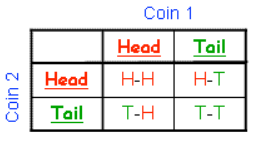
Some people mistakenly think there are only three outcomes for this situation: heads and tails (), heads and heads (), and tails and tails (). If you calculate the probability this way, you might think the probability of getting one head and one tail is:
However, this is incorrect! Here's why:
There are actually four equally likely outcomes when flipping two coins:
- There are two ways to get one head and one tail (either or ).
Now, we can calculate the correct probability:
So, the correct probability of getting one head and one tail is .
Note
Worked Example 3: Rolling Two Dice
Problem:
You roll two dice and subtract the lowest score from the highest score. What are the possible outcomes, and how do we calculate the probabilities of certain results?
This table shows that the possible outcomes when subtracting the smaller value from the larger one range from 0 to 5.
Step 2: Calculating the Probability of Getting a Score of
Question: What is the probability of getting a score of ?
To solve this, we need to:
- Count how many times the result is in the sample space diagram. We see that appears 6 times.
- Calculate the total number of possible outcomes. Since each die has sides, there are possible outcomes. The probability is:
Thus, the probability of getting a score of is .
Step 3: Predicting Results Using Probability
Question: If you roll the dice times, how many times would you expect to get a score of ?
- From the sample space diagram, we can see that a score of appears 10 times.
- The probability of getting a score of is:
- Now, if we roll the dice 180 times, we can predict the number of times we will get a score of by multiplying the probability by the number of trials:
Therefore, if you roll the dice 180 , you would expect to get a score of approximately 50 .