3D trigonometry (OCR GCSE Maths): Revision Notes
📚Revision Notes
3D trigonometry
Introduction to 3D Trigonometry
3D Trigonometry is quite similar to regular 2D trigonometry, but with an added dimension! The key to solving 3D problems is to visualise and break them down into simpler 2D problems involving right-angled triangles. Here's how you can tackle 3D trigonometry problems step by step.
The Secret to Solving Trigonometry Problems
- Understand that 3D Trigonometry uses the same principles as Trigonometry:
- Pythagoras' Theorem: To calculate the length of a side in a right-angled triangle.
- Sine, Cosine, and Tangent (Sin, Cos, Tan): To calculate angles and lengths in right-angled triangles.
- The Challenge in Trigonometry:
- The hardest part is often just spotting where the right-angled triangles are within the shape.
- Steps to Solve a Trigonometry Problem:
- Draw it out flat: Reduce the problem to a problem by projecting the relevant triangle onto a flat plane.
- Label your sides: Identify and label the sides of the triangle as Hypotenuse (), Opposite (), and Adjacent ().
- Fill in the information you know: Insert the given lengths and angles.
- Work out what you don't know in the usual way: Apply Pythagoras' Theorem or the trigonometric ratios (Sin, Cos, Tan) to find the missing side or angle.
Worked Example: Finding Distances in a Shape
Note
Example
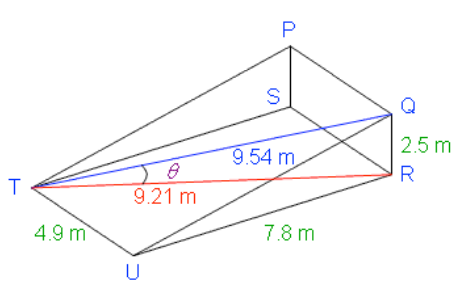
Problem: The diagram shows a wedge of Cheddar cheese, where rectangle PQRS is perpendicular (at 90°) to rectangle RSTU. The distances are PQ = 2.5m, QR = 7.8 m, and TU = 4.9 m. You need to calculate:
- (a) The distance
- (b) The angle
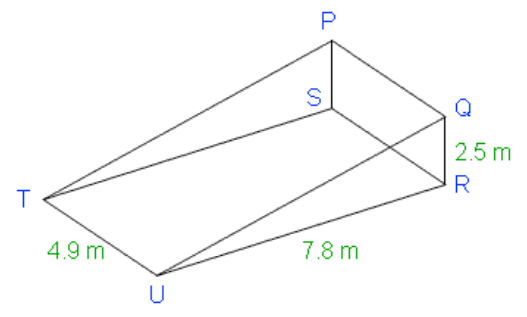
Step-by-Step Solution:
- Understanding the Problem:
- You need to find the distance , which is a line running through the shape, and the angle .
- To do this, you'll need to identify right-angled triangles within the shape.
- Finding :
- Step 1: Spot the right-angled triangle involving . In this case, it's triangle QTR.
- Step 2: Break down the problem into two triangles:
- First, calculate using the triangle .
- Then use the triangle to find .
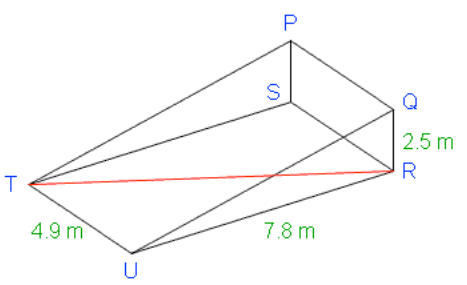
- Calculating :
-
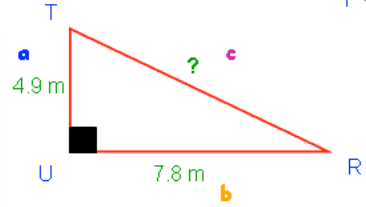
Given: is the hypotenuse of triangle .
-
Use Pythagoras' Theorem:
- Calculating :
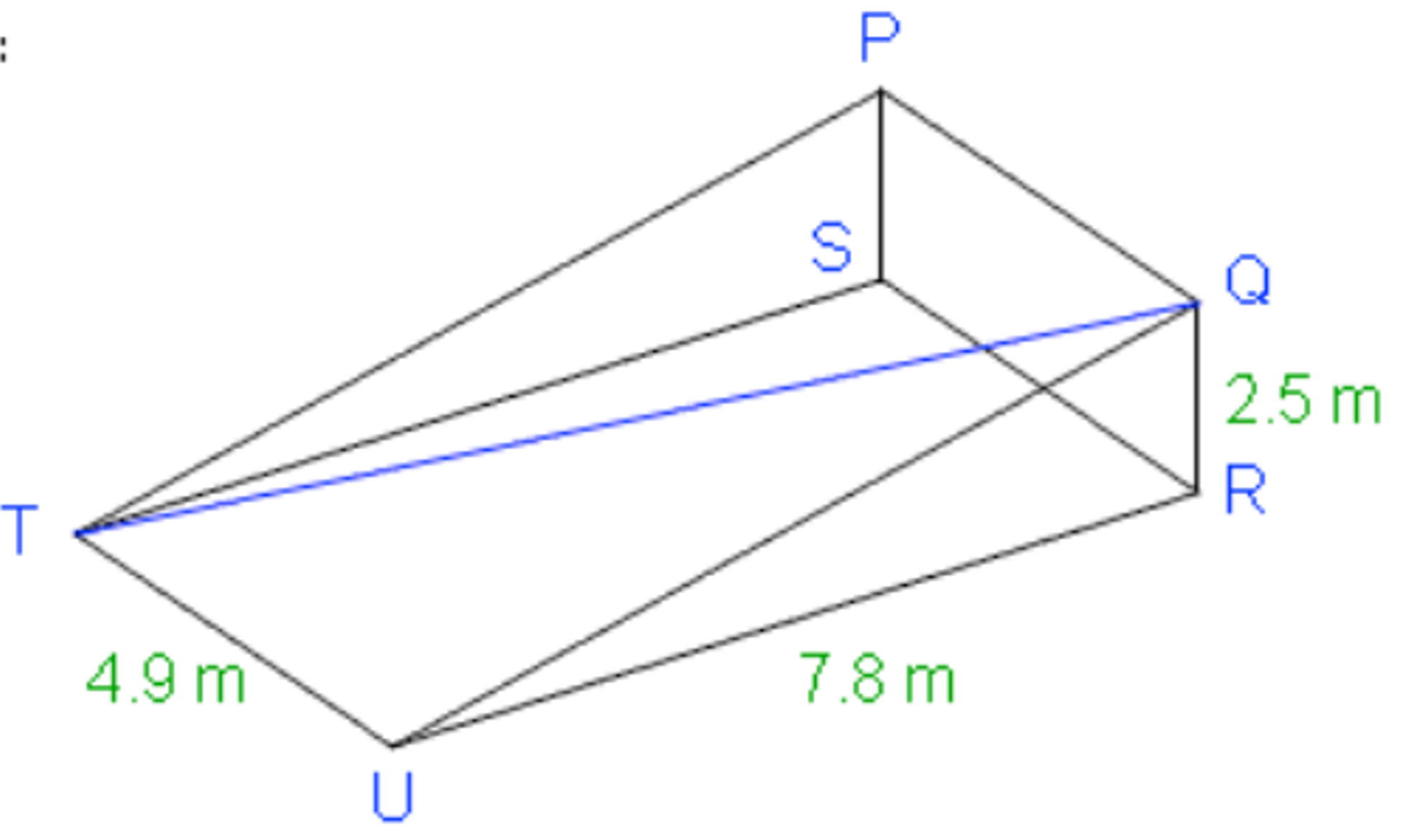
- is the hypotenuse of the triangle .
- Use the lengths and :
- Finding Angle :
- Using Tan:
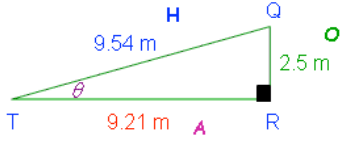
Final Answers:
- Distance : Approximately 9.54 m.
- Angle : Approximately 15.2°.
Worked Example: Calculating the Height of a Vertical Pole in a Tent
Note
Example Problem: A tent is shown in the diagram with a vertical pole OP. The pole is at the centre of rectangle . Given that TQ=13 m, TS=5 m, and SR=12 m, find the height of the pole .
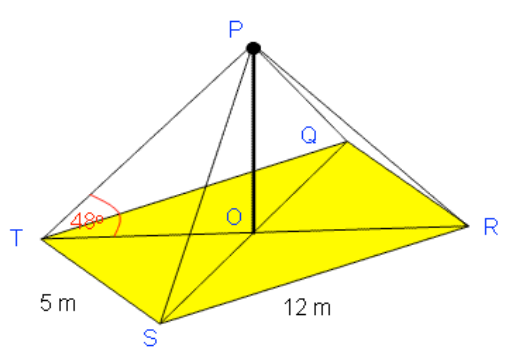
Step-by-Step Solution:
- Breaking Down the Problem:
- Objective: Calculate the height of the vertical pole.
- Identify relevant triangles and determine the lengths or angles that can be used to find .
- Finding the Length :
- is half the length of , since is the midpoint of .
- Step 1: Calculate using Pythagoras' Theorem in the right-angled triangle
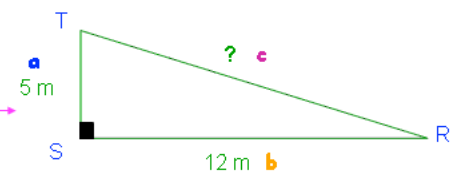
Calculation:
- Therefore, .
- Calculating the Height
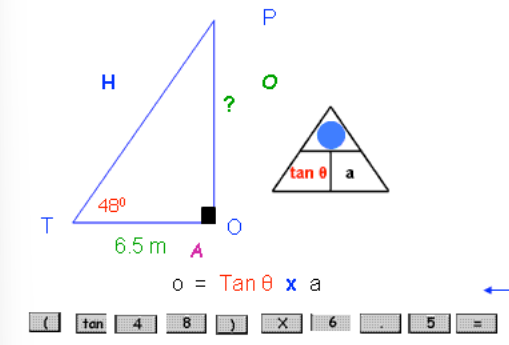
- Now, consider the right-angled triangle , where OT=6.5 m and ∠OTP=48°.
- Use the tangent ratio to find . Calculation: