Vectors (OCR GCSE Maths): Revision Notes
📚Revision Notes
Vectors
What are Vectors?
- Vectors are a method of describing how to move from one point to another in space. They are represented by a pair of numbers enclosed in brackets.
- The top number in the vector tells you how far to move left or right:
- A positive number means you move right.
- A negative number means you move left.
- The bottom number tells you how far to move up or down:
- A positive number means you move up.
- A negative number means you move down.
1. How to Read a Vector
Consider the vector:
- The top number, 3, means you move 3 units to the right.
- The bottom number, 4, means you move 4 units up.
Note
📑Examples of Vectors
Let's look at some specific vectors and what they represent:
- Vector :
- Move 1 unit to the right and 3 units up.
- Vector :
- Move 5 units to the right and 2 units down.
- Vector :
- Move 3 units to the left and 2 units down.
- Vector :
- Move 0 units to the right (i.e., don't move horizontally) and 3 units up.
Visual Representation on a Grid
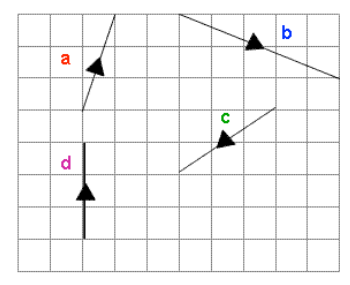
When vectors are drawn on a grid, they start from an initial point (often called the "tail") and point towards a terminal point (called the "head"). The direction and length of the arrow represent the movement described by the vector.
- Vector moves from its initial point 1 unit to the right and 3 units up.
- Vector moves 5 units to the right and 2 units down.
- Vector moves 3 units to the left and 2 units down.
- Vector moves straight up, with no horizontal movement.
2. What is the Magnitude of a Vector?
The magnitude of a vector is a measure of how long the vector is. It tells you the distance from the starting point (tail) of the vector to the ending point (head). To calculate the magnitude of a vector, you can use Pythagoras' Theorem by forming a right-angled triangle with the vector.
How to Calculate the Magnitude
Given a vector:
The magnitude of is found by:
- Identify the Components:
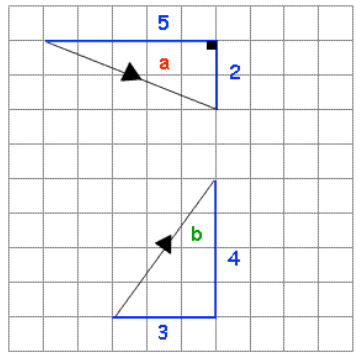
- The vector a has components 5 (right movement) and -2 (downward movement).
- Apply Pythagoras' Theorem:
- Treat the components as the lengths of the two sides of a right-angled triangle.
- The formula to find the magnitude is:
- Calculate each component:
- Add them together:
- Take the square root:
Note
Example: Calculating the Magnitude of Another Vector
Let's take another vector :
- Identify the Components:
- The vector has components 3 (right movement) and 4 (upward movement).
- Apply Pythagoras' Theorem:
- The magnitude is calculated as:
- Calculate each component:
- Add them together:
- Take the square root:
Visual Representation
Important Note:
- Negatives and Squaring: When squaring the components, negatives become positive. This is why you do not need to worry about the signs of the components when calculating the magnitude.
3. What Does It Mean to Add Vectors?
When you add two or more vectors together, you are combining their movements into a single movement. The result of adding vectors is called the resultant vector.
How to Add Vectors
The process of adding vectors involves a simple step-by-step method:
- Add the Top Numbers:
- The top number of each vector represents the movement in the horizontal direction (left or right).
- To add the vectors, simply add the top numbers together.
- Add the Bottom Numbers:
- The bottom number of each vector represents the movement in the vertical direction (up or down).
- Add the bottom numbers together.
- Resultant Vector:
- The resultant vector is formed by combining these sums, with the top number representing the total horizontal movement and the bottom number representing the total vertical movement.
Worked Examples
Note
Example 1: Adding Vectors and
Given:
To find the resultant vector :
- Add the Top Numbers:
- Add the Bottom Numbers:
- Resultant Vector:
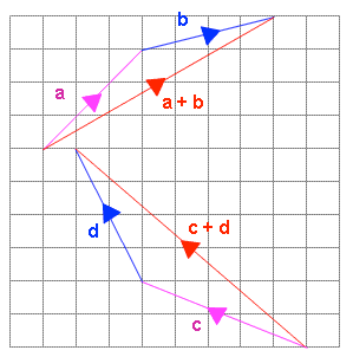
- This means that moving 3 units right and 3 units up (vector a) combined with moving 4 units right and 1 unit up (vector ) results in a movement of 7 units right and 4 units up.
Note
Example 2: Adding Vectors and
Given:
To find the resultant vector :
- Add the Top Numbers:
- Add the Bottom Numbers:
- Resultant Vector:
- This means that moving 5 units left and 2 units up (vector ) combined with moving 2 units left and 4 units up (vector ) results in a movement of 7 units left and 6 units up.
Visual Representation
Important Note:
- Watch Out for Negatives: Always be careful with negative numbers when adding vectors. Adding a negative number is the same as subtracting the positive number.
4. What Does It Mean to Subtract Vectors?
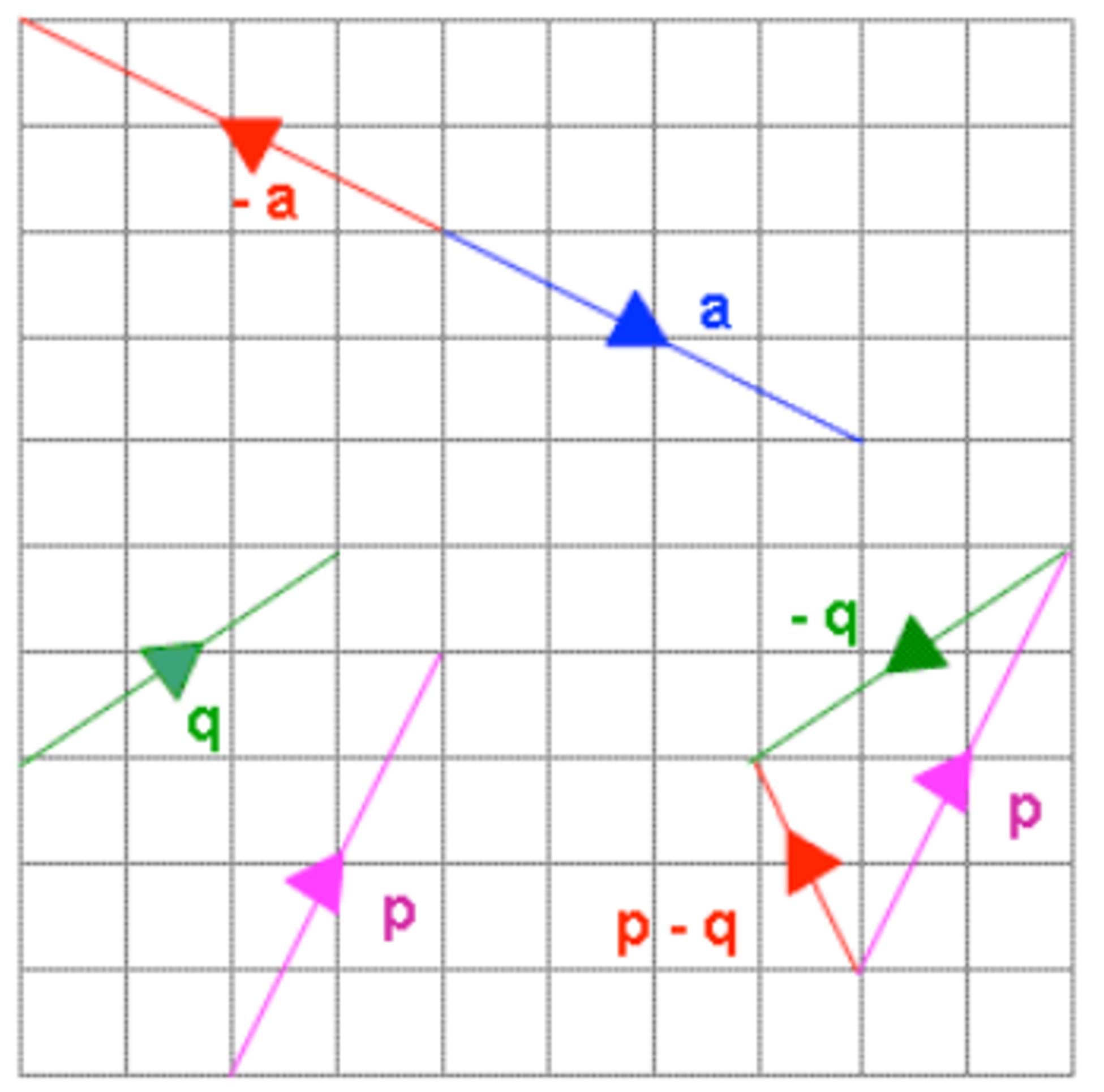
Subtracting a vector essentially means finding the vector that, when added to the second vector, results in the first vector. This can be visualised as reversing the direction of the vector being subtracted and then adding it to the other vector.
How to Subtract Vectors
One efficient way to subtract vectors is to add the negative of the vector. This approach uses the concept that subtracting a vector is the same as adding its opposite.
Steps for Subtracting Vectors:
- Find the Negative of the Vector:
- To subtract a vector, first find its negative by changing the signs of both its components (top and bottom).
Note
example, if , then the negative of is .
- Add the Negative Vector:
- Subtracting vector from vector (i.e., ) is the same as adding the negative of to .
- Use the following equation:
Worked Example:
Note
Example
Subtracting Vectors and
Given:
To find :
- Find the Negative of :
- Add and :
- Add the corresponding components:
- Resultant Vector:
- This resultant vector indicates a movement of 1 unit to the left and 2 units up.
Visual Representation
Important Note:
- Direction Reversal: When subtracting, the direction of the vector being subtracted is reversed.
- Adding the Negative: Subtraction of vectors can always be handled by adding the negative of the vector you wish to subtract.
5. What Does It Mean to Multiply a Vector?
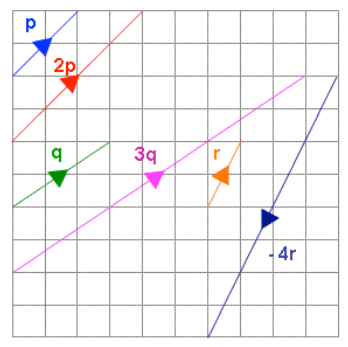
When you multiply a vector by a scalar, you are scaling the vector. This means you are making the vector longer or shorter depending on the scalar value:
If the scalar is positive, the direction of the vector remains the same.
If the scalar is negative, the direction of the vector reverses.
How to Multiply a Vector
Multiplying a vector by a scalar is straightforward. You simply multiply both the top and the bottom numbers (components) of the vector by the scalar.
Steps for Multiplying Vectors:
- Multiply the Top Number:
- The top number represents the horizontal movement. Multiply this by the scalar.
- Multiply the Bottom Number:
- The bottom number represents the vertical movement. Multiply this by the scalar.
Worked Examples: Multiplying Vectors by a Scalar
Note
Example 1: Multiplying Vector by Given:
To find :
Multiply the Top Number:
Multiply the Bottom Number:
Resultant Vector:
- This means that the vector has been scaled up by 2, resulting in a movement of 4 units right and 4 units up.
Note
Example 2: Multiplying Vector by Given:
To find :
Multiply the Top Number:
Multiply the Bottom Number:
Resultant Vector:
- The vector is now scaled by 3, giving a movement of 9 units right and 6 units up.
Note
Example 3: Multiplying Vector by Given:
To find :
Multiply the Top Number:
Multiply the Bottom Number:
Resultant Vector:
- Here, the vector has been scaled by -4, reversing its direction and resulting in a movement of 4 units left and 8 units down.
Visual Representation
Important Note:
Scaling and Direction: Positive scalars stretch the vector in the same direction, while negative scalars reverse the direction.
Consistency: Always apply the scalar to both components (top and bottom) of the vector.
6. What is a Linear Combination of Vectors?
A linear combination of vectors involves multiplying each vector by a scalar (a number) and then adding or subtracting the resulting vectors. This allows us to combine several vectors into a single vector.
How to Calculate Linear Combinations
To find a linear combination, follow these steps:
- Multiply each vector by its corresponding scalar:
- Multiply both the top and bottom components of the vector by the scalar.
- Add or subtract the vectors:
- Combine the vectors by adding or subtracting their corresponding components.
Worked Examples: Linear Combinations of Vectors
Note
📑Example: Given Vectors
Problem (a): Calculate
- Multiply each vector by the scalar:
- Add the vectors:
- Add the corresponding components:
- Resultant Vector:
Problem (b): Calculate
- Multiply each vector by the scalar:
- Subtract the vectors:
- Subtract the corresponding components:
- Resultant Vector:
Important Note:
- Care with Signs: Be especially careful with negative signs when multiplying and adding/subtracting vectors.
- Scalar Multiplication: Always multiply each component of the vector by the scalar before adding or subtracting.
7. Vectors in Geometry
Note
📑Example: Describing Routes in a Regular Hexagon
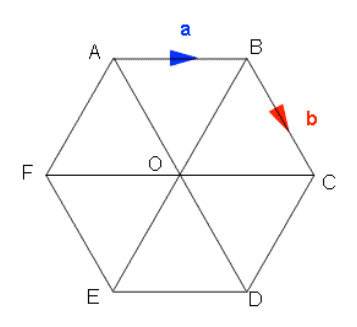
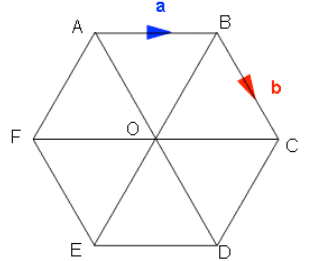
Consider the regular hexagon with vectors and as shown:
- Vector : Represents the vector from to .
- Vector : Represents the vector from to .
We'll describe the routes , , and in terms of these vectors.
Worked Examples
Note
Example
(i) Describing
- Route: The best way to go from to is straight across the middle, because we know each horizontal line in the hexagon is the same length.
- Calculation:
(ii) Describing
- Route: It might be tempting to go directly from to , but that route isn't known. Instead, we'll need to go the opposite way along the given vector .
- Calculation:
(iii) Describing
-
Route: Directly across the middle looks good, but again, that route isn't defined by known vectors. Instead, we must take the longer route:
-
First, go from to using vector .
-
Then from to using vector .
-
Finally, from to using vector .
-
Calculation: