Half-Life (OCR GCSE Physics A, Combined (Gateway Science Suite)): Revision Notes
📚Revision Notes
4.2.5 Half-Life
Half-Life
Note
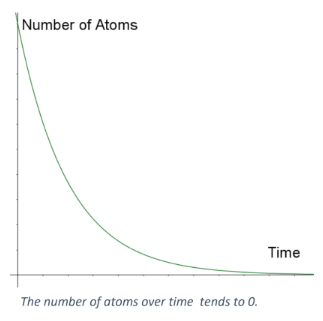
The half-life of an isotope is the time taken for half the nuclei in a sample to decay or the time taken for the activity or count rate of a sample to decay by half. It cannot be predicted when any one nucleus will decay, but the half-life is a constant that enables the activity of a very large number of nuclei to be predicted during the decay.
Example
Example Calculation:
- If 80 atoms fall to 20 over 10 minutes, the half-life?
- – so two half-lives in 10 minutes
- So the half-life is 5 minutes
Characteristics of Half-Life:
- Short Half-Life:
- The source presents less of a risk, as it does not remain strongly radioactive.
- This means initially it is very radioactive, but quickly dies down.
- So presents less of a long-term risk.
- Long Half-Life:
- The source remains weakly radioactive for a long period of time.
- Example: Americium has a half-life of 432 years.
- It is an alpha emitter and is used in smoke alarms.
- It is emitted into the air around the alarm and does not reach far because alpha is weakly penetrating.
- If smoke reaches the alarm, the amount of alpha particles in the surrounding air drops.
- This causes the alarm to sound.
Note
It is suitable because it will not need to be replenished, and its weak activity means it won't be harmful to anyone.
Net Decline
- Calculate the ratio of net decline of radioactive nuclei after X half-lives:
- Half the initial number of nuclei, and keep doing so X number of times.
Note
Formula:
Half-Life
Note
Radioactivity is a completely random process – unpredictable radiation given out by radioactive substances from the nuclei of their atoms can be measured with a Geiger-Muller tube and counter. This records the count rate = the number of radiation counts reaching it per second.
Note
You can't predict which nucleus in a sample will decay next, but you can find out the time it takes for the amount of radiation emitted by a source to halve. This is known as the half-life. Half-life can be used to find a source's activity (Bq) – the rate at which it decays.
Key Terms
- Half-life:
- Time it takes for the amount of radiation emitted by a source to halve.
- Count-rate:
- Number of radiation counts reaching the Geiger-Muller tube per second.
- Activity (Bq):
- The rate at which a source decays (1 Bq = 1 decay/second).
Note
Notes
- The radioactivity of a source decreases over time.
- Note: Activity never reaches zero.
- Half-life:
- Time taken for the number of radioactive nuclei in an isotope to halve (activity to fall to half its initial level).
Example
Example Calculation
- Question:
- The initial activity of a sample is 640 Bq. Calculate the final activity as a percentage of the initial activity after 2 half-lives.
- Calculation:
- 1 half-life:
- 2 half-lives:
Radioactive Isotopes and Half-Life
Radioactive Isotopes
- Release radiation from the nucleus of their atoms.
- Decay is a random process.
Half-Life
- The half-life of a radioactive isotope is the time it takes for the number of nuclei of the isotope in a sample to halve.
- The half-life is also the time it takes for the count rate (or activity) from a sample containing the isotope to fall to half its initial level.
Example
Example Calculation
- Question: A radioactive isotope has a half-life of 15 days and an initial count rate of 200 counts per second. Determine the count rate after 45 days.
- Start: 200 counts/s
- 15 days: 100 counts/s
- 30 days: 50 counts/s
- 45 days: 25 counts/s