Energy Transfers (OCR GCSE Physics A, Combined (Gateway Science Suite)): Revision Notes
📚Revision Notes
2.3.6 Use of Transformers
Note
Transformers are essential in the National Grid for increasing and decreasing the potential difference as needed. Transformers consist of two coils: the primary coil and the secondary coil, both of which are wrapped around an iron core.
Note
If the transformer increases the potential difference, the secondary coil has more turns than the primary coil. This type of transformer is called a step-up transformer and is used to increase the potential difference for electricity transportation via cables. If the transformer decreases the potential difference, the secondary coil has fewer turns than the primary coil. This is known as a step-down transformer and is used to reduce the potential difference before electricity reaches homes.
Note
Transformers are nearly 100% efficient.
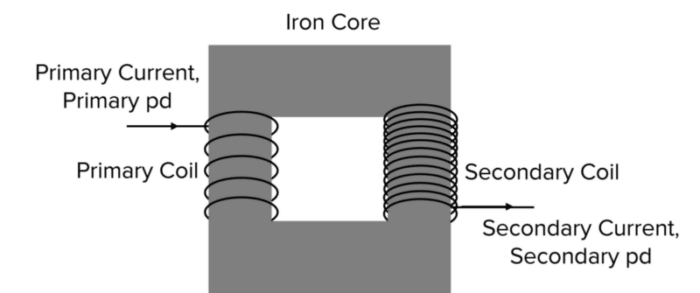
Transformer Calculations
Note
Because transformers are nearly 100% efficient, almost no power is lost when energy moves across a transformer and so we can write:
- = the potential difference in the secondary coil in volts (V)
- = the current in the secondary coil in amps (A)
- = the potential difference in the primary coil in volts (V)
- = the current in the primary coil in amps (A)
Example: Transformer Calculation
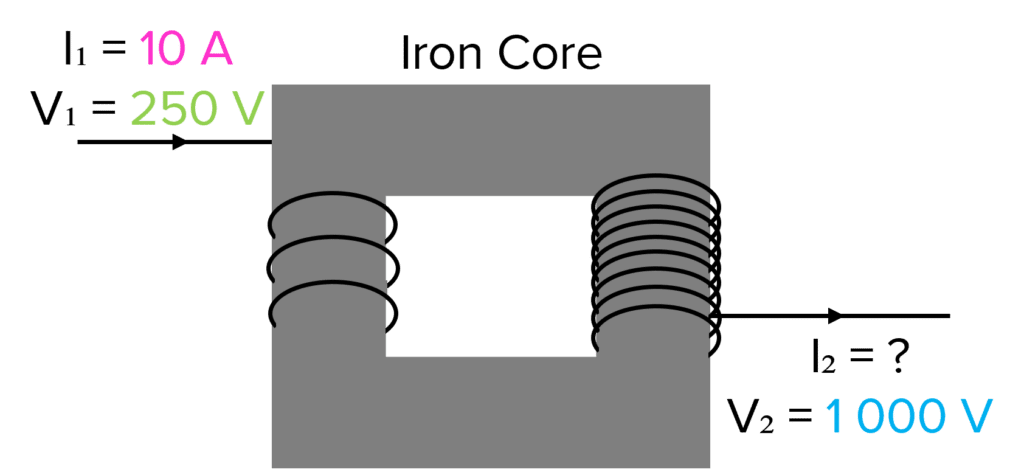
The diagram on the right shows the current and potential difference going into and coming out of a transformer. Calculate the missing value of current.
[2 marks]
Note
Formula