Changes in the Atomic Model (OCR GCSE Physics A (Gateway Science Suite)): Revision Notes
📚Revision Notes
4.1.10 Changes in the Atomic Model
Alpha-Scattering Experiment
Historical Context
- Ancient Greeks:
- Believed everything is made of atoms.
- Atoms are tiny spheres that cannot be divided.
- 1897: Discovery of Electrons
- Scientists discovered that atoms contain tiny negative particles called electrons.
- This showed that atoms are not spheres that cannot be divided and have an internal structure.
Plum-Pudding Model
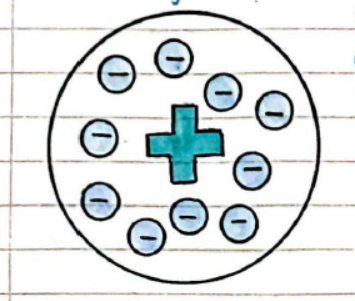
- Suggested that an atom is a ball of positive charge with negative electrons embedded in it.
- The alpha-scattering experiment was carried out to test if this model was correct.
Alpha-Scattering Experiment
- Setup:
- Scientists took a piece of gold foil, which can be hammered into a very thin foil, just a few atoms thick.
- They then fired tiny alpha particles at the gold foil. Alpha particles have a positive charge.
- Observations:
- Most alpha particles passed straight through the gold foil without changing direction.
- Some alpha particles were deflected (changed direction as they passed through).
- Sometimes an alpha particle bounced straight back off the gold foil.
Note
Conclusion:
- Most alpha particles went straight through the gold atoms:
- Therefore, atoms are mainly empty space (the plum-pudding model was wrong).
- Some alpha particles were deflected:
- Therefore, the centre of an atom must have a positive charge. Alpha particles that come close to this area are repelled and change direction.
- Sometimes an alpha particle bounced straight back:
- The centre of an atom must contain a great deal of mass. This central part of an atom is now called the nucleus.
- Impact:
- Scientists replaced the plum-pudding model with the nuclear model.
The Nuclear Model
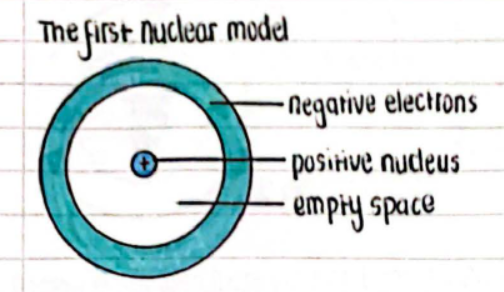
The First Nuclear Model
- Components:
- Negative electrons
- Positive nucleus
- Empty space
- Description:
- Most of the atom is simply empty space.
Niels Bohr's Model
- Electrons:
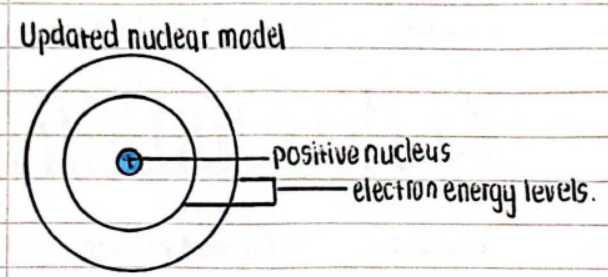
- Electrons orbit the nucleus at specific distances.
- These orbits are now called energy levels or shells.
Updated Nuclear Model
- Components:
- Positive nucleus
- Electron energy levels (shells)
Protons and Neutrons
- Protons:
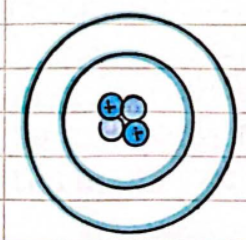
- The positive charge in the nucleus is due to tiny positive particles called protons.
- Neutrons:
- Discovered by James Chadwick; the nucleus also contains neutral particles called neutrons.
Atomic Structure
- Atoms have no overall charge because the number of electrons is the same as the number of protons.
- The radius of an atom:
- The radius of the nucleus:
Subatomic Particles
| Particle | Relative Charge | Relative Mass |
|---|---|---|
| Proton | +1 | 1 |
| Neutron | 0 | 1 |
| Electron | -1 | Very small |