Moments in Physics (OCR GCSE Physics A (Gateway Science Suite)): Revision Notes
📚Revision Notes
5.4.1 Moments in Physics
Moments and Rotation (Physics Only)
Example
Examples of forces causing rotation:
| Situation | Explanation |
|---|---|
| Opening a door | The door is turning on its hinges |
| Seesaw | The seesaw is rotating on a pivot |
| Spanners and a bolt | The spanner turns around the bolt |
Note
Key Points
- When an object is attached to a pivot it is attached to a fixed point about which the object can rotate:
- If a force is applied along a line that passes through the pivot, the object will not rotate and remains stationary.
- If there is a distance between the pivot and the line of action of the force:
- The object will rotate about the pivot in the direction of the applied force.
- If the force is not applied perpendicularly to the object, consider the perpendicular distance from the pivot to the line of force to determine the rotational effect.
Note
The turning effect of a force is called a moment. Moments describe how a force causes an object to rotate around a pivot point.
Note
The size of a moment determines the extent of the rotation:
- A larger moment results in a greater rotational effect.
- A smaller moment results in less rotation.
Note
Moments can be increased. We can increase the size of a moment by either increasing the force applied, or increasing the perpendicular distance from the pivot. Moments can be decreased. We can decrease the size of a moment by either decreasing the force applied, or decreasing the perpendicular distance from the pivot.
Example
Example Bike Riding: Pressing your foot down on the pedal causes a moment about the pivot, turning the pedal arms.
Note
Formula

- Where the moment of a force, , is in Newton-metres , force is in Newtons , and distance is the perpendicular distance from the pivot to the line of action of the force, in metres .
Clockwise and Anticlockwise Moments
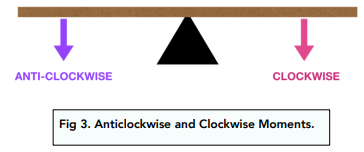
Since moments cause objects to rotate, we can classify them by their direction. The two terms that we use to describe the direction of a moment are clockwise and anticlockwise, as in Fig 3.
Moments, Gears and Levers
Balancing Moments
Note
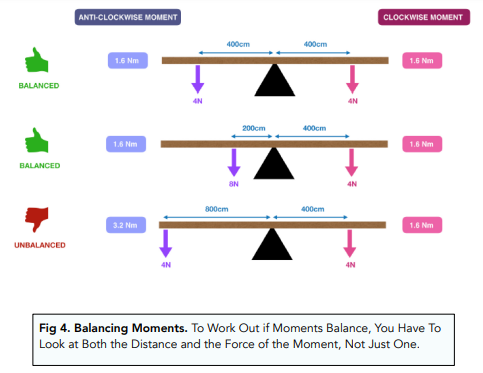
In certain situations, moments can balance each other out and the object will stay still (instead of turning). For this to be the case, the total clockwise moment will be equal to the total anticlockwise moment about a pivot.
If the total clockwise moment doesn't equal the total anti-clockwise moment, the object will rotate:
Equilibrium
- Equilibrium is when the sum of anticlockwise moments = the sum of clockwise moments.