Stopping Distance (OCR GCSE Physics A (Gateway Science Suite)): Revision Notes
📚Revision Notes
5.8.2 Stopping Distance
Vehicle Stopping Distances
- After seeing a hazard:
- Thinking Distance:
- This is how far the car goes before you react. It's the distance you travel while your brain is deciding to hit the brakes.
- Braking Distance:
- This is how far the car travels after you hit the brakes, while the car is slowing down until it comes to a stop.
Note
Formula
Factors Affecting Thinking Distance
- Speed
- Affected by reaction time
- Concentration
- Tiredness
- Distractions
- Influence of drugs/alcohol
Factors Affecting Braking Distance
- Speed
- Poor road conditions (icy, wet)
- Bald tyres (low friction)
- Worn brake pads
- Weight (more passengers)
Speed and Braking Distance
Note
The greater the speed, the greater the distance travelled during the same time (reaction time).
Typical Stopping Distances (Physics Only)
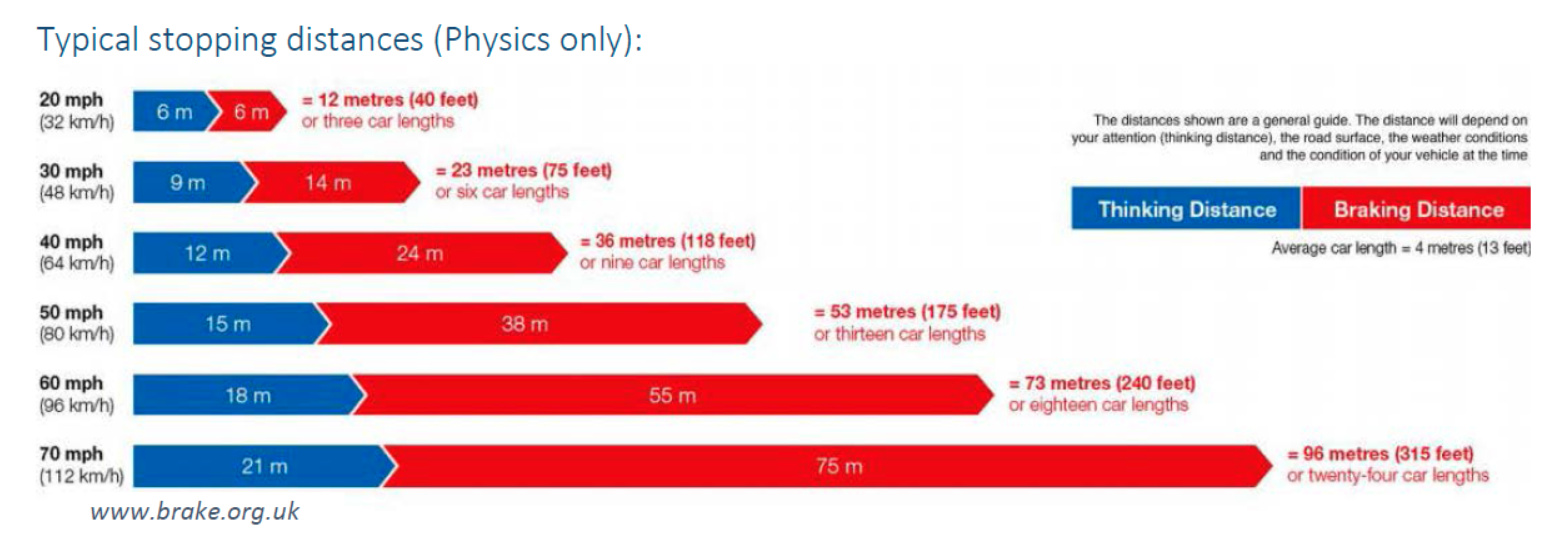
- 20 mph: 6 m (thinking) + 6 m (braking) = 12 m (total)
- 30 mph: 9 m (thinking) + 14 m (braking) = 23 m (total)
- 40 mph: 12 m (thinking) + 24 m (braking) = 36 m (total)
- 50 mph: 15 m (thinking) + 38 m (braking) = 53 m (total)
- 60 mph: 18 m (thinking) + 55 m (braking) = 73 m (total)
- 70 mph: 21 m (thinking) + 75 m (braking) = 96 m (total)
Reaction Times
- Reaction times vary (0.2 – 0.9s for each person).
- Measure reaction times by the "ruler drop":
Note
Drop a ruler through the person's open hand, the time it takes to catch it can be determined by
Where s is the distance the ruler travels through the hand
Braking Mechanics
- When a force is applied to the brakes of a vehicle:
- Work is done by the brakes (by friction) onto the wheel.
- So the vehicle's kinetic energy reduces.
- And the temperature of the brakes increases.
- Greater speed = greater braking force needed to stop the car (over the same distance).
- So greater force = greater acceleration.
- This may lead to brakes overheating and a loss of control, which is dangerous.