Colour & Reflection of Light (OCR GCSE Physics A (Gateway Science Suite)): Revision Notes
📚Revision Notes
6.3.6 Colour & Reflexion of Light
Investigating Refraction of Light
Note
Method
- Gather the equipment. For this experiment, you will need a ray box, a piece of paper, a pencil, a transparent block of material and a protractor.
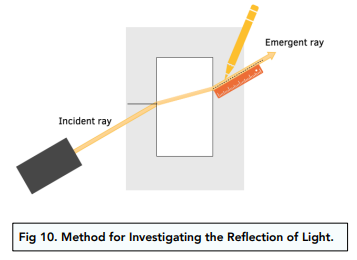
- Set up the equipment. Place the block in the centre of the piece of paper. Trace around the block. Position the ray box so that it can be aimed at the block.
- Draw on the normal. Using a ruler and a protractor, draw on a line that is 90 degrees to the block. This will act as the normal.
- Draw the incident ray. Using the protractor, measure an angle from the normal. Draw a line along this angle and then aim the light ray along it. Trace this ray; it is the incident ray. Make sure to label this ray with the angle.
- Draw the emergent ray. When the ray box is aimed at the block, you will see the incident ray going into the block, and another ray coming out of the other side of the block. This is the emergent ray, which you should draw over using your pencil. Make sure to label this ray with the angle of the incident ray.
- Repeat the experiment. Repeat steps 4 and 5 for a range of angles.
- Remove the block. Now that you have carried out the experiment for a range of angles, you can remove the transparent block. You should be left with a series of lines going into the block and coming out of the block.
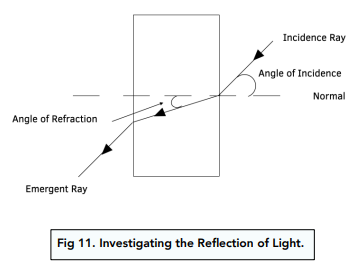
- Join up the rays. Since you have labelled each pair of rays, you can now join them up using rulers. This will show you the refracted ray, which would have been inside the block. Your results should look like the diagram below.
- Measure the angle of refraction. Using the normal, you can measure the angles of refraction using a protractor.