Islam Key Practices: Worship (OCR GCSE Religious Studies): Revision Notes
📚Revision Notes
2.4.4 Salah in Islam
Salah is the second of the Five Pillars of Islam and refers to the obligatory prayers that Muslims perform five times a day. It is a fundamental act of worship that strengthens a Muslim's connection with Allah, provides spiritual discipline, and follows the tradition of the prophets.
Importance of Salah
- Salah is essential as it allows Muslims to communicate directly with Allah.
- It serves as a reminder of the greatness of Allah and the purpose of life.
- Regular prayer helps Muslims to remain focused on their faith, purify their heart, and seek guidance.
The Five Daily Prayers
The Qur'an emphasises the importance of regular prayer, as seen in the verse: "Establish prayer at the decline of the sun [from its meridian] until the darkness of the night and [also] the Qur'an of dawn. Indeed, the recitation of dawn is ever witnessed." (Qur'an 17:78)
Muslims are required to perform five prayers each day, known as Salah. These prayers are:
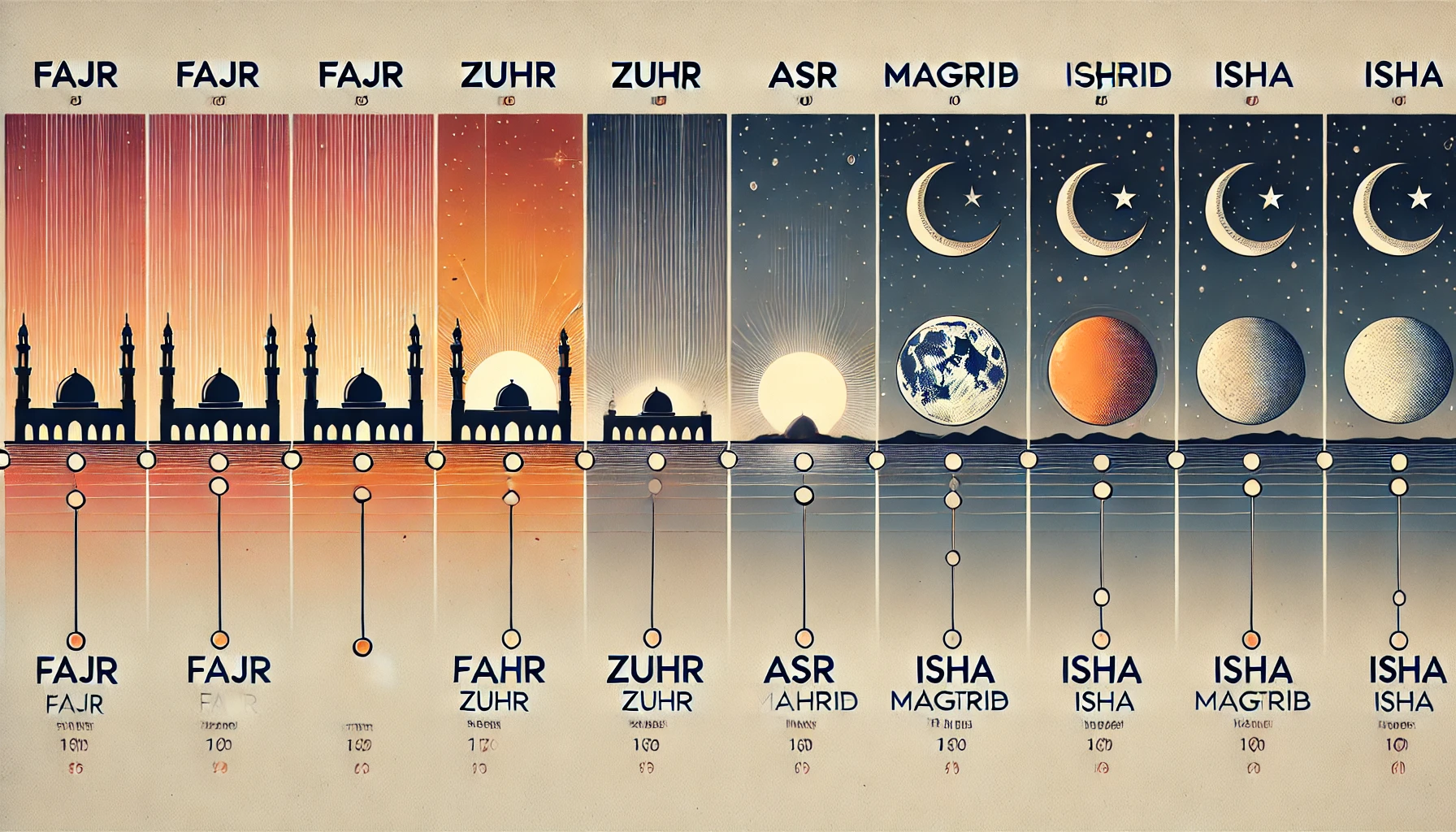
- Fajr - Performed at dawn, before sunrise.
- Dhuhr - Performed after midday, once the sun has passed its highest point.
- Asr - Performed in the afternoon, before the sun sets.
- Maghrib - Performed just after sunset.
- Isha - Performed at night, after twilight has disappeared.
Key Aspects of Salah
To perform Salah properly, Muslims must follow several key steps:
- Wudu (Ablution): Before prayer, a Muslim must perform wudu, which involves washing specific parts of the body to achieve spiritual cleanliness.
- Timing: Each of the five daily prayers must be performed at its specific time. This discipline helps Muslims maintain a regular routine that aligns with the rhythm of the day.
- Facing Makkah: During Salah, Muslims must face the Kaaba in Makkah, which is the holiest site in Islam. This direction is known as the qiblah.
- Physical Postures: The prayer includes a series of movements, known as rak'ah, which involve standing, bowing, prostrating, and sitting. These actions symbolise submission, humility, and devotion to Allah.
- Recitation in Arabic: During Salah, specific verses from the Qur'an and phrases praising Allah are recited in Arabic. The recitations are crucial as they represent the words of Allah and the Prophet Muhammad.
Niyyah (Intention)
Before beginning Salah, a Muslim must have the correct intention, known as niyyah. This means they must consciously intend to pray to Allah. Without proper niyyah, the prayer is considered invalid, as Allah knows the true intentions behind each act of worship.
Additional Prayers
Although the five daily prayers are obligatory, Muslims can perform additional voluntary prayers, known as nafl or sunnah prayers. These extra prayers can be offered at any time and are often done to seek forgiveness, guidance, or express gratitude to Allah.
Visual Aids for Understanding
- Infographic on the Five Daily Prayers: A visual representation showing the names, times, and order of the five daily prayers.
- Diagram of the Rak'ah: A step-by-step visual guide showing the different postures and movements involved in a single rak'ah.
Note
Understanding and practising Salah is central to the life of a Muslim, ensuring a constant reminder of faith and duty towards Allah.