Worship in Sunni & Shi'a Islam (OCR GCSE Religious Studies): Revision Notes
📚Revision Notes
2.4.1 Worship in Sunni & Shi'a Islam
Five Pillars of Sunni Islam
Note
The Five Pillars of Islam are the fundamental acts of worship and practice that form the foundation of a Sunni Muslim's faith and actions. They are:
- Shahada (Declaration of Faith): The Shahada is the declaration that there is no god but Allah, and Muhammad is His Messenger. This statement affirms the monotheistic belief that is central to Islam.
- Salah (Prayer): Sunni Muslims perform Salah five times a day at prescribed times: Fajr (dawn), Dhuhr (midday), Asr (afternoon), Maghrib (sunset), and Isha (night). These prayers are a direct link between the worshipper and Allah.
- Zakat (Charitable Giving): Zakat is the obligation to give a portion of one's wealth to those in need, typically calculated as 2.5% of a person's savings. This practice is meant to purify wealth and distribute resources within the community.
- Sawm (Fasting during Ramadan): During the month of Ramadan, Sunni Muslims fast from dawn until sunset, abstaining from food, drink, and other physical needs. Fasting is seen as a way to develop self-discipline, empathy for the less fortunate, and closeness to Allah.
- Hajj (Pilgrimage to Mecca): Hajj is a pilgrimage to the holy city of Mecca that every Muslim must undertake at least once in their lifetime, if physically and financially able. It occurs annually during the Islamic month of Dhu al-Hijjah and includes several rituals that commemorate the actions of the Prophet Ibrahim and his family.
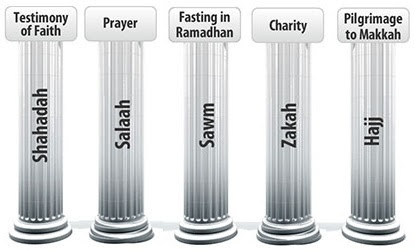
Five pillars of Islam
Ten Obligatory Acts of Shi'a Islam
Note
In addition to the Five Pillars, Shi'a Islam has the Ten Obligatory Acts, which encompass similar practices with additional duties that reflect their unique theological perspectives:
- Salah (Prayer)
- Sawm (Fasting)
- Zakat (Charitable Giving)
- Hajj (Pilgrimage)
- Khums (20% Tax): Shi'a Muslims pay Khums, an additional tax that requires them to give 20% of their surplus income, which is distributed among religious scholars and the poor.
- Jihad (Struggle in the Way of Allah): Jihad is the struggle against sin, injustice, and the inner self, as well as the defence of Islam. Both Sunni and Shi'a Muslims believe in jihad.
- Amr-bil-Ma'ruf (Enjoining Good): Shi'a Muslims are obligated to encourage good behaviour and actions within the community.
- Nahi Anil Munkar (Forbidding Evil): The act of discouraging and preventing wrong or sinful actions in society.
- Tawalla (Loving the Ahl al-Bayt): Shi'a Muslims express devotion and love for the family of the Prophet Muhammad, known as the Ahl al-Bayt.
- Tabarra (Disassociation from Enemies of Ahl al-Bayt): This act involves distancing oneself from those who are considered enemies of the Prophet's family, reflecting the historical and theological divisions that have shaped Shi'a identity.
Enjoin what is right and forbid what is wrong.
— Qur'an 9:71
Jihad in Both Sunni and Shi'a Islam
Jihad, meaning "struggle" or "striving," is an important concept in both Sunni and Shi'a Islam, with slightly different emphases.
In Sunni Islam, jihad is often understood in terms of both the internal struggle against sin (the greater jihad) and the external struggle, which can include defending the Muslim community (the lesser jihad).
Shi'a Islam similarly acknowledges these two aspects of jihad but often places greater emphasis on the internal, spiritual struggle. Additionally, Shi'a views on jihad are heavily influenced by the concept of justice and the historical suffering of the Ahl al-Bayt, leading to a more pronounced focus on fighting against oppression and tyranny in a moral and spiritual context.