Market Equilibrium (Junior Cert Business Studies): Revision Notes
📚Revision Notes
Market Equilibrium
Market equilibrium represents a crucial concept in economics where the forces of supply and demand come together to determine prices in the marketplace. Understanding this concept helps explain how prices are set for goods and services in our economy.
What is market equilibrium?
Market equilibrium occurs when the amount of a product that consumers want to buy exactly matches the amount that producers want to sell. This happens at a specific price point where the demand and supply curves intersect on a graph.
Important
Market equilibrium is the point where quantity demanded equals quantity supplied, creating a balanced market with no shortage or surplus.
When a market reaches equilibrium, both buyers and sellers are satisfied:
- Buyers can purchase the quantity they want at the current price
- Sellers can sell the quantity they want at the current price
- There is no pressure for the price to change
Note
In a perfectly competitive market, equilibrium represents the most efficient allocation of resources, where no waste occurs and both consumer and producer needs are met optimally.
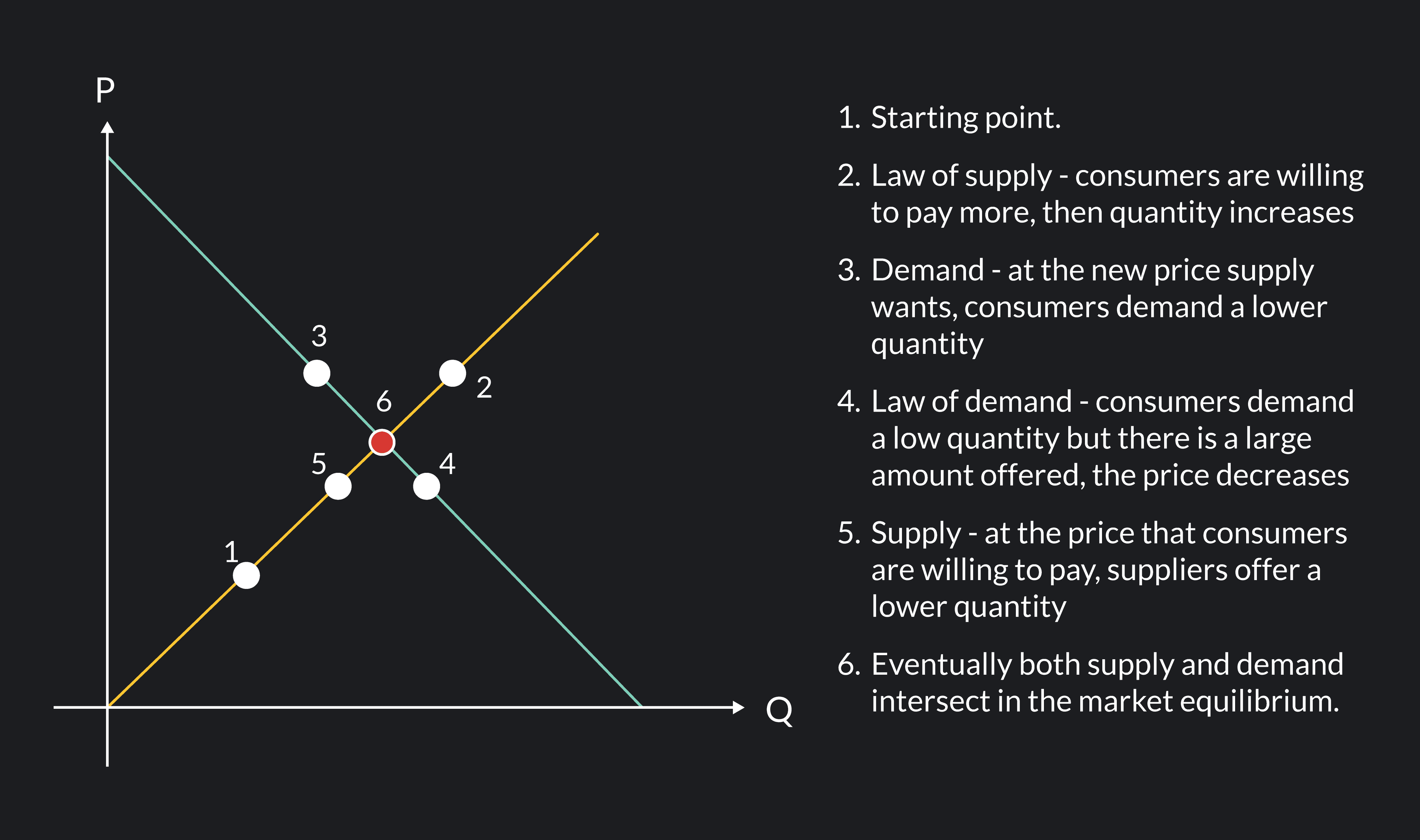
Understanding equilibrium price and quantity
Two key measurements help us understand market equilibrium:
Important
Equilibrium price is the price at which sellers are willing to supply a product and buyers are willing to purchase it.
Important
Equilibrium quantity is the amount of the product that will be bought and sold when the market is in equilibrium.
These values are determined by finding the point where the supply and demand curves meet. For example, if a local bakery's supply and demand curves intersect at €3 per loaf and 50 loaves, then €3 is the equilibrium price and 50 loaves is the equilibrium quantity.
How markets reach equilibrium
Markets naturally move towards equilibrium through the price mechanism. When market conditions change, prices adjust to restore balance:
- When supply increases but demand stays the same, prices tend to fall
- When supply decreases but demand stays the same, prices tend to rise
- When demand increases but supply stays the same, prices tend to rise
- When demand decreases but supply stays the same, prices tend to fall
Example
Real-World Example: Irish Potato Market
If Irish farmers produce more potatoes than usual in a good harvest year:
Step 1: Increased supply shifts the supply curve to the right
Step 2: At the original price, there is now excess supply
Step 3: Sellers lower prices to clear surplus stock
Step 4: New equilibrium is reached at a lower price and higher quantity
What happens when markets are not in equilibrium
Markets don't always stay in perfect balance. When supply and demand are not equal, we see market imbalances that create pressure for price changes.
Excess demand (shortage)
When demand is greater than supply, we have excess demand, also called a shortage. This situation leads to:
- More customers wanting to buy than products available
- Upward pressure on prices
- Sellers potentially raising prices to balance the market
Example
Concert Ticket Example
Concert tickets for a popular Irish band demonstrate excess demand:
- Limited venue capacity (supply constraint)
- High fan interest (strong demand)
- Result: Ticket prices on resale markets increase dramatically
- Market reaches new equilibrium at higher prices
Excess supply (surplus)
When supply is greater than demand, we have excess supply, also called a surplus. This situation leads to:
- More products available than customers wanting to buy
- Downward pressure on prices
- Sellers potentially lowering prices to clear excess stock
Note
Seasonal sales are a common example of businesses responding to excess supply. Retailers reduce prices to move surplus inventory and return to market equilibrium.
Real world examples
Market equilibrium principles apply across many industries:
Example
Agricultural Markets: Irish Beef Industry
The price of Irish beef fluctuates based on equilibrium forces:
- Supply factors: Number of cattle available, farming costs, weather conditions
- Demand factors: Consumer preferences, export opportunities, health concerns
- Historical impact: When BSE concerns reduced demand, prices fell until new equilibrium was restored at lower price levels
Example
Housing Market: Dublin Property Prices
Property prices in Dublin reflect equilibrium between:
- Supply: New builds, existing properties for sale, planning permissions
- Demand: Population growth, employment levels, investment interest
- Result: Limited supply and high demand has pushed Dublin house prices up significantly until equilibrium is reached
Example
Labour Markets: Professional Football
Professional footballers' salaries demonstrate equilibrium in specialised labour markets:
- Supply: Limited number of players with exceptional skills
- Demand: Clubs competing for talent, revenue generation potential
- Equilibrium: High wages reflect the balance between scarce supply and strong demand
Summary
Key Points to Remember:
- Market equilibrium occurs when quantity demanded equals quantity supplied
- Equilibrium price is where buyers and sellers agree on value
- Excess demand (shortage) pushes prices up
- Excess supply (surplus) pushes prices down
- Markets naturally move towards equilibrium through price adjustments
- Real-world markets constantly adjust to find new equilibrium points as conditions change