Investigating Design (Junior Cert Engineering): Revision Notes
📚Revision Notes
Investigating Design
Design is a fundamental skill that combines creativity with problem-solving. When we investigate design, we're exploring how to create effective solutions that meet people's needs while considering both visual appeal and practical functionality.
What is investigating design?
Investigating design means examining how we create, solve problems, and make decisions when developing new products or solutions. This process involves thinking creatively, working independently or with others, and applying knowledge from various subjects to real-world challenges.
Note
Design investigation also means recognising what makes good designs effective. By studying familiar objects like tools, furniture, or items found in nature such as honeycombs and spider webs, we can understand how successful designs balance function, appearance, cost, and construction. Generally, the simpler a design is, the better it works - provided it still fulfils its intended purpose.
As you develop your design skills, you'll gain confidence to tackle increasingly complex problems. However, it's important to have your teacher check your solutions for practicality and feasibility before proceeding to construction.
Important
Always have your teacher check your solutions for practicality and feasibility before proceeding to construction.
Visual design principles
Understanding how visual elements affect appearance is crucial for effective design investigation.
Lines, forms and colours
When investigating any design, you need to consider how different visual elements work together to create the desired effect.
Lines significantly impact how we perceive objects. They can be used strategically to create interesting shapes and patterns:
- Vertical lines make objects appear taller than they actually are
- Horizontal lines give objects a broader appearance
- Curved and sloping lines suggest movement and speed

Form refers to the three-dimensional shape of an object. Forms can be geometric (like cubes or spheres) or irregular in shape.
Colour affects how we perceive and respond to designs. Colours can make objects appear bright, dark, dull, rich, warm, or cool. While materials have natural colours that can be attractive, they can also be modified through painting or other finishes. Colours should be chosen to either harmonise with each other or create deliberate contrast.

Rhythm, proportion and balance
These principles help create visually pleasing and effective designs:
Rhythm can be achieved through the repetition of lines, curves, shapes, forms, and colours. This creates a sense of pattern and flow in the design.
Proportion involves the relationship between the sizes of different parts within a design. Good proportion means making components the right size relative to each other and to the whole design.
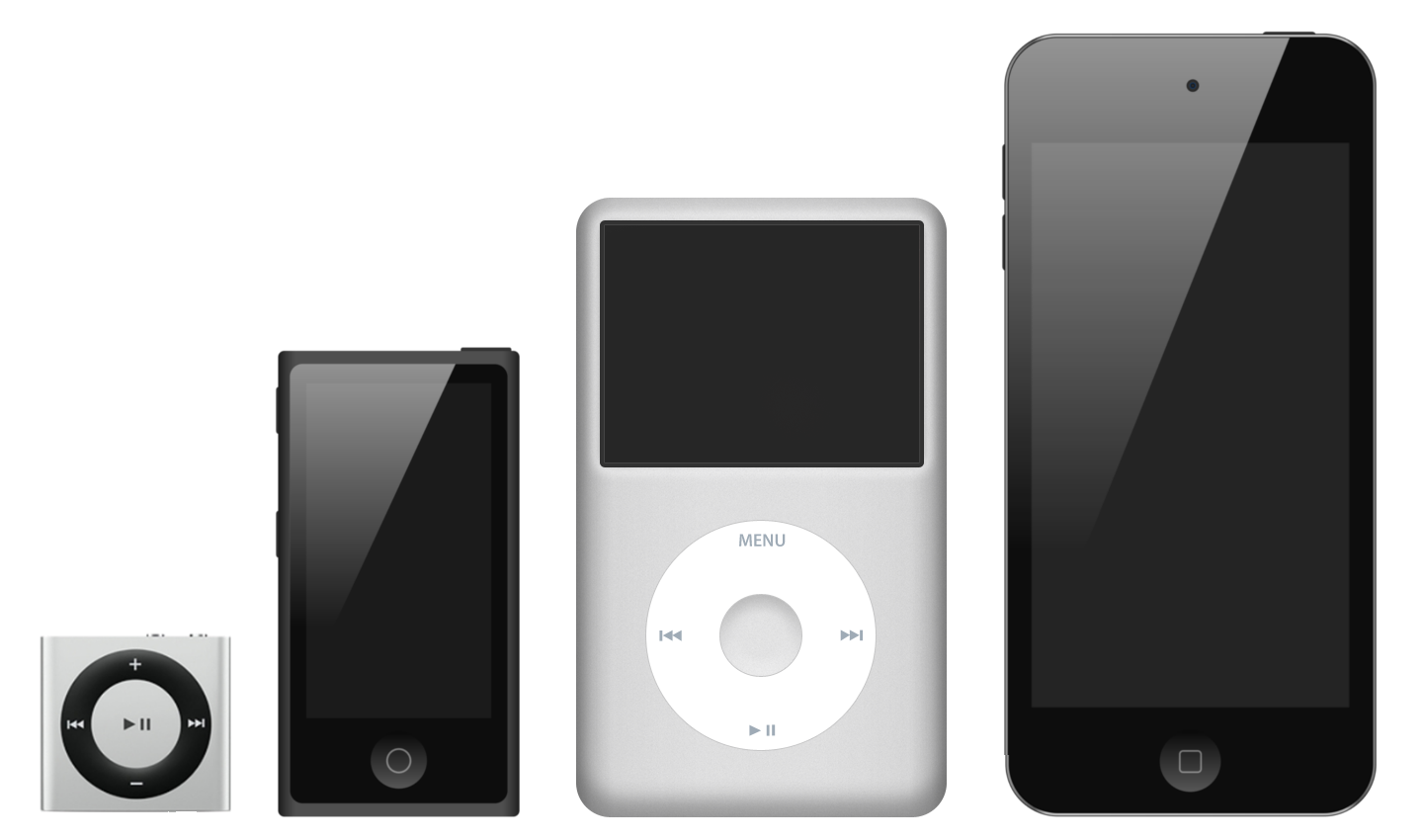
Balance can be achieved by having similar elements on each side of a central line, though visual balance can also be created through other arrangements of elements.
Ergonomics
Ergonomics is the science of designing products and systems that work well with human capabilities and limitations. This field brings together knowledge from anthropometry, physiology, psychology, and sociology to create designs that are comfortable, efficient, safe, and stress-free to use.
Anthropometry
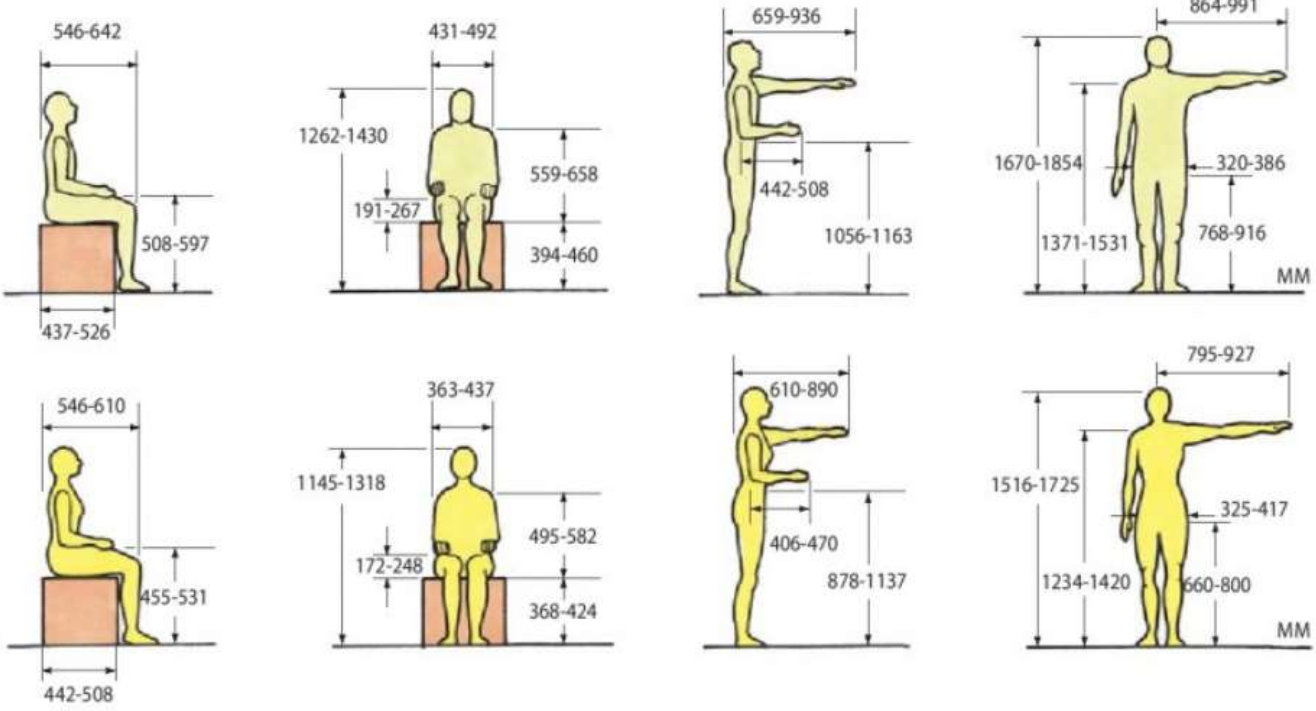
Anthropometry involves collecting and using data about human body measurements and dimensions. This information is essential when designing furniture, workstations, vehicles, and other products that people interact with physically.
Example
Practical Application: Chair and Table Design
When designing chairs and tables, the dimensions must accommodate the range of human body sizes to ensure comfort and usability for different users. This requires considering height ranges, reach distances, and body proportions across different populations.
Physiological factors
These factors relate to people's physical abilities and limitations, including strength, stamina, and coordination. Designers must consider these when creating products that require physical interaction.
For instance, car controls must be positioned where they're easily accessible and operable by drivers with varying physical capabilities.
Psychological factors
Our senses provide information about our surroundings, and designers can incorporate features that help people respond appropriately to sensory information:
Sound is widely used to indicate operations or warn of risks. Examples include reversing truck alarms, alarm clocks, smoke detectors, whistling kettles, and car horns.
Colours serve important communication functions. Red, orange, and green are commonly used for safety features and information systems, such as traffic lights. Colours in homes and workplaces can also affect people's moods and well-being.
Social factors
These factors consider how designs affect different groups of people, including those with disabilities, children, and elderly users.

Important
Accessibility must be considered when designing buildings and transport systems. For example, doors need to be wide enough for wheelchair access. Special care must be taken when designing children's products to ensure safety, such as avoiding small detachable parts that could present choking hazards.
The design process
The design process is a structured approach for solving problems systematically. It involves breaking work into stages, with each stage building on the previous one. This process can be called a design cycle or design loop because it often requires returning to earlier stages to refine solutions.
Design brief
The design brief provides a clear description of the problem to be solved. It may identify a specific need, problem, or situation that requires a design solution. A good brief gives clear guidance to get started while leaving room for creative innovation.
Search for information
This stage involves gaining a deeper understanding of the problem, including its functions, properties, limits, and restrictions. This process creates a specification - a detailed list of requirements the solution must meet.
A useful approach is to structure your information search around the "five Ws":
- What is the purpose of the solution?
- Where will it be used?
- Who will use it?
- When will it be used?
- Why will it be used?
You should also consider questions about limits, restrictions, safety issues, and appearance requirements.
Note
Information Gathering Methods:
Methods for gathering information include:
- Interviewing people
- Visiting libraries and reading books and magazines
- Visiting shops and exhibitions
- Examining existing or related solutions
- Writing to relevant companies
- Searching for information on the internet
A bubble chart can be a useful method for recording information during your research, allowing you to add information outwards from a central topic.
Research ideas
This stage involves generating potential solutions through creative thinking. You should explore completely new ideas, adapt existing solutions, and look to nature for inspiration. Use sketches and notes to capture and develop your ideas.
Brainstorming is an effective group activity where everyone contributes ideas to solve the problem. Ideas are shared and can lead to further developments and modifications. Focus on generating a large variety of solutions rather than getting caught up in details at this stage.
A useful approach is to break the problem into sections, develop solutions for each section, then explore different combinations of partial solutions to create complete design options.
Develop ideas
Once you have multiple ideas, select the most promising ones and develop them further. Compare the functions and properties of each idea with your specification requirements and criteria. Check how well each idea addresses the original problem.
Use sketches, notes, and prototypes to develop your ideas further. Sketches should include plans and elevations to show the complete design and how it might be improved. Cut-away views and exploded views help show how parts fit together.
Prototypes are particularly valuable for testing proportions, size, and functionality. They can often be made from simple materials like cardboard or hardboard and should be full-size when possible.
Produce drawings
This stage involves creating detailed working drawings that enable the product to be manufactured. These technical drawings must clearly show the shape of each part and provide all necessary dimensions for construction.
Orthographic projection (plans and elevations) are typically used, along with multiple views of individual parts. Cut-away views and sections may be needed to clarify hidden details, and pictorial views sometimes help show overall assembly.
Materials selection
Several factors must be considered when selecting materials:
- Availability - Is the material accessible in the required form?
- Properties - Does the material have the necessary characteristics?
- Cost - Is the material affordable for the project?
- Methods - Can the material be shaped and joined using available techniques?
Important
Before finalising material choices, ensure you can work with them safely and that you have access to appropriate tools and equipment.
Manufacturing
Manufacturing involves several key procedures:
- Planning the sequence of operations for making parts
- Creating a timetable for completing various stages
- Ensuring access to necessary tools and equipment
- Designing and making any special tools required (templates, jigs, formers, moulds)
- Following safety precautions when using tools and equipment
- Marking out materials accurately
- Working to high standards of accuracy to ensure parts fit together properly
- Protecting surface finishes and achieving high-quality results
Test and modify
Testing determines whether the product works as intended and meets the requirements specified in the brief. If the design fails to function satisfactorily, examine each component to identify problems and make necessary adjustments or modifications.
In some cases, testing may reveal that parts need to be redesigned and remade to achieve proper functionality.
Evaluation
The final stage involves comprehensive testing to determine how well the solution addresses the original problem. Compare the finished product against your specifications and success criteria. This evaluation connects back to the original brief.
If the solution isn't satisfactory, you may need to modify the design or return to an earlier stage in the design process to develop alternative approaches.
Summary
Key Points to Remember:
- Design involves creative problem-solving that combines thinking, making, and practical application of knowledge
- Visual elements like lines, forms, and colours significantly impact how designs are perceived and used
- Ergonomics ensures designs work well with human capabilities by considering physical, psychological, and social factors
- The design process provides a systematic approach to problem-solving through clearly defined stages
- Each stage of the design process builds on previous work, and you may need to revisit earlier stages to refine your solution