Electronic Systems & Devices (Junior Cert Engineering): Revision Notes
📚Revision Notes
Electronic Systems & Devices
Introduction to electronics
Electronics has transformed our modern world dramatically. We now live in what many call the electronic age because electronic devices are everywhere in our daily lives. From smartphones and tablets to washing machines and central heating systems, electronics controls and powers much of our technology.

Electronic devices have made many incredible achievements possible, including space travel, safer aviation, global television broadcasts from space, and connecting computers worldwide through the internet. Understanding how these systems work helps us appreciate the technology that surrounds us.
Note
The rapid advancement of electronics has accelerated dramatically since the invention of the transistor in 1947, leading to the digital revolution that defines our modern era.
The systems model
All electronic systems follow a simple three-stage process that helps us understand how they work. This is called the systems model.
Important
The Systems Model is Fundamental
Every electronic system, no matter how complex, can be broken down into these three basic elements. This model is essential for understanding, analysing, and designing any electronic device.
Every electronic system contains three main elements:
- Input: Sensors that respond to changes in their surroundings, such as temperature sensors, light sensors, and moisture sensors
- Process: Units that react to changes detected by input sensors and then control output devices accordingly
- Output: Devices that produce useful results, including bulbs, bells, buzzers, and electric motors
This three-stage approach makes it easier to analyse and design electronic circuits by breaking them down into manageable parts.
Input devices
Input devices are components that either provide power to a system or detect changes in the environment. Let's examine the most important types:
Batteries
Batteries are essential power sources for portable electronic devices. They convert chemical energy into electrical energy and come in many different sizes and shapes.
Batteries are compact and portable, making them ideal for powering everything from calculators to mobile phones. In circuit diagrams, batteries are represented by two parallel lines of different lengths, with dashed lines connecting them to show multiple cells.
Note
Battery voltage depends on the chemical composition - alkaline batteries provide 1.5V per cell, while rechargeable NiMH batteries provide 1.2V per cell.
Switches
Switches are used to make or break electrical circuits, controlling whether current can flow through a circuit or not.
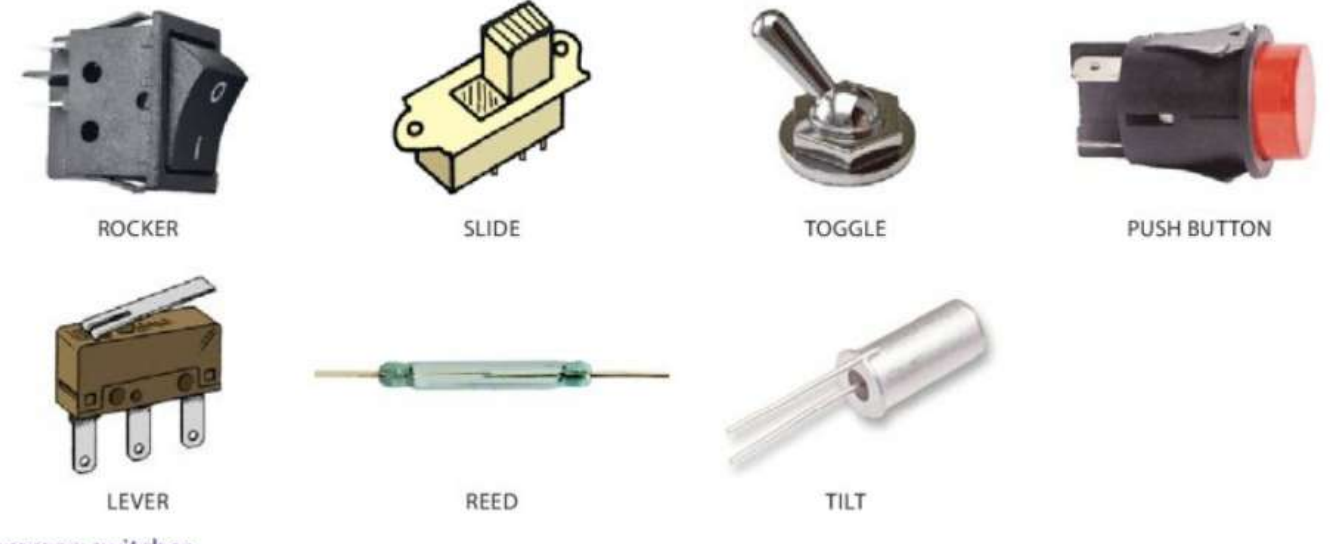
There are many different types of switches available:
- Rocker switches: Toggle up and down
- Slide switches: Move horizontally
- Toggle switches: Flip with a lever
- Push button switches: Press to activate
- Lever switches: Also called microswitches
- Reed switches: Activate with magnets
- Tilt switches: Respond to movement
Switch terminology and symbols
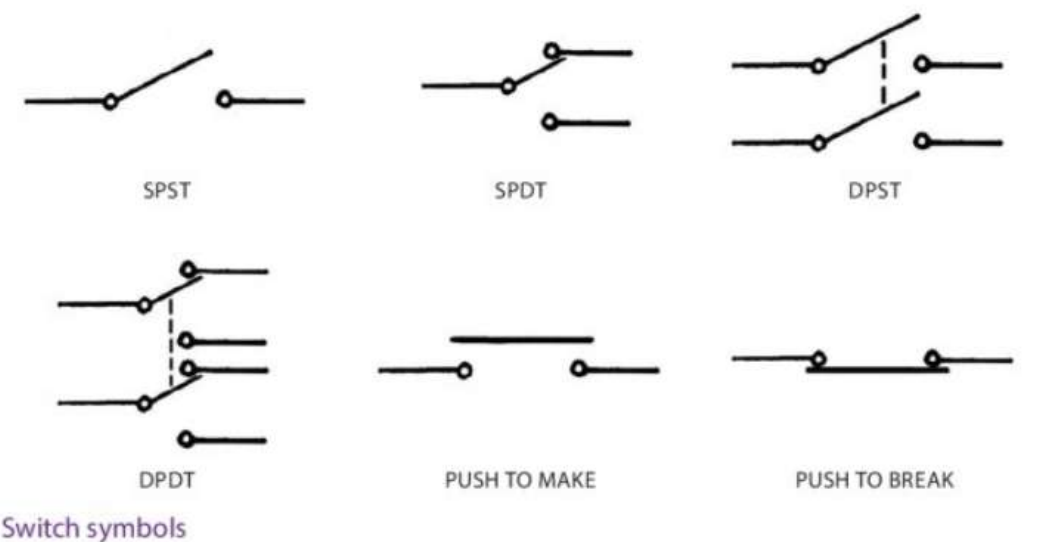
Switches are classified using specific terminology that describes their capabilities:
- Poles (P): The number of separate circuits the switch can control
- Throws (T): The number of positions each pole can be switched to
- S stands for "Single" and D stands for "Double"
Important
Switch Classification System
Understanding the SPST, SPDT, DPST, and DPDT classification system is crucial for selecting the right switch for your circuit. Always consider both the number of circuits you need to control (poles) and the switching positions required (throws).
Common switch types include:
- SPST (Single Pole Single Throw): Controls one circuit with on/off positions
- SPDT (Single Pole Double Throw): Controls one circuit with three positions
- DPST (Double Pole Single Throw): Controls two circuits with on/off positions
- DPDT (Double Pole Double Throw): Controls two circuits with three positions each
- Push to Make: Normally open, closes when pressed
- Push to Break: Normally closed, opens when pressed
Resistors
Resistors are components that reduce the amount of current flowing in a circuit. They follow a simple principle: the greater the resistance, the lower the current.
Fixed resistors have a constant resistance value that cannot be changed. Their resistance values are indicated by coloured bands around the component, following a standard colour code system.
Variable resistors can be adjusted to change their resistance value. There are two main types:
- Potentiometers (spindle type): These have three terminals and can be adjusted by turning a spindle. They're commonly used to control motor speeds, speaker volumes, and light brightness
- Preset resistors: These are smaller and designed for fine-tuning circuits during setup, adjusted using a small screwdriver
Note
The relationship between voltage, current, and resistance follows Ohm's Law: V = I × R, where voltage (V) equals current (I) multiplied by resistance (R).
Capacitors
Capacitors are components that store electrical energy, similar to tiny rechargeable batteries. The unit of capacitance (storing ability) is the farad (F), though microfarads (μF) are more commonly used because farads are very large units.
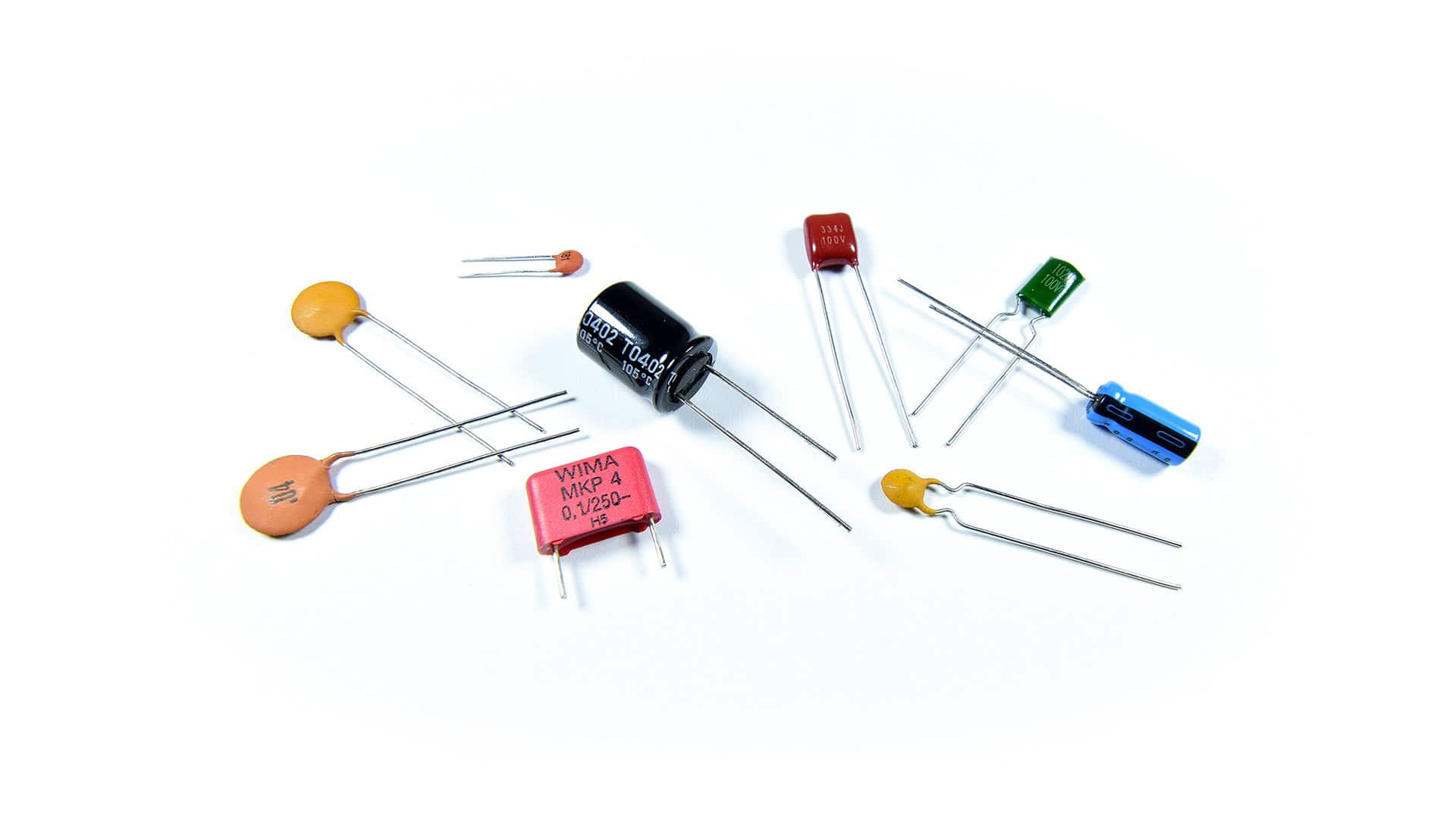
There are several types of capacitors:
- Ceramic capacitors: Non-polarised, meaning they can be connected either way round in a circuit
- Electrolytic capacitors: Polarised, meaning their positive terminal must be connected to the positive side of the circuit
- Variable capacitors: Can be adjusted and were historically used for tuning analogue radios
Important
Capacitor Polarity Warning
Always check if a capacitor is polarised before connecting it. Electrolytic capacitors can be damaged or even explode if connected with reverse polarity. Look for the positive (+) marking or the negative band indicator.
Diodes
Diodes are components that allow electrical current to flow in only one direction. This makes them useful for protecting other components in a circuit from damage caused by current flowing the wrong way.
Key features of diodes:
- A coloured band indicates the negative end (cathode)
- The positive end must be connected to the positive side of a battery
- They act like one-way valves for electricity
- Essential for circuit protection
Note
The voltage drop across a silicon diode is approximately 0.7V when conducting, which is important to consider in circuit calculations.
Sensors
Sensors are special input devices that detect changes in their environment and convert these changes into electrical signals.
Thermistors
Thermistors are temperature-dependent sensors that change their resistance when the temperature changes. The most common type decreases in resistance as temperature increases. They come in rod and disc shapes and are represented by a zigzag resistor symbol in circuit diagrams.
Light dependent resistors (LDRs)
LDRs are light sensors whose resistance changes based on the amount of light falling on them. They have high resistance in darkness and low resistance in bright light. This makes them perfect for automatic lighting systems and security devices.

Moisture sensors
These sensors detect the presence of water by measuring electrical conductivity. When water bridges the gap between exposed wires, it completes a circuit. However, safety is crucial - never use high voltage supplies with moisture sensors as this could be dangerous.
Important
Moisture Sensor Safety
Always use low voltage supplies (under 12V) with moisture sensors. High voltages combined with water create serious safety hazards and can cause electric shock.
Process units
Process units are components that control and manipulate electrical signals, acting as the "brain" of electronic systems.
Transistors
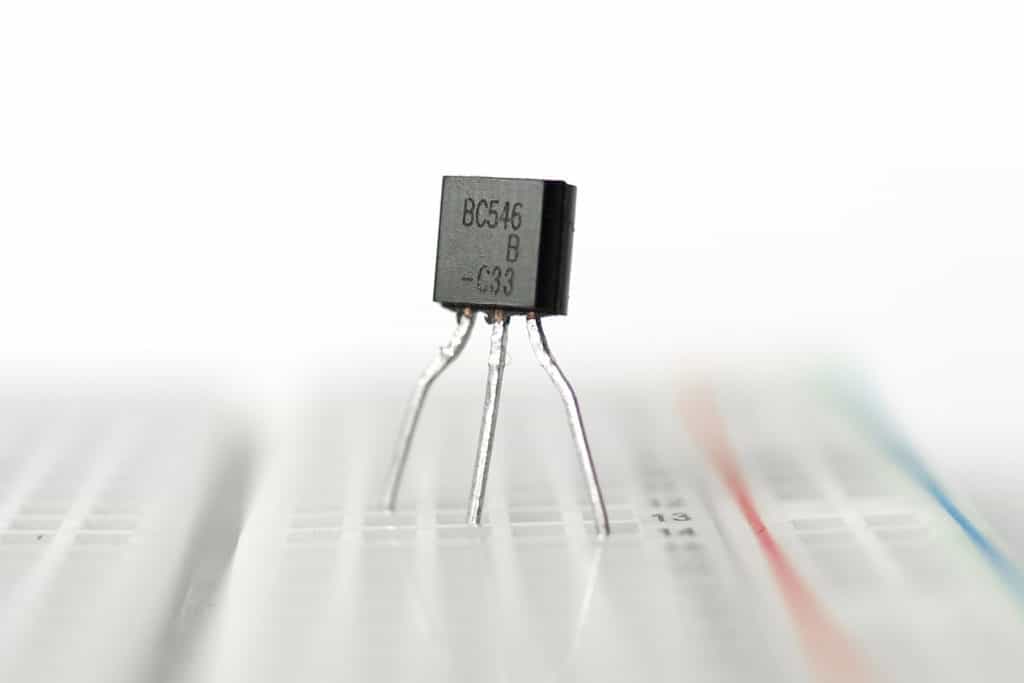
Transistors are revolutionary devices that can act as both electronic switches and amplifiers. They have three terminals:
- Collector (c): Where current enters
- Base (b): The control terminal
- Emitter (e): Where current exits
There are two main types:
- NPN transistors: Current flows from collector to emitter when base is positive
- PNP transistors: Current flows from emitter to collector when base is negative
For silicon transistors, approximately 0.6V applied to the base is needed for switching. When functioning as a switch, a small change in base current causes a large change in collector-emitter current, making them excellent amplifiers.
Important
The Transistor Revolution
Transistors revolutionised electronics by replacing bulky vacuum tubes. Their invention in 1947 made modern computers, smartphones, and virtually all digital technology possible. Without transistors, the electronic age as we know it would not exist.
Integrated circuits (ICs)
Integrated circuits are miniature electronic circuits built on tiny silicon chips, typically no larger than 5mm². They contain multiple transistors, resistors, capacitors, and other components all connected together.
555 Timer IC
The 555 timer is one of the most popular ICs, featuring eight pins numbered 1-8. It can operate in two modes:
- Monostable: Has one stable state, used for switching outputs on or off for fixed time periods
- Astable: Has no stable state, used for making lights flash at regular intervals
IC Voltage Regulator
Voltage regulators maintain constant output voltages (such as 5V or 12V) regardless of input voltage variations. This ensures other components receive stable power supply, protecting them from damage.
Example
Worked Example: 555 Timer in Astable Mode
Step 1: In astable mode, the 555 timer continuously switches between high and low outputs Step 2: The timing is controlled by two resistors (R1 and R2) and one capacitor (C1) Step 3: Flash rate = 1.44 ÷ ((R1 + 2×R2) × C1) Step 4: For R1=1kΩ, R2=2kΩ, C1=100μF: Flash rate = 1.44 ÷ (5000 × 0.0001) = 2.88 Hz
Output devices
Output devices convert electrical energy into other useful forms of energy like light, sound, or movement.
Light-producing devices
Bulbs convert electrical energy into both light and heat energy through their filament. They can be connected either way round in a circuit and are commonly used for illumination.
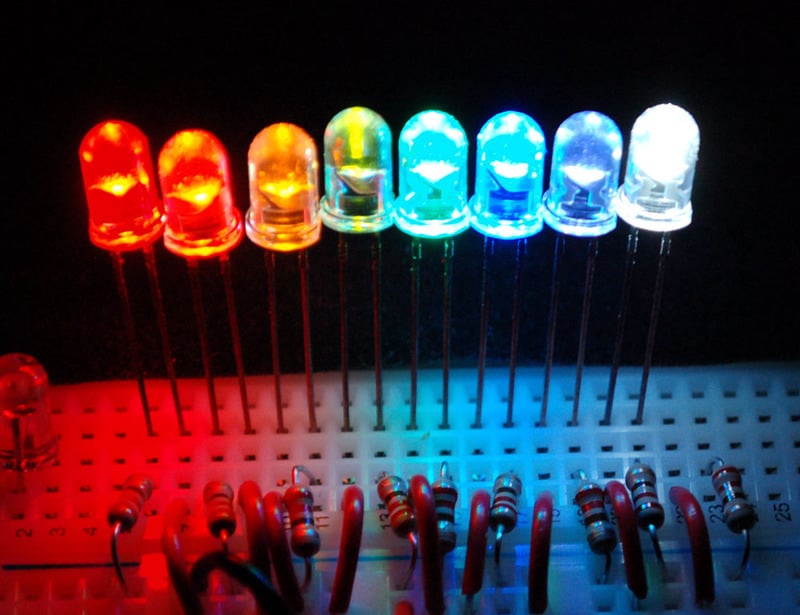
Light-emitting diodes (LEDs) are highly efficient light sources available in various colours including red, green, and amber. Key advantages include:
- Very long lifespan
- Low power consumption
- Minimal heat production
- Relatively inexpensive
However, LEDs must be connected correctly (anode to positive, cathode to negative) and typically need a series resistor to limit current and prevent damage.
Note
LEDs are so efficient that they convert almost 90% of electrical energy into light, compared to traditional bulbs which waste about 90% of energy as heat.
Sound-producing devices
Electric bells use electromagnets to make a hammer strike a gong, converting electrical energy into sound energy. The electromagnetic mechanism creates the striking action that produces the ringing sound.
Buzzers produce continuous sound and convert electrical energy directly into sound energy. Unlike bells, they create steady tones rather than intermittent strikes. Buzzers must be connected with correct polarity to function properly.
Loudspeakers produce continuous sounds, musical notes, or speech by converting electrical energy into sound energy. They use electromagnetic coils and diaphragms to create sound waves that can reproduce complex audio signals.
Motors
Motors convert electrical energy into mechanical energy, producing rotary motion that can power various mechanisms.
Small DC motors are useful for project work and can rotate in either direction by changing their positive and negative connections. They're commonly found in toys, fans, and small appliances.
Stepper motors provide precise movement control, allowing rotation to be controlled to fractions of a revolution. They're essential where accurate positioning is required, such as in CNC machines and 3D printers.
Servo motors offer extremely accurate positioning by rotating output shafts through precise angles. They contain internal feedback systems with position sensors that communicate with control units. Simple servos use potentiometers for position feedback and are popular in radio-controlled models, while sophisticated versions with both position and speed feedback are used in robotics and automated manufacturing.

Note
Servo motors are different from regular motors because they include built-in control systems that automatically adjust to maintain the desired position, making them ideal for precision applications.
Remember!
Summary
Key Points to Remember:
- All electronic systems follow the Input-Process-Output model - this helps you analyse any electronic device
- Polarity matters for many components - diodes, LEDs, electrolytic capacitors, and buzzers must be connected the correct way round
- Switches are classified by poles and throws - remember SPST, SPDT, DPST, and DPDT abbreviations
- Sensors convert environmental changes into electrical signals - thermistors respond to temperature, LDRs to light, and moisture sensors to water
- Transistors revolutionised electronics - they can act as both switches and amplifiers, making complex circuits possible