Structures (Junior Cert Engineering): Revision Notes
📚Revision Notes
Structures
What are structures?
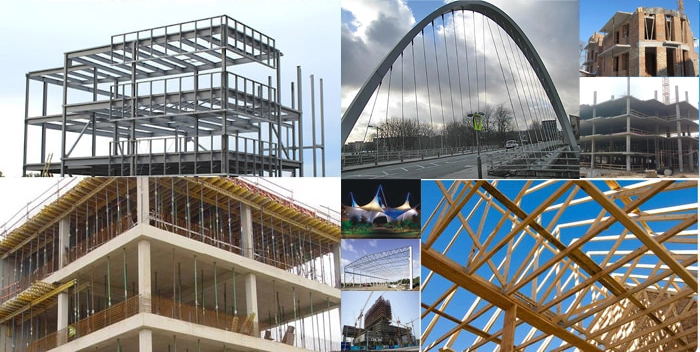
Structures are fundamental elements in engineering that serve a crucial purpose - they support and carry loads without failing or collapsing. Engineers design structures to remain stable when various forces act upon them. You can find structures everywhere around you, from simple chairs and tables to complex buildings, bridges, cranes, trains, and cars.
Note
The key to successful structural design is understanding how different forces affect materials and ensuring the structure can handle these forces safely. This fundamental principle underlies all engineering design decisions.
Types of forces acting on structures
When loads are applied to structures, they create different types of forces that engineers must consider. There are five main types of forces that can act on structural elements:
Important
Understanding these five force types is essential for any structural engineer. Each force affects materials differently and requires specific design considerations to ensure safety and stability.
Compression
Compression occurs when forces push inward on a structural member, trying to squash or crush it. Think of a column supporting a building - the weight above pushes down and compresses the column. Materials under compression are being squeezed together.
Tension
Tension is the opposite of compression. It happens when forces pull outward on a structural member, trying to stretch or tear it apart. A rope holding a heavy load experiences tension - the forces are trying to pull the rope apart at both ends.
Bending
Bending forces cause structural members to curve or deflect. When you stand in the middle of a plank, it bends downward under your weight. The top of the beam becomes compressed while the bottom becomes stretched (in tension).
Shear
Shear forces act parallel to the surface of a material, trying to slide one part past another. It's like trying to cut through a material with scissors - the forces act in opposite directions along the same plane.
Torsion
Torsion involves twisting forces that try to rotate one end of a structural member relative to the other end. When you turn a screwdriver, you're applying torsion to twist it.

Static vs dynamic loads
Engineers must also consider whether loads are static or dynamic:
- Static loads remain constant and don't change over time. A car parked on a bridge creates a static load.
- Dynamic loads change with time and can include movement or vibration. The same car driving across the bridge creates a dynamic load that varies as it moves.
Note
Dynamic loads are often more challenging to design for because they can create additional stresses and vibrations in the structure. Engineers must account for these variable forces to ensure structural integrity under all operating conditions.
Shape of structure members
The shape and orientation of structural members greatly influence their strength and performance. This is a crucial principle in structural engineering.
Hollow sections are particularly important because they can be both rigid and lightweight. The shape provides excellent resistance to bending while using less material than solid sections. You can see this principle in bicycle frames, scaffolding poles, and many building structures.
Note
The depth and corrugation (ridged patterns) of structural members also contribute significantly to their ability to resist bending forces. Deeper beams are typically stronger in bending than shallow ones.
Triangulation in structures
Triangulation is one of the most important principles in structural design. Triangles are naturally rigid shapes - once you fix the lengths of all three sides, the shape cannot be deformed without breaking one of the sides.

Important
Triangles are the only polygon that is naturally stable. This geometric property makes triangulation fundamental to creating strong, stable structures that can resist deformation under load.
Engineers use triangulation extensively to create stable structures. By arranging structural members in triangular patterns, they can build strong, rigid frameworks that resist deformation. You can see triangulation in:
- Bridge trusses
- Roof structures
- Crane jibs
- Electricity pylons
- Telephone poles
The method of using triangular arrangements to make structures stable is called triangulation. This principle allows engineers to create very strong structures using relatively lightweight materials.
Examples of iconic structures
The Samuel Beckett Bridge, Dublin

Example
Engineering Example: Cable-Stayed Bridge Design
The Samuel Beckett Bridge demonstrates how modern engineering combines form and function. The bridge uses 31 cable stays arranged to resemble a harp, efficiently transferring loads from the bridge deck to the main tower through tension in the cables.
Key engineering features:
- Cable-stayed design for spanning the River Liffey
- Artistic harp-like appearance while maintaining structural integrity
- Load transfer through tensioned cables to central tower
The bridge was named after Irish writer Samuel Beckett and officially opened to pedestrians in December 2009. It won Engineers Ireland's "Engineering Project of the Year" award in 2010, recognising its innovative design and engineering excellence.
The Atomium, Brussels

The Atomium in Brussels, Belgium, represents an extraordinary example of structural engineering combined with artistic vision. This structure represents a body-centred cubic (BCC) crystal structure - specifically the unit cell of an iron crystal magnified 165 billion times.
Example
Engineering Example: Complex Geometric Structure
Built for the 1958 Brussels World Exposition, the Atomium demonstrates how engineers can create complex three-dimensional structures while maintaining structural stability.
Design specifications:
- Nine large spheres connected by structural tubes
- Six spheres accessible to public through 3-metre diameter connecting tubes
- Represents iron crystal structure magnified 165 billion times
- Combines artistic vision with structural engineering principles

Large suspension bridges like this one demonstrate how triangulation and cable systems work together to span enormous distances while carrying heavy traffic loads.
Key structural design principles
Understanding structures involves recognising how forces flow through different members and how the overall geometry affects stability. Engineers must consider:
- Material properties - How different materials respond to various forces
- Load paths - How forces travel through the structure from their point of application to the foundations
- Safety factors - Designing structures to handle much more load than expected
- Environmental effects - How weather, temperature changes, and other factors affect structural performance
Summary
Key Points to Remember:
-
Structures must be designed to carry loads safely - They support everything from people to vehicles to building contents without collapsing.
-
Five main forces affect structures - Compression (squashing), tension (pulling), bending (curving), shear (sliding), and torsion (twisting).
-
Triangulation creates stability - Triangular arrangements of structural members provide excellent rigidity and strength using minimal material.
-
Shape matters for strength - Hollow sections and proper orientation of structural members greatly influence their load-carrying capacity.
-
Real structures demonstrate these principles - From cable-stayed bridges to crystal-inspired monuments, successful structures apply fundamental engineering principles in creative ways.