Spelling & Grammar Tips (Junior Cert English): Revision Notes
📚Revision Notes
Spelling & Grammar Tips
Understanding proper spelling and grammar is essential for clear communication in your Junior Cycle studies. These fundamental language skills will help you express your ideas effectively across all subjects. Let's explore the key punctuation rules and spelling strategies that will improve your writing.
Punctuation essentials
Note
Think of punctuation marks as traffic signals for your writing - they guide readers through your thoughts and help them understand your meaning clearly.
Each punctuation mark has specific rules and purposes that, when used correctly, make your writing more professional and easier to understand. Mastering these fundamentals will significantly improve your communication skills across all subjects.
Using commas effectively
Commas are among the most frequently used punctuation marks, and learning to use them properly will significantly improve your writing clarity. They serve several important functions in creating well-structured sentences.
The primary purpose of a comma is to separate different parts of a sentence from one another. When you want to show that one section of your sentence is distinct from another part, a comma helps create this separation.
Example
Basic Comma Usage Examples:
Separating clauses:
- "When you have finished your dinner, put your plate in the dishwasher"
- "If you like, you can come to the party with me"
Another crucial use of commas involves adding extra information within a sentence. When you include additional details that could be removed without changing the core meaning of your sentence, commas should surround this information.
Example
Adding Extra Information:
"The Junior Cert students, who had been working hard since September, were delighted to be finished their exams."
The phrase "who had been working hard since September" provides extra context but isn't essential to the main message.
Important
Critical Rule: When NOT to Use Commas
If removing the extra information would fundamentally change your sentence's meaning, then commas should not be used.
Compare these sentences:
- "The students who have worked very hard this week will not be given homework" (only some students)
- "The students, who have worked very hard this week, will not be given homework" (all students)
When writing lists, commas separate individual items, such as "I am studying Irish, English, French, Geography, History, Chemistry and Biology." Notice that you don't need a comma before "and" in a list. Additionally, when addressing someone by name, use a comma to separate their name from the rest of your sentence: "Eoghan, may I borrow your calculator?" or "I like your new coat, Aisling."
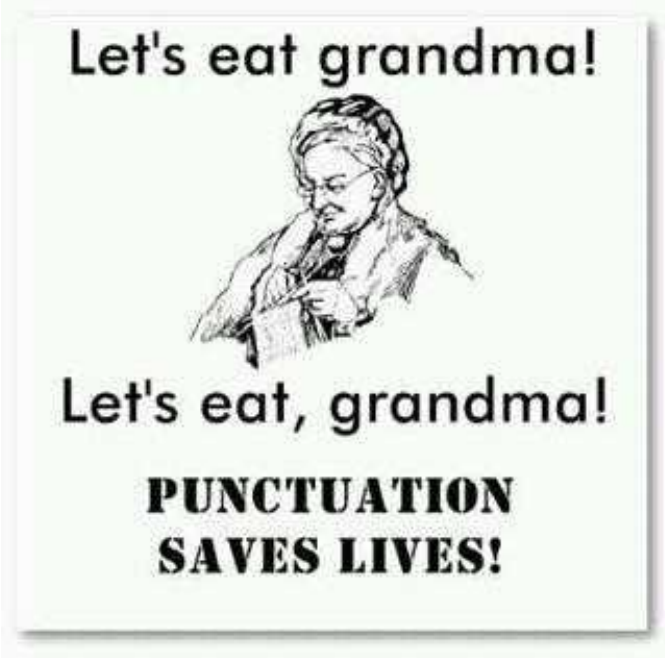
Note
The importance of proper punctuation cannot be overstated - as the humourous example shows, the difference between "Let's eat grandma!" and "Let's eat, grandma!" could literally be a matter of life and death! This demonstrates how crucial punctuation is for conveying your intended meaning.
Understanding semicolons
The semicolon is a sophisticated punctuation mark that appears as a comma with a dot above it. This punctuation mark serves as a bridge between sentences that are closely related but could technically stand alone.
Example
Semicolon Usage Examples:
Instead of separate sentences:
- "It was very late. We were utterly exhausted"
Using a semicolon to show connection:
- "It was very late; we were utterly exhausted"
Alternative with comma and conjunction:
- "It was very late, and we were utterly exhausted"
Semicolons are particularly useful when writing lists where some items already contain commas. For instance: "I have a dog; a huge, fat cat; a goldfish; three brown, hairy guinea pigs and a rabbit." The semicolons help separate the main items even though some descriptions include commas.
Mastering full stops, question marks, and exclamation marks
Full stops serve as the foundation of sentence structure by marking the end of complete thoughts. They're also used instead of exclamation marks when giving orders that don't convey urgency, such as "I am finally finished my homework" or "Please hand up your homework at the end of the class."
Question marks should only appear at the end of direct questions - sentences that ask something directly.
Example
Direct vs Indirect Questions:
Direct questions (use question marks):
- "Where is Conor?"
- "Who broke my favourite mug?"
- "What is wrong with Aisling?"
- "When are we going to the cinema?"
Indirect questions (use full stops):
- "She wondered if I was always late for class."
- "Siún asked what I wanted for dinner."
Important
Exclamation Mark Guidelines:
- Express strong emotion or give urgent commands
- Should be used sparingly in academic writing
- Never use multiple exclamation marks together (unprofessional)
- Never combine question marks and exclamation marks
Examples: "Get out immediately!", "Help!", "How dreadful!"
Conquering apostrophe usage
Important
Golden Rule for Apostrophes: When in doubt, leave the apostrophe out. Only use one when you're certain of the reason.
Apostrophes cause more writing errors than perhaps any other punctuation mark, but understanding their two main functions will help you use them correctly. Apostrophes primarily indicate possession (showing ownership) and omission (marking missing letters in contractions).
Showing possession
Example
The Reliable Apostrophe Method:
Step 1: Identify who or what possesses something Step 2: Place the apostrophe directly after that noun
Examples:
- "The teacher corrected Aisling's homework" → Aisling possesses the homework
- "The teacher corrected the children's homework" → Children possess the homework
For singular nouns, use an apostrophe plus 's to show possession: "the boy's book," "the dog's bone," "Aisling's garden," "Siún's toy," "nobody's problem."
Note
Special Cases for Singular Nouns:
When a singular noun already ends in 's', you can use either:
- "Lucas's book" or "Lucas' book"
- "Mr Jones's house" or "Mr Jones' house"
For double letters like 'ss' or 'x', always add apostrophe-s:
- "The fox's tail"
- "The boss's mistake"
When dealing with plural nouns, simply add an apostrophe to the plural form. For example, since "child" becomes "children" in plural, you write "The children's teacher praised their work." Similarly, use "The men's coats" and "The women's coats."
For joint possession involving multiple people, add the apostrophe-s only to the final person mentioned: "Eoghan, Breffni and Aisling's house," "Conor and Killian's bedrooms," "Romeo and Juliet's marriage."
Marking omissions
Apostrophes replace missing letters in contractions: "I'm" equals "I am," and "We're" equals "We are."
Important
Common Contraction Mistakes:
It's vs Its:
- "It's" means "It is"
- Test by substituting: "The dog ate it's bone" → "The dog ate it is bone" (wrong!)
- Correct: "The dog ate its bone"
- Remember: "its" is a possessive pronoun (like my, your, his, her)
Would've/Should've/Might've:
- These mean "would have," "should have," "might have"
- NOT "would of," "should of," "might of"
- There's no English construction where these words are followed by "of"
Using quotation marks correctly
Quotation marks (also called inverted commas or speech marks) indicate direct speech - the exact words someone spoke. Place them at the beginning and end of the spoken words: "I will see you after class," said the teacher.
Note
Dialogue Formatting Tip: Start a new paragraph each time you change speakers. This helps readers follow conversations easily.
Quotation marks also indicate titles of books, films, poems, and other works when you're writing by hand: "The novel I am studying this year is 'Roll of Thunder, Hear My Cry' by Mildred Taylor" or "My favourite poem is 'Base Details' by Siegfried Sassoon." When typing, these titles are usually italicised instead, but quotation marks work well for handwritten work.
Common spelling challenges
Spelling correctly demonstrates attention to detail and helps your readers focus on your ideas rather than being distracted by errors. Many frequently misspelt words follow patterns that, once learned, will improve your overall spelling accuracy.
Words with double letters
Note
Double Letter Memory Tips: Several common words require double letters that students often forget. Learning these patterns will help you spell many related words correctly.
Remember that "address" uses double 'd' and double 's'. Similarly, "necessary" contains one 'c' and double 's', while "really" is spelled with double 'l'. The word "questionnaire" needs double 'n' plus "aire" at the end.
The 'i before e' pattern
The traditional rule "i before e except after c" helps with many words, including "deceive." However, "weird" is one notable exception that doesn't follow this pattern, so it requires special attention.
Effect versus affect
Important
Effect vs Affect - The Key Difference:
Effect = noun (you can put "the" before it)
- Memory trick: "the Ending in E, and Effect beginning with E"
- Examples: "the effect," "to no effect," "powerful effect"
Affect = verb (an action word)
- Example: "The subject choices you make now will affect your future"
Practise versus practise
Example
Practice vs Practise Pattern:
Practice (noun) = ends in 'ice' (like the noun "ice")
- "I am going to be late for piano practise"
Practise (verb) = ends in 'ise'
- "I practise the piano every day"
Definite and definitely
Important
Most Common Spelling Error: Remember that there's no 'a' in "definite" - the word relates to "finite" in mathematics. "Definitely" simply adds "ly" to "definite."
Other frequently misspelt words
Here are key spelling patterns to remember:
- "Apparent" ends in "-ent"
- "Independent" also ends in "-ent," not "-ant"
- "Argument" contains no 'e' before the final "ment"
- "Grateful" relates to "grate," not "great"
- "Separate" is separated by "par" in the middle
- "Unfortunately" ends in "ately"
- "Villain" ends in "ain"
- "Rhythm" begins with "rhy"
Contractions and homophones
Example
Who's vs Whose Test:
Who's = contraction meaning "who is" Test: "Who's coming to the party?" → "Who is coming to the party?" ✓
Whose = shows possession Examples: "Whose book is this?" or "She doesn't know whose book it is"
Summary
Key Points to Remember:
- Commas separate parts of sentences and surround extra information that could be removed without changing the main meaning
- Semicolons connect closely related complete thoughts and help separate complex list items
- Apostrophes show possession (add 's to singular nouns, just ' to plural nouns) and mark missing letters in contractions
- Use quotation marks for direct speech and titles of works when writing by hand
- Many spelling errors can be avoided by remembering patterns like double letters, "i before e except after c," and the difference between nouns ending in -ice versus verbs ending in -ise